AI For Business Course Overview
The AI Course for Business Leaders is a program that teaches executives, founders, and senior managers how to build AI strategy, evaluate AI tools and vendors, lead AI adoption across business functions, and govern AI use responsibly. No coding or technical background is required.
The AI for Business Course Leaders by Gyansetu is an 8-module online program built for CEOs, founders, department heads, senior managers, and business owners who need to make AI decisions — not write AI code. You don’t need a technical background. You don’t need to understand how a neural network is trained. What you need is the ability to evaluate an AI proposal from your team, ask the right questions of a vendor, and decide where AI actually creates value in your business — and where it doesn’t.
Here’s what the data says about where Indian businesses currently stand. NASSCOM’s 2024 AI Adoption Index puts India’s AI maturity score at 2.47 out of 4 — described as the “Enthusiast” stage, with 87% of companies in the middle stages of adoption. Fewer than 15% of companies have an AI strategy aligned with their broader corporate strategy. And 67% of companies allocate less than 10% of their IT budget to AI — even as NASSCOM estimates AI could unlock $621 billion, roughly 18% of India’s 2023 GDP.
That gap between potential and execution is a leadership gap, not a technology gap.
Gyansetu has trained 32,500+ professionals across 50 countries since 2013, and has delivered 250+ corporate trainings for organisations navigating exactly this kind of transformation. The course is accredited by NASSCOM — a credential recognised across Indian MNCs, GCCs, and the consulting firms that business leaders work with directly.
You finish with a working AI roadmap for your own organisation or function — built during the course, not handed to you as a template. Plus a capstone presentation you can take directly to your leadership team or board.
Why Choose Gyansetu’s AI Course for Business Leaders?
Gyansetu’s AI Course for Business Leaders is built for that leader — the one who needs strategic AI fluency now, applied to their actual organisation, without the multi-month global executive education timeline or price tag.
5 things that separate this course from the alternatives:
- India-specific data and regulatory context throughout: Every module references NASSCOM’s actual adoption data, India’s Digital Personal Data Protection Act 2023, and the AI maturity stages Indian companies are genuinely operating at. Global programmes teach AI strategy in the abstract. This course teaches it against the regulatory and competitive environment you’re actually operating in.
- You build a real roadmap — not a generic framework: The capstone isn’t a case study about a fictional company. It’s an AI roadmap for your organisation or function, built progressively across all 8 modules. By the end, you have a document — not notes about a framework you’ll have to adapt later.
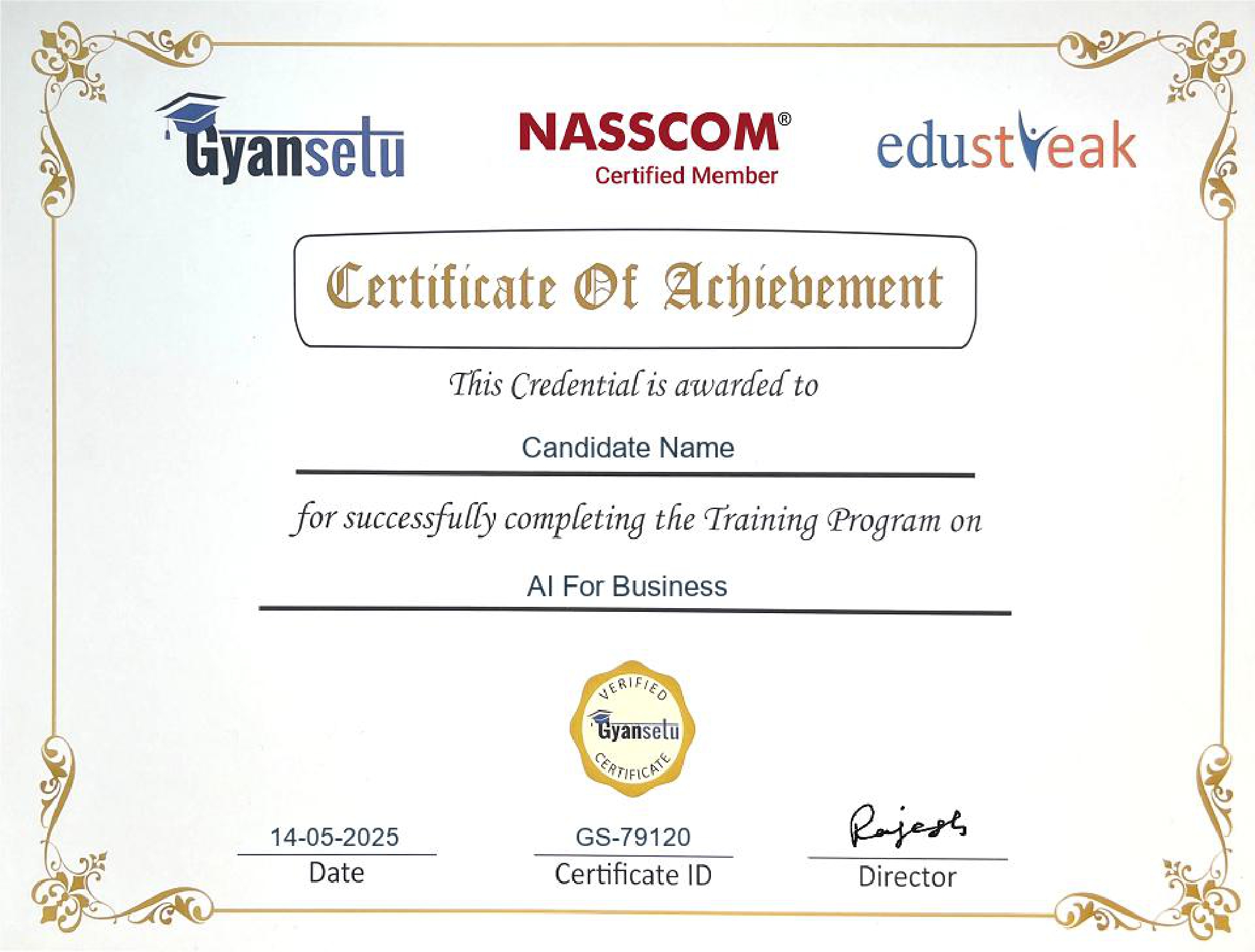
- NASSCOM-registered certification: Gyansetu’s certification is registered with NASSCOM and verified through a live portal at gyansetu.in. For leaders presenting AI credentials to boards, investors, or hiring committees, this is a recognised, India-relevant credential — not a generic “certificate of completion.”
- Small cohort, peer learning from other Indian business leaders: Batch sizes of 5–10 mean you’re working alongside other business leaders facing the same AI decisions — not watching a video alone. The peer discussion around real vendor pitches and real budget constraints is often as valuable as the curriculum itself.
- Built on 13 years of corporate training experience: Gyansetu has delivered 250+ corporate training and trained 32,500+ professionals across 50 countries since 2013. This course isn’t a first attempt at executive education — it’s built on more than a decade of understanding how Indian organisations actually adopt new capabilities.
NASSCOM’s data is clear: fewer than 15% of Indian companies currently have an AI strategy aligned with their business strategy. That’s not a gap in technology. It’s a gap in leadership direction — and it’s closing for the leaders who act on it first.













 Complete Business AI Stack
  Beginner to Advanced Roadmap
  Hands-On Learning
  Real Organizational Deliverables
  Strategy & AI Focus
  Tools & Frameworks
  Industry Mentors
  Placement Support
  Flexible Learning