Best Linux Training Overview
Best Linux Training in Gurgaon at Gyansetu is an extensive course for Linux Administration. The course will include learning on topics such as Red Hat Enterprise Linux, File System Administration, User and Group Administration, Shell Scripting, Network Services, Industry-Standard Linux Certification Training, and DevOps Basics. This training involves 5 hands-on projects, lab classes, and NASSCOM certification. No prior experience is required.
Best Linux Training In Gurgaon by Gyansetu is a course with modules designed specifically for those who are fresh out of college, IT graduates, system administrators and professionals wishing to learn more about Linux administration. Prior knowledge of IT is not required. Knowledge of servers is also not necessary. The requirement for learning Linux is the dedication to practice Linux administration in a practical lab environment. There is no other way to learn Linux.
This is how the current job market scene looks like. Linux runs on 96.3% of the total 1 million popular web servers in the world. In India, Red Hat Enterprise Linux is the most common OS on all enterprise IT servers, and RHCSA is the basic certification that TCS, Infosys, Wipro, HCL, NTT Data, DXC Technology, and IBM in Gurgaon test for Linux system administrators. The salary range of Linux system administrators in Gurgaon stands at ₹4.35–6.87 LPA, as per the latest Payscale reports from 2026 — while RHCE certified admins earn ₹6-15 LPA in the IT sector.
It’s the gap in your certification that would make you apply and get selected for a Linux job.
The program comprises modules: introduction to Linux fundamentals and installation, file systems and disks management, user & group management, shell scripting & automation, configuring network services, securing & controlling access, Industry-Standard Linux Certification Training, and capstone project. Software taught in this course will include Red Hat Enterprise Linux 9, CentOS, Ubuntu, Bash, Vi/Vim editor, SSH, Apache, Nginx, MySQL, Ansible, and Git.
Gyansetu has trained more than 32,500+ professionals from 50 different countries since 2013, and helped place over 20,000+ learners into companies like TCS, Infosys, Wipro, Accenture, and IBM. The certification training program for Linux is certified by NASSCOM, which is the recognized credential in the industry among all those IT service and product companies in Gurgaon’s Cyber City, Udyog Vihar, and DLF Phase technology hub.
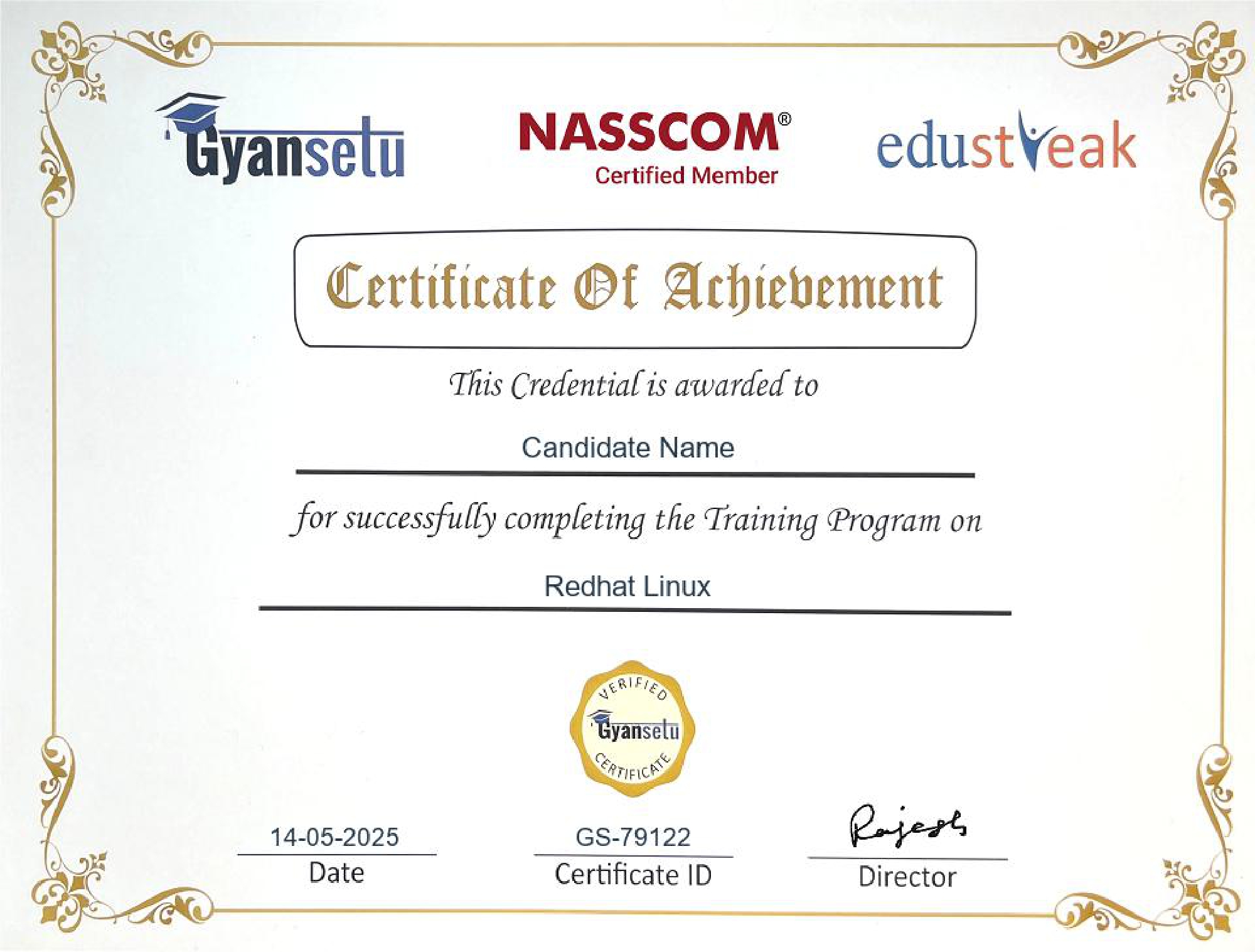
Upon completion, you will have completed 5 different Lab Projects, have the Industry-Standard Linux Certification Training Kit, and have your NASSCOM-certified credential. A credential tied to demonstrated Linux administration skills.
Why Choose Gyansetu for the Best Linux Training in Gurgaon?
There are many Linux training institutes in Gurgaon. Besant Technologies has been offering Linux training for a number of years now. Galaxy Cloud gives 24×7 access to labs and boasts 20 projects. AP2V focuses on Red Hat certifications. All these are good choices. The deciding factor would be this: which training makes sure that you end up getting a Linux job?
“Gyansetu’s success story consists of 20,000+ placement opportunities for students in organizations such as TCS, Infosys, Wipro, Accenture, and IBM since 2013.” This is what makes the difference, and it is verifiable.
What sets Gyansetu’s Linux training apart?
- Live lab sessions on real Linux servers — not simulated environments: Learning Linux cannot happen by using slides and videos because it involves practical experience only; one has to do it practically in real machines with real commands and real problems. The exercises at Gyansetu are conducted on real Linux servers where students configure, crash, and fix configurations. This is the same environment which is tested during the RHCSA exam and is also encountered on the first day of Linux administration.
- RHCSA exam preparation as a dedicated module: The vast majority of the training centers for Linux in Gurgaon make mention of RHCSA on their website. Not many provide a module solely dedicated to RHCSA – two timed mock tests in exam conditions, objective-wise revision, and an analysis that will tell you precisely where you need to improve before the test day. Module 7 is that module. The reason is simple – RHCSA is a performance-based test – you cannot crack it through rote learning.
- NASSCOM-registered certification: In every Linux training center in Gurgaon, you will be provided with a completion certificate. However, all certificates are not alike. The certification of Gyansetu is registered at NASSCOM, which has been accredited by the IT companies in Cyber City, Udyog Vihar, and DLF Phase. It is awarded when you finish your final module – Module 8, which is an entire server management exercise using Ansible.
- Batch sizes of 5–10 students: Big training centers offer Linux classes for 25-40 people each. However, Gyansetu offers only 5-10 individuals per class. In an active lab setting, this makes all the difference, as you will receive trainer assistance in the lab instead of being placed in a queue for it. If we look at preparation for RHCSA, then this kind of attention helps to catch any mistakes.
- Placement support with named Gurgaon companies: Placement Team creates CV based on your 5 lab project and RHCSA certification status. In case of Linux administrator posts in TCS, Infosys, HCL, and IBM Gurgaon, it will be a CV with proven experience rather than one detailing studied topics. The placement process by Gyansetu continues even after your batch ends until you get placed.
There is one point that should be considered: It takes approximately Rs. 30,000-35,000 for taking an RHCSA exam in India. Reattempting and failing such exams is costly too. You need to prepare yourself properly using two full-length mock tests under realistic conditions, not by watching videos.