


Most people learn about generative AI the same way: they ask ChatGPT something, get a weirdly good answer, and then spend the next ten minutes trying to figure out what just happened. That’s a good start. But ChatGPT is just one tool. There’s a technology behind it, and that’s generative AI. The difference between the two is more important than you might think.
This article will tell you what generative AI actually is, how it works without using too much jargon, what it makes, and, most importantly, what it gets wrong. And that last one, most articles don’t even try. We’re not like most articles.
What Will I Learn?
What Is Generative AI, Exactly?
A generative AI is a type of software that can generate new content, such as text, images, audio, videos, or code, by learning from existing content. You provide a prompt, and it generates new material.
This is a basic summary of what a generative AI is. Here’s what makes this type of AI unique in comparison with its predecessors.

Generative AI Course & Certificate
Average time: 6 month(s)
Skills you’ll build: Prompt Engineering, RAG Pipelines, LLM Fine-Tuning, LangChain, Vector Databases
How Is Generative AI Different from Regular AI?
Traditional AI is sometimes called discriminative AI. It is a way of looking at data and making a judgment based on what you see. Show it a thousand pictures of cats and a thousand pictures of dogs; it can then distinguish one from another. Show it a new picture; it can say whether it is a cat or not a cat. That is all it can do; it can only classify. It cannot create.
But what Generative AI is doing is completely different. It is looking at all those pictures of cats and then drawing you a new one. A new one that has never existed before. A new one sporting a 1920s detective hat, if you ask for that.
The difference between “classification” and “creation” is what is significant here.
To make things simple, think of traditional AI as a detective. It looks at evidence and makes a judgment based on what it sees. Generative AI is like an artist who has studied ten million different paintings and can therefore paint in any style you wish.
Is Generative AI the Same as ChatGPT?
No — and this is the confusion that catches almost everyone new to the subject.
Generative AI is a type of technology. ChatGPT is an application of that type of technology. The analogy is similar to the distinction between smartphones and iPhones. An iPhone is indeed a smartphone, but not all smartphones are iPhones, and the set is much broader than the individual product.
GPT-4o, the underlying AI used by ChatGPT as of early 2026, is a type of generative AI developed by OpenAI. Claude, developed by Anthropic, is another type of generative AI. Gemini, developed by Google DeepMind, is another. Midjourney is an image generator. GitHub Copilot is a code generator. All are examples of generative AI. None of them are generative AI; they are all users of the technology.
How Does Generative AI Actually Work?
The problem with most explainers is they make you think this process happens by magic, or they get so deep into neural network architecture that they leave everyone else in the dust, who aren’t ML engineers.
So, let’s get real.

What Is a Foundation Model?
But before that happens, somebody has to create the foundation model, which is the base upon which everything else is built.
It’s like a construction site. The foundation model is the concrete base. It’s huge, general-purpose, expensive to create. And everything built on top of it – ChatGPT, Claude, Copilot, DALL-E – those are buildings. And the base doesn’t care what the buildings are. It just allows buildings to exist.
Foundation models are trained on enormous amounts of data. GPT-3, which came out in 2020, was trained on 45 terabytes of text data. Now, that’s a huge number. But let’s talk about it in terms of something that actually means something. So, that’s 45 million books’ worth of data. And the model reads all of that. Not in the sense that it actually reads it, of course. It does it mathematically. It finds patterns in how everything relates to each other.
The end result of all of that is a model that can predict, with uncanny accuracy, exactly what should come next.
What Is Fine-Tuning and Why Does It Matter?
A foundation model is a generalist. It knows a lot about a lot. But knowing a lot about a lot is not always the best way to get something done.
Fine-tuning is the process of taking this generalist model and making it better at something, anything, by training it on a much smaller dataset. A legal tech company might fine-tune the model on legal documents and briefs. Now it is much better at understanding legal language. A medical AI company might fine-tune the model on medical documents and papers.
Analogy: A foundation model is like a highly educated generalist. Fine-tuning is like giving this generalist a six-month apprenticeship in the field.
Some common techniques for fine-tuning are RLHF, LoRA, and QLoRA. You don’t need to know how these techniques work. But you do need to know they exist. They’re the reason different AI tools, even those using the same model, can feel very different to use.
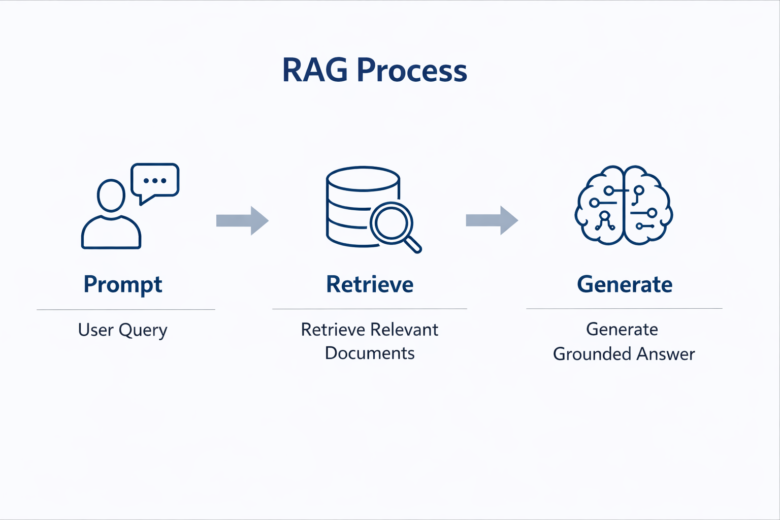
What Is RAG (Retrieval-Augmented Generation)?
RAG is probably the most important concept in practical gen AI that nobody explains very well. So let’s fix that!
The basic gen AI only knows what it learned. Its knowledge has some cut-off date. Ask it about something after that point, and it either makes something up or says it doesn’t know.
What RAG does is change this so that instead of answering based on what it learned, it can “look it up” right before answering a question.
Analogy: think of a student taking an open book exam. One student studied for the exam but didn’t have any notes. The second student studied for the exam and also brought their notes to the exam. The second student is able to answer the exam questions more correctly. RAG is the notes.
So why are enterprise gen AIs so much better than chatbots? Because most gen AIs are based on RAG. Because RAG stops the gen AI from making things up and only answering based on actual information.
What Can Generative AI Create?
The short answer is: a lot more than most people realize, and in early 2026, the lines between categories are blurring fast.

Text Generation
This is the most mature and popular one.
like GPT-4o, Claude, and Gemini can generate coherent and contextually relevant text in an incredibly wide variety of formats, such as emails, essays, summaries, code comments, legal documents, marketing texts, research papers, and many, many more.
The quality is really impressive. Of course, the limitations exist, and we’ll come to those.
Image and Video Generation
DALL-E 3, Midjourney v6, and Stable Diffusion allow for photorealistic images, illustrations, and concept artwork to be created directly from text prompts. What used to require a professional designer and hours of work now takes seconds and a well-written prompt.
Video Generation – Sora from OpenAI, still in its early stages, is showing a steep growth curve. Short-form AI videos, while choppy and unrealistic in 2023, are nearly indistinguishable from real videos in early 2026.
Audio, Voice, and Music
Voice cloning, multilingual dubbing, original music composition. ElevenLabs can clone a voice from a short sample. Suno and Udio can compose full songs from text prompts. Text-to-speech has come so far that the challenge of telling whether a piece of audio is made by a human or by a machine is a legitimate area of research.
Code Generation
GitHub Copilot, Cursor, and other tools have revolutionized the coding process for developers. The tools have the ability to autocomplete functions, create boilerplate code, and even translate code from one language to another. The tools also have the ability to explain the purpose of any code a developer is not familiar with. According to surveys conducted on developers who use these tools, developers who use these tools are able to finish coding 20-55% quicker.
The Rise of Multimodal AI
This is where things got really interesting in 2025 and 2026.
The latest models no longer work in a single medium, they work in all of them at once. You can show GPT-4o a picture of a piece of code written on a whiteboard, and it will read it, diagnose the problem, and explain how to fix it. You can describe a sound, and ask for the code to make it, and so on.
This multimodal shift – this capability to work with text, images, audio, and video in a single model, is probably the most significant change in gen AI from 2025 through early 2026.
And this capability is largely absent in any of the “what is generative AI” writing that was done before this change.
The Biggest Gen AI Tools Right Now
A note on Anthropic and Claude in particular: they are always underrepresented in “what is generative AI” explainers, despite being one of the three dominant labs in the world, along with OpenAI and Google. Anthropic is a lab that focuses a lot on AI safety research, and their Constitutional AI methodology affects how sensitive topics are handled in Claude differently from other tools.
What Is Generative AI Actually Used For?
The use cases listed in most articles about gen AI are basically the same: “content creation, customer support, coding.” True. Also not very useful if you’re trying to figure out whether this is something you should know about.
So let’s organize this by who’s using it.
[INTERNAL LINK: “Generative AI for business” — commercial supporting page]
If you’re a business manager or team lead:
- Writing internal communications, reports, and meetings summaries
- Creating first drafts of RFPs, proposals, and client presentations
- Processing large amounts of customer feedback data, such as feeding 500 survey responses into a model and asking “what are the top three complaints?”
- Creating onboarding materials and training documents more quickly
If you’re a developer or technical professional:
- Autocompleting and generating boilerplate code
- Debugging — explaining what a piece of unfamiliar code does and why it’s failing
- Translating between programming languages
- Writing unit tests automatically from existing functions
If you’re a creative or individual professional:
- Writing first drafts of articles, scripts, or marketing texts (and then heavily editing those first drafts, not the final ones)
- Brainstorming ideas for images for client presentations before actually designing those images
- Translation and localization of texts from one language to another
- Summarizing lengthy research reports, legal texts, or reports in minutes
Weirdly enough, the professionals who get the most out of gen AI aren’t the ones who trust it most — they’re the ones who treat it like a smart but occasionally unreliable colleague. They use its output as a starting point, not a final answer.
Should You Use Generative AI? A Simple Decision Framework
Most articles about this subject get this exactly wrong. They spend 3,000 words explaining what generative AI is, and not a single word helping you think about whether you should change your approach as a result. That’s backwards.
Let’s start with a simple framework: answer the following four questions honestly.
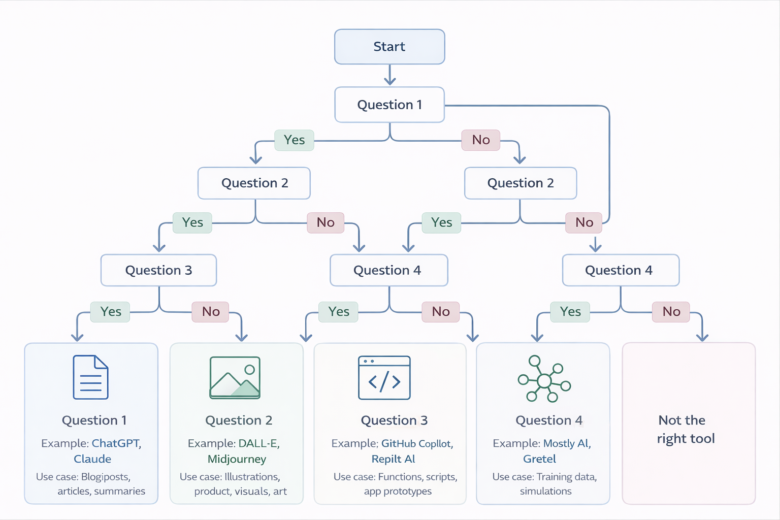
Question 1: Is this a task of creating a draft output?
Gen AI is good for a task that involves creating an output – a document, a summary, some code, an image. Gen AI is not good for a task that involves actual reasoning and problem-solving without a pre-existing pattern. Yes → Then proceed. No →Then probably not a good fit.
Question 2: Is a good first draft good enough, or does it have to be perfect?
A good first draft is good enough if a human will edit and refine the output before it is consumed. A perfect output is required if it is being sent straight to a client, a government agency, a courtroom, or a doctor’s desk. The former is gen AI’s strength. The latter is not.
Question 3: Is the input information sensitive or proprietary in some way?
Are you pasting in customer info, trade secrets, financial models, employee info, etc.? This is a problem if you’re pasting that kind of info into a public AI tool. Enterprise tools can help with some of this. They cannot help with public tools.
Question 4: Does the output need to be based on real-life experience, real personal voice?
A ghost-written memoir. A eulogy. A personal reference letter that needs to sound like you really know the person. Gen AI can create something that sounds like those things. Gen AI cannot create those things themselves. Again, if authenticity, not just convincing simulation, is a requirement, then maybe use it as a starting point.
Scoring:
- Yes to 1 and 2, No to 3 and 4: Strong candidate for Gen AI
- Yes to 1, Undecided on 2, No to 3 and 4: Built-in human review required
- Yes to 3 or 4: Approach with great caution, or search for Enterprise Solution with proper data handling
Three tasks where gen AI consistently delivers:
- Summarizing long documents you need to understand quickly
- Generating first-draft marketing copy for human refinement
- Explaining unfamiliar code or technical concepts in plain language
Three tasks where gen AI consistently disappoints:
- Answering questions about recent events past its training cutoff (without RAG)
- Any math or calculation that requires precision – it looks confident but is often wrong
- Tasks that require the citation of specific, verifiable sources – it will make up convincing ones
What Generative AI Gets Wrong — and Why
So, my honest opinion is that the limitations section is more interesting than the capabilities section. Knowing the limitations of the tool is half the skill of effectively using the tool. Most “what is generative AI” articles do not mention this. We are mentioning this.
What Are AI Hallucinations?
Hallucination is when a generative AI model is producing content that is confidently wrong. Not vaguely wrong. Confidently, specifically, plausibly wrong.
The most famous hallucination from the legal world so far: In 2023, a lawyer in New York used ChatGPT to research cases for a brief in Mata v. Avianca. The AI cited six cases. All of them were completely made up – made-up case names, made-up courts, made-up quotes – and all of them were presented in exactly the same style and format as if they were real. The lawyer filed the brief without checking. The judge wasn’t amused.
Why does this happen? Because a generative AI doesn’t “know” things the way you do. It doesn’t have a knowledge base it consults. Instead, it predicts the most statistically likely next word based on all the text it’s been trained on. When it’s prompted about a topic it knows little or nothing about, it doesn’t say “I don’t know.” Instead, it pattern-matches its way to a response that sounds like an answer. The problem is not that it’s lying. A generative AI doesn’t have any conception of truth or falsehood. It’s matching a pattern, and sometimes the pattern leads to a false conclusion.
RAG (as discussed earlier) and guardrails – restrictions on the sources it will use – greatly reduce hallucinations. But don’t think that either of these will completely eliminate them. Any generative AI, if considered a final source of truth, will sooner or later lead you astray. When considered a smart first draft that needs checking, it is actually useful.
Why Does Generative AI Have Bias?
Short answer: It was learned from people, and people are biased.
The data set comes from information on the internet, books, etc. This information reflects biases toward certain demographics, worldviews, etc. The model learns these biases.
The model does not know that these biases exist; it merely reflects what it has learned.
This is seen in many areas, such as AI image generators traditionally showing more light-skinned people for a default image, or professional roles being predominantly male or female, depending on the input.
The bias benchmarks BBQ and StereoSet measure these biases, and most labs have invested heavily in reducing them. They have made progress, and the problem is not solved.
The Deepfake Problem
Deepfakes are videos, audio, or images created or altered by AI and are intended to trick people into believing that a person said or did something that he or she did not. The technology is now available to anyone who has a laptop and a few hours of free time.
The most commonly known use case for deepfakes is the damage to reputation. The less commonly known use case for deepfakes is the damage to the economy. The most significant use case for deepfakes in 2025 and into 2026 is financial fraud. The use of voice cloning scams, where a person duplicates an individual’s voice based on a few seconds of an audio clip and uses it to make wire transfers, costs businesses hundreds of millions of dollars.
Detection tools exist, and they’re getting more advanced; several big labs and governments have invested in watermarking standards for AI-generated content. This arms race has no signs of slowing down.
A Quick History of Generative AI
Generative AI feels new. It isn’t. The foundational ideas go back decades; what changed recently was compute power, data scale, and one very important 2017 paper.

| Year | Milestone |
| 1950 | Alan Turing publishes “Computing Machinery and Intelligence” — introduces the concept of machine intelligence |
| 1964 | Joseph Weizenbaum at MIT creates ELIZA — essentially the first chatbot, using pattern-matching scripts |
| 2013 | First variational autoencoders (VAEs) appear — early generative architecture for image tasks |
| 2014 | Generative adversarial networks (GANs) introduced — generator vs. discriminator, enabling realistic image synthesis |
| 2017 | Ashish Vaswani and colleagues at Google Brain publish “Attention Is All You Need” — the transformer paper that changed everything |
| 2019–2020 | OpenAI releases GPT-2 and GPT-3 — text generation scales dramatically; GPT-3 shocks researchers |
| 2022 | ChatGPT launches in November — 1 million users in 5 days; the public moment that changed the conversation permanently |
| 2023 | Explosion of tools, competition, and concern — GPT-4, Claude 1/2, Gemini, Midjourney v5, regulatory hearings globally |
| 2024 | Multimodal maturity — GPT-4o, Gemini 1.5, Claude 3; models process text, image, and audio simultaneously |
| 2025–2026 | Agentic AI emerges as dominant paradigm; EU AI Act enforcement begins; open-source models rival closed ones |
But the 2017 transformer paper is something special. “Attention Is All You Need,” the paper by Ashish Vaswani and his team at Google Brain and the University of Toronto, introduced the world to the transformer architecture which drives every important generative AI model out there. GPT stands for “Generative Pre-trained Transformer.” The T is the one in this paper. Without it, the 2020s AI movement would not be the way it is.
Generative AI in 2026 — Where Things Stand Now
Every “what is generative AI” piece written before 2025 lacks this section. That is unfortunate because 2025 marked the year the story changed.
The shift to agentic AI. Basic generative AI follows commands. You ask it something, and it answers. Agentic AI does more than that. It does things on its own, such as browsing the internet, writing code, executing code, booking appointments, managing files, etc. — without your direct oversight. By early 2026, agentic AI has gone from the realm of the hypothetical to the realm of the corporate. The question is no longer ‘what can gen AI create?’ — it’s ‘what can gen AI do?
The regulatory landscape. The most significant piece of legislation on AI worldwide, the EU’s AI Act, was implemented in 2024, with further expansion in 2025. The legislation categorizes AI systems according to risk level and has specific rules for high-risk applications. The situation in the US is less clear-cut, but for anyone looking to build on or leverage gen AI in an enterprise environment, the regulatory situation is no longer a choice.
Open-source vs. closed-source. Meta’s Llama series, along with models on Hugging Face, has enabled developers to leverage high-quality base models without any API costs or vendor lock-in required. The difference in quality between the very best open-source and closed-source models has significantly closed in 2025. This is a key consideration for any enterprise with data privacy concerns, as running a model locally means your data never leaves your environment.
The energy conversation. Training large models is a massively resource-intensive process. The public conversation about the energy costs of the AI boom is a legitimate and important one. Data center power consumption associated with AI workloads saw a significant increase in 2024-2025. Whether this is a short-term scaling problem or a long-term structural problem is a matter of debate and research.
Agentic AI Course
Average time:6 month(s) + Lifetime Access
Skills you’ll build: Autonomous Decision-Making, Reinforcement Learning, Multi-Agent System Design, Natural Language Understanding & Generation, API Integration & Autonomous Execution, Goal-Oriented Planning & Problem Solving
Frequently Asked Questions
Q1. What is the difference between Generative AI and Artificial Intelligence?
Ans. Artificial intelligence is the overarching term referring to the development of systems that can execute tasks which require human intelligence. Generative AI, on the other hand, is the subset of Artificial Intelligence that can generate new content. It is important to note that all Generative AI is Artificial Intelligence, but not all Artificial Intelligence is Generative AI.
Q2. Is ChatGPT the same as Generative AI?
Ans. No. ChatGPT is one product developed using Generative AI. It is important to note that Generative AI is the overarching term, and ChatGPT is one product developed using this technology. Other Generative AI products include Claude, developed by Anthropic, Gemini, developed by Google, Midjourney, which is used for image creation, and GitHub Copilot, which is used for coding.
Q3. Can AI replace human jobs?
Ans. The answer is yes to some extent, to some jobs, to some parts of those jobs. I’d say it’s more accurate to refer to AI as a productivity multiplier, not a job destroyer. “The first draft, yes. The boilerplate, yes. The summary, yes. The judgment, no. The context, no. The accountability, no. And anything that actually requires lived experience? Forget about it.
Q4. How accurate is generative AI?
Ans. Well, that depends on what you’re asking it to do, and what tool you’re using. For things where there’s a clear pattern in the training data, such as emails, document summarization, or basic code generation, yes, it’s quite accurate. For answering factual questions, particularly those involving recent events or specific citations, I’d say it’s confidently wrong.
Q5. Is generative AI free to use?
Ans. The majority of the tools have a free version. ChatGPT, Claude, and Gemini have free versions. However, to use the most powerful models, have more rate limits, or use enterprise features, you need to pay for the subscription. Running open-source models locally requires some technical setup, which is free.
Q6. What is the difference between generative AI and AGI?
Ans. AGI, or Artificial General Intelligence, is a hypothetical future technology that can perform any intellectual task a human can, in any domain. No such technology has been built yet. Generative AI is impressive technology, but it is narrow. It can only perform pattern-matching on data it has been trained on. It does not understand, reason from first principles, or actually “think.” The difference between current gen AI and AGI is large, though.
Q7. Why does generative AI sometimes make things up?
Ans. Because it doesn’t “know” facts, but instead predicts what words are likely to come after other words, based on what it learned from its training data. When it is asked a question where there is confident-sounding information on this topic in its training data, but this particular fact is not represented, it will make something up instead of saying “I don’t know.” This is called a hallucination. RAG, guardrails, and continual model evaluation help reduce this, but none completely eliminate this risk.
Q8. What are the biggest risks associated with generative AI?
Ans. The biggest risks are: hallucinations leading to false information being taken as true, bias in the information provided, deepfakes leading to fraud, privacy risks when using public tools with proprietary information, and intellectual property risks with information provided by gen AI. All of these are risks, but they are risks that can be managed with proper toolsets and workflows, and are not necessarily risks to keep gen AI from being used, but to use gen AI in a proper manner.
Conclusion
The type of generative AI that most people can imagine right now is already outdated. The type of tools that most people tried in 2023 is not the type of tools that most people should use in early 2026 in terms of capabilities, in terms of speed, in terms of the number of things they can handle at the same time.
The most useful thing you can do after reading this is not to suddenly become an expert. The most useful thing you can do is take one thing that you do on a regular basis, perhaps a weekly report, perhaps a type of email that you write over and over again, perhaps some code that you have to write from scratch every time, and spend one hour trying whether a gen AI can help you do it faster without making it worse.
That’s it. That’s the experiment. Most people who do this experiment discover at least one use case that sticks.


