


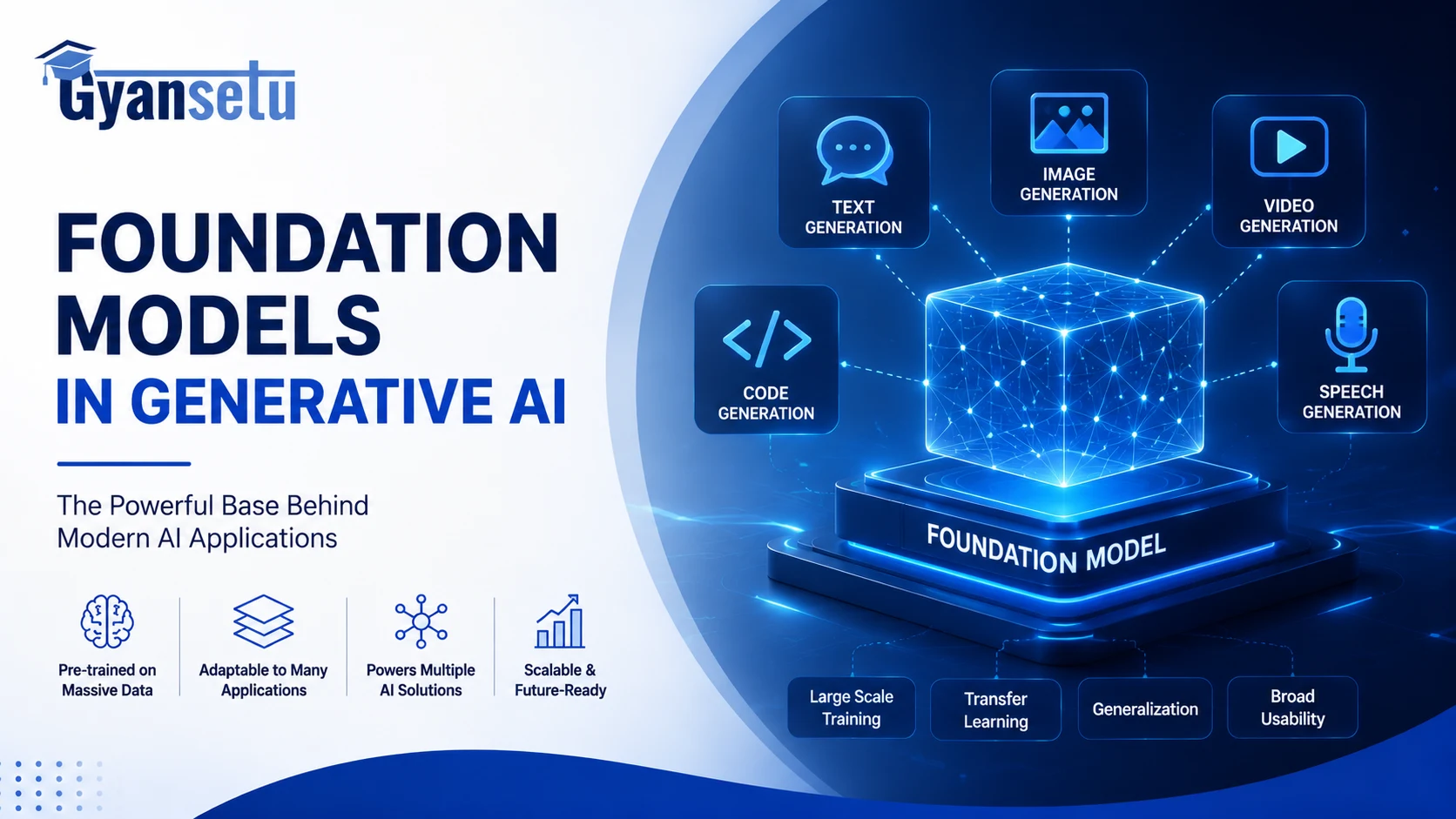
The artificial intelligence system your designer employed this morning, the chatbot assisting you in solving your customer support issues, and the autocomplete completing your emails – they all operate using the same technology. One class of models. Diverse applications. The majority of people interact with foundation models daily without knowing what they are called.
It is a problem more significant than it appears. For instance, in 2026, picking which foundation model to apply, whether to fine-tune it, and how to deal with its data privacy implications are becoming among the most costly technological decisions a company makes. Doing it by chance is not impossible. Doing it deliberately necessitates comprehending what you’re doing.
This article describes what a foundation model is, how they operate, and – crucially – how to select and utilize one, something that almost no explanation mentions at all.
What Will I Learn?
What Are Foundation Models in Generative AI?
Foundation models are huge AI models that are trained on gigantic amounts of multimodal data such as text, images, code, and audio using a technique of self-supervised learning. The model acquires wide knowledge from the large amount of data it is exposed to and becomes able to tackle a variety of tasks, including writing, image generation, analysis, coding, etc. A new model is not created for each task; one model acts as a basis for adapting to all other tasks. That is the defining idea.

Generative AI Course & Certificate
Average time: 6 month(s)
Skills you’ll build: Prompt Engineering, RAG Pipelines, LLM Fine-Tuning, LangChain, Vector Databases
Foundation Models vs. Traditional ML — What Actually Changed
Before 2018, the construction of an AI algorithm for some purpose started with creating everything anew. To create it, you had to collect some data — annotated by humans, often in their millions. The program would learn from it. It did precisely one job. Want to do sentiment analysis? Then it needed one model, one data set, and one team. Translation? Then you had another model and another data set and another team too.
This was somehow deemed ordinary.
But something changed. Scientists realized that when they fed a single massive model plenty of unlabeled, diverse data — the entire internet basically — they were able to develop general knowledge about language patterns, visual patterns, and code structures. This knowledge was transferable. They could fine-tune it just a little bit to perform sentiment analysis and beat all-purpose sentiment models. They could fine-tune it for translation, and again, the same would happen.
The cost equation was turned entirely upside down.
Developing a custom NLP model in 2019 took days of computing, expensive labeled datasets, and professional ML developers. In 2026, invoking a foundation model API to accomplish the same task costs pennies per call, and requires no training at all.
This change was not only technological, but also structural in nature. Instead of the AI systems being custom-built, they evolved into becoming software created upon a platform. This distinction between platform-based and custom-built is the crucial point that needs to be considered when making decisions about usage.
The Takeaway: Foundation models have not only enhanced AI capabilities; they have made them available for non-AI researchers.
Foundation Models vs. LLMs — They Are Not the Same Thing
This is the misunderstanding that virtually every single piece on this keyword falls into: writers treat “foundation model” and “large language model” as interchangeable terms. This is incorrect, and conflating them leads to concrete mistakes that occur in selecting a model to use.
LLMs belong to a category of models called foundation models. In other words, a large language model is a foundation model that focuses primarily or only on text input – GPT-4, Claude 3.5 Sonnet, and Mistral Large are all examples of LLMs. However, there are many other types of foundation models besides LLMs, including models designed to generate images (Stable Diffusion 3, DALL-E 3), multimodal models that can process both texts and images (GPT-4o, Gemini 1.5 Pro), audio models, and specialized code models like Codestral.
“Foundation Model” was introduced in a paper published by the Center for Research on Foundation Models in 2021, authored by Percy Liang. According to their definition, “foundation models are trained on broad data at scale and adaptable to a wide variety of downstream tasks.” Before this paper, people used to call them “large pretrained models,” or sometimes just named them. The use of the word “foundation” in the phrase is intentional and refers to a particular architecture design philosophy, which is “broad training followed by specialization.”

In practice, this becomes important during the process of model selection. For tasks that involve only text, such as summarization, classification, and question answering, one should opt for an LLM. Tasks involving image generation are simply not part of the domain of LLMs. And finally, if reasoning about both image and text prompts is required, then a multimodal foundation model is required.
How Foundation Models Actually Work
Self-Supervised Learning — How Models Teach Themselves
What allowed foundation models to work on such a scale was self-supervision, where there is no need for any human-labeled data.
The idea is straightforward. Present the model with the prompt, “The cat sat on the ___.,” where there is an intentional blank space in the sentence. Teach the model to fill in the blank. If the process is repeated for countless numbers of sentences extracted from the internet, the model will be capable of developing its own understanding of language, including grammatical structures, vocabulary, knowledge connections, and basic inference skills, without being given a single labeled data point.
This idea works similarly when applied to images. Train the model on masked pictures; teach the model to reconstruct the masked part of the picture. After millions of repetitions, the model is able to recognize objects, light effects, and what distinguishes a cat from a dog based on the pixels.
Labeled data, which used to limit AI research for years, became a relic of the past. That is what enabled foundation models to grow in their capacity — now it is compute, not labeling rate, that stands in the way.
The Transformer Architecture
There is hardly any popular language foundation model that doesn’t employ transformers. No knowledge of mathematics is required to utilize such models, but the essence of this architecture should be clear to you.
What makes transformers function is the attention mechanism. While decoding a sentence, transformers don’t analyze words sequentially, from left to right; instead, they consider all the words together and calculate which words correlate with each other irrespective of their positions within the sentence. For example, when analyzing the sentence “The animal didn’t cross the street because it was too tired,” transformers recognize the word “it” as a pronoun standing for “animal” and not “street.” That is not how the syntax works; it is just an understanding gained from billions of sentences.
It is precisely that capability to process relationships between distant parts of sentences, regardless of their distance and length, that allowed transformers to replace all existing architectures in the field of languages.
Pre-Training, Fine-Tuning, and Prompting — Three Different Things
And this is why most explainers get lost in translation when explaining foundation models. The explainers present foundation models as if their usage is uniform; there are three types of them, each requiring different amounts of effort, money, and technical skills.
Pre-training entails what the large AI labs do. Take a model and train it on trillions of tokenized text, code, and images data. Pre-training GPT-4 reportedly cost over $100 million. That is clearly out of question for any enterprise out there. For that matter, pre-training is barely ever done even by many research labs. Let’s just put this aside for now.
Fine – Tuning is the process consisting of taking a pre-trained base model and training it further on a smaller dataset that is related to the target task at hand. If your goal is to have a model write texts in your company’s voice using internal product terminology – you need to fine-tune a model to achieve it. Parameter-efficient techniques like LoRA (Low-Rank Adaptation) have reduced the price of fine-tuning substantially starting 2023; today you may fine-tune an adequately powerful model within a couple of hours using one single GPU, instead of multiple weeks.
Prompting refers to running an exact replica of the model through API calls where the actions taken by the model depend solely on how you instruct it. There’s no need for training and no need for data whatsoever. For most practical purposes in a business setting in 2026, that’s where you would like to start and, quite likely, that’s where you will remain.
Between fine-tuning and prompting lies another strategy that many companies forget about: RAG or retrieval augmented generation. It’s not the case where you train the model with your data and encode everything into weights. You retrieve documents relevant to the query on the fly and then add those documents to the prompt context. Your model responds to a query using information from your documents without any prior knowledge about them.

What Foundation Models Can Do in 2026
Language and Reasoning
Summarization, classification, Q&A, translation, document extraction, report writing – this is the most distinct class with the greatest tradition. State-of-the-art frontier LLMs have context window capabilities of 128k or higher, which means that you can input whole legal agreements, technical handbooks, and scientific literature in a single prompt and formulate a question in regards to particular segments. It will take just seconds to complete a task that previously required days of effort by a group of specialists.
Vision and Image Generation
These two different skills need to be distinguished clearly. The image generation tools, such as Stable Diffusion 3 and DALL-E 3, receive text prompts and generate an image. On the other hand, vision-language models like GPT-4o work in reverse, consuming images and then generating text insights from them. These could be chart analysis, recognizing text from scans, generating descriptions for product pictures, object recognition, etc. This would be the use case for business applications. While the creative skill receives more hype, the document understanding skill is the one that delivers the bottom line.
Code Generation and Debugging
This is precisely the field where the shift in daily operations has been the most noticeable. Examples of such models include Codestral and those behind GitHub Copilot, which are capable of generating, explaining, refactoring, and debugging code in over forty programming languages. Research conducted in 2022 confirmed productivity boosts ranging between 30% and 55% for some coding activities carried out by software engineers working with artificial intelligence tools.
Multimodal Tasks
Multimodal foundation models process and generate across various modalities in a single exchange. You take a picture of a whiteboard drawing and instruct it to code the drawing. You provide a graph, and you request an analysis comparing different regions through a written response. You copy a customer’s complaint, and you request a flowchart of the process to solve it. GPT-4o and Gemini 1.5 Pro are the top multimodal foundation models currently available at the beginning of 2026.
AI Agents and Autonomous Workflows
This wasn’t even being discussed two years ago. Now, it’s at the center of the enterprise AI discussion.
Foundation models are becoming the brain behind AI agents — those that don’t just respond to a prompt but plan complex actions, interact with external applications, surf the internet, write code, run programs, and perform end-to-end tasks without human intervention. In simple terms, a foundation model gives an answer; the AI agent powered by this model does something with it. The former is the intellect behind the action, while the latter is its structure.
The Major Foundation Models — A Plain-Language Comparison
[VISUAL: This table is the primary visual asset for this section. Render with clean formatting, model type color-coded: LLM in blue, Image in purple, Multimodal in green, Code in orange]
| Model | Creator | Type | Open/Closed | Best For | Watch Out For |
| GPT-4o | OpenAI | Multimodal | Closed | General reasoning, vision tasks, coding | Cost at scale; vendor lock-in |
| Claude 3.5 Sonnet | Anthropic | LLM | Closed | Long documents, analysis, safety-critical outputs | No native image generation |
| Gemini 1.5 Pro | Google DeepMind | Multimodal | Closed | Very long context, multimodal pipelines | Latency on complex tasks |
| LLaMA 3 | Meta | LLM | Open-weight | Custom deployment, fine-tuning experiments | Requires your own infrastructure |
| Mistral Large | Mistral AI | LLM | Open-weight | Efficient European deployments, lower cost | Smaller ecosystem than OpenAI |
| Stable Diffusion 3 | Stability AI | Image | Open | Image generation and editing | Struggles with text inside images |
| DALL-E 3 | OpenAI | Image | Closed | High-quality images from text prompts | Limited customization options |
| Codestral | Mistral AI | Code | Open-weight | Code generation and completion | Code tasks only; not general-purpose |
Open weight models need to get some airtime too. Mistral models and LLaMA series by Meta can both be obtained and hosted on your machine or personal cloud environment. This opens up some interesting possibilities for businesses where data confidentiality is of utmost importance like healthcare, law firms, finance companies, etc. Since the data never goes out of your own environment, it’s a huge win there. But there’s the catch!
Should You Fine-Tune or Just Prompt? A Decision Framework
The problem with most articles discussing this concept is that they put the horse before the cart. The notion suggests that any serious use of an AI system will naturally evolve into fine-tuning. But this is not always true, and this misconception has resulted in wasted time and money.
This should help you understand how to think about this better.
Start with this question: Is an effective prompt sufficient to get satisfactory outputs? Test the model with 50 to 100 samples using your best prompt. If the output quality is acceptable, then no further action is necessary. There is no need for fine-tuning, and this will save you a lot of time, money, and effort. Prompt tuning is more flexible and easier to adapt to future changes.
However, if prompting fails, ask why before reaching for fine – tuning. Two root causes, two different solutions:
The model lacks knowledge it needs. Your internal product names, proprietary processes, last month’s pricing data. This is a knowledge gap. Fine-tuning can fill it, but it is the wrong tool — those weights go stale the moment your data changes, and retraining to keep up is expensive. RAG is almost always better for knowledge problems. Retrieve the relevant documents at query time. Inject them into the context. Updatable in real time, no retraining required.
The model behaves differently than you need. Consistent output formatting. Tone specific to the domain. A unique classification taxonomy for your business needs. These are issues with the behavior. Tuning is definitely worthwhile in this case; you’re not imparting knowledge but shaping the behavior of your model. Use techniques like LoRA or other PEFT to save on computational resources. Use the smallest possible base model for your task.
When prompted, RAG failed to fix the issue tune. However, revisit the task definition first. Poorly defined tasks always lead to poorly defined answers.

Real Costs — What It Actually Takes to Use a Foundation Model
Three tiers. Vastly different numbers. Most individuals significantly undervalue Tier 1 and overvalue Tier 3.
Tier 1 – API Access. You invoke a model using a provider’s API and charge per token used. The price for GPT-4o is $2.50 per million input tokens and $10.00 per million output tokens as of early 2026. On the other hand, Claude 3.5 Sonnet offers a more affordable pricing scheme. For a typical business application processing several hundred customer documents daily, then the monthly API costs will range from $20 to several hundred dollars. This option demands nothing from you but is the first step in the process.
Tier 2 – Fine – Tuning on a Managed Platform. Amazon Bedrock, Azure AI Studio, and the training system used by Hugging Face all provide managed fine-tuning: you provide the data, and they handle the compute. Prices range from hundreds of dollars for smaller datasets fine-tuned on lighter models to thousands of dollars for larger datasets and more complex tasks using frontier models. This is where you proceed after you’ve convinced yourself through API tests that fine-tuning is really necessary.
Tier 3 – Training From Scratch. The cost of training GPT-4 alone is rumored to be well over $100 million. Gemini and Claude training operations are also of a similar scale. That’s the route that OpenAI, Google, Meta, and Anthropic take. Training from scratch is not an option for corporations, nor even realistically for most academic institutions.
The reality check is rather banal but accurate nonetheless. Begin with Tier 1, then only move onto Tier 2 once you’ve determined that prompting and RAG are not enough for your particular use case. Virtually no team ever requires Tier 3.
The Challenges Worth Taking Seriously
Hallucination — When Confident Is Wrong
The foundation models create their output through prediction by looking at statistical patterns learned through training. They cannot verify the truthfulness of data through an existing database; they can only repeat back to you patterns of knowledge they think are true with complete confidence. Hence, they can claim falsehoods as true with total conviction.
Legal citation that doesn’t exist. Drug interaction that never existed in the literature. Sales numbers that look believable but are entirely fake. While there have been many improvements through approaches such as RLHF and grounding with RAG to prevent hallucination, as of early 2026, the issue still persists.
For high-stakes domains — medical, legal, financial — hallucination is not a tolerable edge case. It is a liability. Any deployment in those contexts needs retrieval grounding, output confidence scoring, or a human reviewer in the loop before outputs reach end users.
Bias — Where It Comes From and What You Can Do
A model is trained on data. And the internet, which has been the source of much of the training data in state-of-the-art models, has many human biases in ample supply, which the model ingests and manifests in its predictions. These manifest as systematic biases in its outputs: stereotypical descriptions, unequal abilities in different languages/dialects, discrimination in classifying/creating content for different demographics.
There isn’t a single model that is devoid of bias. Training on clean data will reduce bias but will not make it vanish. Good deployment practices would be something like: auditing the model on diverse test sets before deployment, building systems to detect any output bias drifting over time, and having a system for addressing those biases.
Data Privacy — What Happens to What You Send
Each prompt sent to an external API will travel through someone else’s servers. Providers give the choice to enter into enterprise data contracts which will ensure that your data cannot be reused in future training, but your data will still have to traverse their server.
For regulated industries, it becomes more of a compliance issue than anything else. There are three main choices: enter into a data processing contract with the API provider, use open-weight models with your own infrastructure, or have guidelines for prompts.
How to Start Using Foundation Models Today
Three steps. No infrastructure required for the first two.
Step 1: Name a specific task, not a goal. “Enhance customer service using AI technology” cannot be tested. “Categorize incoming customer service tickets into five distinct categories and generate a suggestion for a reply to each” is a task you can actually assess within the day. Define such a task before you even write one line of code.
Step 2: Test through a public API before committing to anything. Select one model—Claude or GPT-4o seems like a reasonable choice in 2026—and spend one day crafting prompts against fifty to one hundred instances in your real-world scenario. Measure your output against a rubric you will define ahead of time. This will cost you next to nothing in terms of API expenses but give you a much better idea about whether you can do this than any week of preparation could.
Step 3: Set a quality baseline before you optimize. Measure the quality of outputs from your test set using your initial prompts. Note it down. You should only begin testing with RAG, improved prompting, or fine-tuning after doing this to establish a point of comparison for any changes you make. Most groups neglect this step, spending weeks optimizing their system without ever having established a benchmark for improvement.
This is the secret everyone ignores. The leading cause of failure in foundation models is not choosing the wrong architecture or omitting fine-tuning. It is embarking on building when you haven’t even defined quality output yet.[INTERNAL LINK: Prompt engineering guide — structuring your evaluation framework]
Frequently Asked Questions
Q1. What is the difference between a foundation model and an LLM?
Ans. A large language model (LLM) is one kind of foundation model, which is predominantly trained on text-based data. On the other hand, a foundation model is a more extensive class of models, which not only includes the former but also models like those for generating images, multimodal, audio, and code-based applications. Thus, while all LLMs are foundation models, not all foundation models are LLMs.
Q2. Are foundation models the same as Generative AI?
Ans. Not quite. Generative AI refers to a certain ability, the creation of new content, such as texts, images, and sounds. In contrast, foundation models refer to the actual model that enables most modern-day generative AI applications.
Q3. Can small companies use foundation models?
Ans. Yes, and this marks a huge shift compared to just a few years back. The existence of APIs makes it possible for anybody to run GPT-4 or Claude without having to train or maintain any models themselves. The compute costs that were previously associated with advanced AI do not apply to using models, but rather to developing models. Both a two-member startup and a Fortune 500 company make the same API call.
Q4. What is fine-tuning a foundation model?
Ans. To fine-tune is basically retraining a pre-trained model on a specific dataset for your purposes. The knowledge that the model already has will be preserved, and you’ll be teaching it how to behave differently or providing it with special knowledge. Technologies such as LoRA make this much cheaper than complete fine-tuning.
Q5. Which foundation model is best for my project?
Ans. This would depend on the nature of your project, your need for data privacy, and budget constraints. For projects dealing with document understanding and long context processing, Claude 3.5 Sonnet can be used. For projects that require use of multiple models or images, either GPT-4o or Gemini 1.5 Pro. For projects requiring self-hosting with data privacy considerations, either LLaMA 3 or Mistral can be considered. You should start testing API first.


