


Vector databases contain data stored in high-dimensional numeric arrays known as embeddings and use the mathematical concept of similarity for fetching data rather than keyword searching. Unlike the query “Does this value exist?” that we find in a regular database system, the vector database asks a question like “What does this query mean?” and finds results similar to the query in meaning. It forms the foundational storage mechanism for semantic searches, RAG pipelines, and agent memory for AI.
Here is a strange fact: the most important database powering AI in 2026 almost never returns an exact match.
Traditional databases are built on precision. You type “smartphone” and you get back exactly that word. A SQL query returns rows where product_name = ‘smartphone’ — not “mobile device,” not “cellphone,” not an alternative that solves the same problem. This works perfectly for payroll systems, inventory records, and CRM data.
It falls apart entirely with respect to AI.
If a user queries an AI chatbot with “what have I said about my Q3 budget plan last week?” there isn’t an exact row to pull up. The chatbot needs to be capable of understanding meaning and to retrieve documents that may not contain any words from the query but semantically relate closely enough to fulfill the user’s request. This is what a vector database does; it stores meaning using mathematics, and it retrieves information based on proximity.
The following is almost never explained correctly: by 2026, the key use case of vector databases is agent memory. Every time an AI coding agent knows which files it has processed before, every time a customer service agent can reference context from past conversations, every time a research agent knows to not read something twice – this is where vector databases come in. See below on use cases, since this is going to change how you view vector databases completely.
What Will I Learn?
What Is a Vector Database?
Vector databases are special types of databases that store information as arrays of numerical values termed vectors, index the array using geometric structures, and compute the mathematical distance between the queried vector and all other vectors stored.
In this context, the term “similarity” performs much of the function. While a relational database determines matching values, a vector database determines how similar two sets of numerical values are. Similarity of values is similarity of meanings.

Data Science Course
Program Highlights
✓ 6 Months Industry-Focused Program
✓ Live Classes by Industry Experts
✓ 15+ Real-World Projects
✓ Resume & Interview Preparation
✓ Placement Assistance
Skills You’ll Build
Python • SQL • Power BI • Statistics • Machine Learning • Generative AI
Vector Database vs. Traditional Database — The Key Difference
The contrast is sharp enough to put in a table.
| Feature | Relational Database | Vector Database |
| Data format | Rows and columns (structured) | High-dimensional numerical arrays (vectors) |
| Query type | Exact match via SQL | Similarity search via ANN |
| Best for | Transactions, structured records | Semantic retrieval, AI applications |
| Returns | Rows where value = query | Nearest neighbors by distance |
| Handles unstructured data | No — requires ETL preprocessing | Yes, natively |
| Latency at billion-vector scale | Not designed for this workload | Sub-100ms with proper indexing |
A relational database stores the fact that your customer bought “running shoes.” A vector database can understand that “trail runners,” “marathon footwear,” and “outdoor athletic gear” all encode similar meaning — and return all of them for a query about one.
That is not a search improvement. It is a fundamentally different kind of retrieval.
How Vector Databases Work (The 3-Step Process)
There is no need for you to know the math behind the vector database. However, there is a need for you to understand the three-stage pipeline as that will affect everything you do with regard to optimization and costs.
Step 1: Convert raw data to embeddings. The embedding algorithm analyzes your source data (which could be any document, image, product description, support ticket, etc.), and transforms that data into a vector.OpenAI’s text-embedding-3-large is able to generate 3,072 numbers per input, but can also be shortened using Matryoshka representation learning, per OpenAI’s embedding model announcement. Every single number represents a semantic feature that has been learned from that content.
Step 2: Store and index. This process results in those arrays being placed in the vector database, which constructs an index structure that is optimized for the rapid processing of spatial queries. The index doesn’t keep the vectors in a linear form; rather, it sorts them into geometric data structures, enabling query processes to skip all areas that do not need to be searched at all.
Step 3: Query by similarity. Once the user makes an inquiry, the very same model will transform this inquiry into a vector form. The database then compares the vector to the index and finds the shortest mathematical distance between them. The shortest match results come first.
The magic happens in step two when the algorithm performs steps three efficiently.

What Are Vector Embeddings?
Embedding is an array of numbers representing meanings.
In the case of “cat,” the embedding could be [0.2, −0.4, 0.7 …], with 1,536 dimensions, while for “dog” – [0.6, 0.1, 0.5 …]. These arrays are closer numerically – because they are semantically close too. As for “astrophysics,” it will be far from each other.
The crucial point: similar things get represented by similar numbers. Semantically close things are simply found by calculating the closest vectors to a given vector, which defines how recommendation systems work or how an agent finds a proper memory out of tens of thousands memories.
Approximate Nearest Neighbor (ANN) Search — Why “Approximate” Is Fine
Most expositors will describe ANN without clarifying the concept of “approximation,” which turns out to be the most essential bit.
The brute force algorithm would have to compare each and every vector with your query, resulting in one million distance calculations for a million-vectors database. At the billion-vectors level, where real applications exist, this becomes simply impractical.
With ANN algorithms, you don’t perform the brute force calculation at all. Instead, you use indexing algorithms to make educated guesses about where the closest vectors are, check those areas first, and return answers with up to 95% precision within 10-50 ms, whereas the same level of recall requires a couple of seconds.
In the practical world, 97% precision with 15 ms beats 100% with 4 seconds hands down. Always. No one is waiting four seconds for an answer from a chatbot. And no one is waiting four seconds for suggestions for products they can buy.
The Indexing Algorithms — How Vector DBs Stay Fast at Scale
There are four major algorithms that facilitate fast search in vector databases. Managed services like Pinecone and Weaviate Cloud choose which algorithm to use on your behalf; therefore, tuning them manually in production is impossible. Nevertheless, it is helpful to know about their trade-offs so that you can appreciate performance properties, memory implications, and decide whether a certain database works best for your use case. To be honest, most developers ignore this part until queries become too slow.
HNSW — The Algorithm Running Most Production Systems in 2026
HNSW stands for Hierarchical Navigable Small World. Graph-oriented. Fast. Memory-intensive. And in 2026, it rules the production vector database market.
It’s a bit like a network of airports. The top levels of the graph contain long-range edges (think of direct flights between two main airports) that enable queries to quickly travel to the appropriate region of the space. The lower levels have dense local edges, like shuttle flights between neighboring airports, that allow the algorithm to find its way to actual nearest neighbors after it has reached the right area.
At query time, search starts from the top level and traverses down through denser layers to reach nearest neighbors, skipping past most nodes of the graph on the way, thanks to long-range edges.
And here’s the deal: two important things must be considered when choosing HNSW. First of all, HNSW works well for updates: new vectors can be inserted into it without rebuilding the whole index – vital in any environment where writing is a necessity. Secondly, HNSW consumes quite a lot of memory due to its graph-like architecture, and at the billion-vector mark, this becomes the sole reason why people start looking at PQs.

Product Quantization (PQ) — Compression for Scale
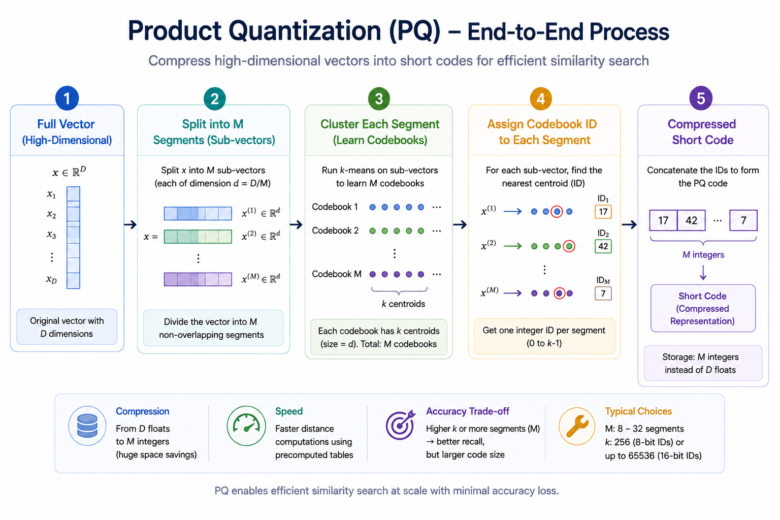
Here is the problem that PQ tackles: a float32 vector with 1,536 dimensions needs around 6KB of storage space. A billion vectors will need 6TB of storage. Keeping this amount of information in the RAM (which HNSW needs to be efficient) is simply too costly.
What Product Quantization does is transform this large vector into a compact code of between 32 and 128 bytes. It divides the large vector into smaller vectors (chunks), clusters similar chunks throughout the whole dataset, and replaces each chunk by the ID number of the corresponding cluster centroid. Information is inevitably lost. However, with PQ you can fit 100 times as many vectors in the same amount of memory and still calculate approximate distances well enough for ANN searches.
The PQ index is virtually always used together with HNSW in production environments, rather than on its own.
LSH — The Bucketing Approach
Locality Sensitive Hashing (LSH) predates HNSW and is less prevalent in the year 2026 in production artificial intelligence (AI) systems, although it can be found in certain cases. This approach is simple – for each vector, use a hash function that will ensure vectors close to one another land in the same bucket, then simply hash your query and check only those buckets for matches.
The LSH approach is highly memory efficient and fast because it does not require the graph structure at all. However, it sacrifices recall rate, especially for higher dimensions, as well as metric flexibility. You will find this approach implemented in cybersecurity software and duplication identification tools much more often than in general AI retrieval scenarios. In any case, when starting out in 2026, HNSW is the standard approach.
Random Projection — The Dimension Reducer
OpenAI’s embedding models generate vectors of dimension 1,536. Some multimodal models exceed this number. Random Projection is a preprocessing method and not an independent index which compresses the dimensions of vectors prior to the indexing process while reducing memory usage without degrading search performance.
According to the Johnson-Lindenstrauss lemma, dimensionality can be substantially reduced without losing the similarity between vector elements. For example, reducing 1,536 dimensions down to 256 before HNSW indexing will help you reduce memory usage by 6 times with little cost to accuracy.
Random Projection could be thought of as a kind of compression pass before the real deal begins.
Metadata Filtering — The Hidden Power Feature
Typical introductions to vector databases talk about similarity search. And yet, that is often not the entire query when used in practice.
The true query is not usually “Give me the most similar vectors,” but “Give me the most similar vectors under these conditions.”
E-commerce product searches with filters for relevant products: Products that are similar to this jacket, come in women’s sizes, cost less than $80, are in stock, and are not by brands the user has previously purchased from. Legal research systems: Cases similar to this case brief, dated from 2020 or after, in the federal circuit, and not already in the review queue. Recommender system queries: Articles similar to the articles this user likes, but articles they haven’t read before.
This is known as metadata filtering. Each vector can contain metadata fields such as category, price, date, author, user ID, language, status, and anything else the application requires. The database maintains an additional metadata index along with the vector index. Searches use both at the same time.
There are two approaches here:
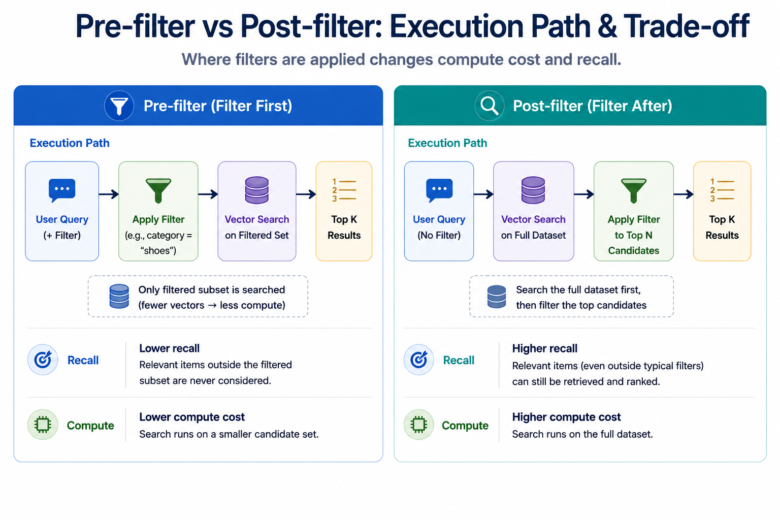
Pre-filtering applies before running the ANN search to reduce the set of candidates. This is faster if the filter manages to exclude a significant number of items. Risk of missing out on relevant documents due to a restrictive filter; this may lead to only a small portion of the vectors being searched.
Post-filtering does an ANN search on the entire index, and then filters the results using the metadata constraints. Improved recall. Increased computation, since you have to pull more documents in order to filter out some of them.
Modern databases such as Weaviate and Qdrant employ a hybrid strategy, which avoids both issues through in-memory metadata. The exact details about how each one does this do not matter as much as the takeaway: if there are any filtering needs for your application whatsoever, make sure that the selected database can handle this requirement properly first. It will be a more significant performance consideration than you think.
What Is a Serverless Vector Database?
There were two issues with first-generation vector databases. One, you’d provision a cluster, pay for it all the time, and hope that the traffic would justify the cost. The other one, for a single application with predictable query volume it was okay, but for a multi-tenant platform with queries every few seconds as well as once a month, it wasn’t.
In serverless, compute and storage are decoupled. Vectors are kept in inexpensive object storage. Compute comes up on demand, processes the query, and goes back to sleep. You’re paying only for the compute time that was actually used.
There are three concrete issues solved by serverless AI teams:
Storage-compute separation. Vectors stored in S3-equivalent object storage cost a fraction of vectors stored in always-on memory-resident clusters. The savings at a billion-vector scale are substantial.
Multi-tenant efficiency. This can allow the serverless router to group users who have similar patterns of access to a particular computer tier, high frequency users in the always-warm computer tier while low frequency users are in cold-start computer tiers. Their information is well separated. The queries of user A at one million vectors per day will not make User B pay for 24/7 computers.
Freshness without rebuild delays. The freshness layer is basically a temporary cache to store the incoming data in order to make it immediately available to queries until an index builder in the background adds the incoming data to the main geometric index. There is no need to rebuild the whole index.
Currently, Pinecone Serverless is the most popular instance of such an approach as far as the year 2026 is concerned. Other instances are that of Weaviate Cloud and Qdrant Cloud. Interestingly, the serverless approach used to be called experimental only two years ago.

Real-World Use Cases for Vector Databases in 2026
AI Agent Memory — The Real Driver Behind the 2026 Adoption Surge
The massive increase in the uptake of vector databases – up by 377% compared to last year – will not be driven by search engineers improving their product catalogs. No way, that is coming from AI agents.
Most articles have gotten this one wrong. RAG isn’t going to be the major driver for vector databases in 2026. Agent memory is.
This is how it works in practice. The coding agent assisting you in refactoring your 50,000 lines of code needs to keep track of which files it already reviewed, which architectural decisions it has made three layers deep, and what constraints you had imposed when the task began. This is not a search problem. This is a memory problem. And it is being solved with vector databases.
All LangChain, LlamaIndex, LangGraph, and AutoGen projects allow integrating with vector databases as a primary persistence layer for agent memory. It is always used consistently among all of them: each action produces its memory record in the vector database; each new decision starts with querying the database for the relevant context. Agent memory is not reset after every step — it always operates on a cumulative knowledge base.
Pinecone’s namespace allows creating isolated vector space for each user and agent session individually. Weaviate’s multitenancy design addresses the same issue using an alternative implementation path. It is done due to a new reality of agent applications that have millions of concurrent users requiring isolated persistence of memories becoming a mainstream requirement rather than an edge case scenario.
This is something that is not covered in any of those popular “What is a vector database?” guides from 2023. Because, essentially, nothing in the technology changed, but the use case did.

Retrieval-Augmented Generation (RAG)
RAG enables you to feed your personal information to the LLM without having to train it again.
Your internal documents (policies, contracts, support tickets, product manuals) are processed by chunking, embedding, and storing them in the vector database. Then, once the user asks a question, the most relevant chunks are found using similarity search and provided to the LLM as context. The LLM will then answer based on your real-life, up-to-date information instead of making up generic hallucinations.
The fast retrieval capabilities offered by vector databases allow RAG to do what it does. During inference, you may have thousands of requests simultaneously being processed. Going through a 10-million-document collection in brute force manner could take several extra seconds per request. ANN search takes less than 50 ms.
[INTERNAL LINK: What is retrieval-augmented generation?]
Semantic Search
The legal search engine contains 40 million legal cases as vectors. When a lawyer searches for “cases with misrepresentation in the buying or selling of real estate,” the vector search engine returns 20 of the topically most similar cases – including cases using “fraudulent concealment,” “seller disclosure,” and “material nondisclosure” as their key terms.
None of these terms were contained in the original search. There is no way to return them through keyword searching. The vector search engine didn’t find matching words; it found matching meaning.
This ability, of being able to retrieve information through semantic similarity as opposed to word matching, is something that cannot be accomplished through traditional full-text searches. It is not merely improved keyword searching; it’s an alternative altogether.
Recommendation Engines
Discover Weekly by Spotify, “Because you watched” by Netflix, and related products by Amazon.
They all employ vectors to capture user preferences and the properties of items; and their vectors are created from embedding algorithms fed with behavior data. A listener/viewer/buyer’s behavior turns into vectors. Everything – songs, movies, and products – turns into vectors. Recommendations will be the nearest neighbors to that vector of user preferences in the embedding space.
As per reports, the number of tracks and users involved in the embeddings created by Spotify runs into hundreds of millions. The very possibility that recommendations can be returned in real-time at such a scale has a lot to do with ANN search effectiveness. Otherwise, recommendations would mathematically be impossible.
Anomaly Detection and Fraud
Typical actions form a cluster. Your typical transaction volume, your regular login location, the usual sequence of your API requests — they all cluster closely in vector space since they represent similar semantic actions.
Fraud action appears to be an outlier. Transaction vector which is not expected in proximity of your typical vectors. Login action from a location which is not within the geographic range expected from you. The vector database identifies it by comparing the distance of this incoming vector with its existing cluster and triggering the alarm upon surpassing the threshold.
Why does it beats traditional rule-based approaches? Because the vector database finds new fraud patterns which have never been programmed into rules. They don’t need to understand what fraud actions look like, only where it is in vector space.
When NOT to Use a Vector Database
This section is more useful than the previous one. Knowing when not to use a technology is half the skill.
Your dataset is under 100,000 vectors and latency is not critical. For small datasets, pgvector (a PostgreSQL extension) handles vector similarity search well enough without adding a second database to your infrastructure. A pgvector query over 50,000 records typically returns in under 100ms. No new system to operate, no new skills to learn, no additional cost. The overhead of a dedicated vector database is simply not justified at that scale.
You need exact string matching, not semantic retrieval. Legal discovery, compliance auditing, and patent search often require exact phrase matches. If “Force Majeure” must return results containing exactly those words (not synonyms, not related legal concepts), a full-text search engine like Elasticsearch or OpenSearch is the correct tool. Semantic similarity is not always the goal, and in high-stakes exact-retrieval contexts, approximate matching introduces risk rather than value.
Your application depends on ACID transactions. Vector databases prioritize availability and query performance over strict consistency. They are not designed for transaction rollback, complex relational joins, or guaranteed write atomicity. If your use case requires those properties — financial ledgers, order management, inventory systems — stay with a relational database. Vector databases are retrieval engines; they are not transactional data stores.
Your workload is pure summarization or thematic analysis. Asking “summarize all themes across these 10,000 documents” requires the LLM to read all the context, not just the nearest neighbors to a query vector. For broad synthesis tasks, a list index or full-context approach often outperforms nearest-neighbor retrieval. Nearest-neighbor search is point-lookup; thematic analysis needs a full sweep. The right tool depends on which kind of task you are running.

Popular Vector Databases Compared (2026)
| Database | Type | Best For | Hybrid Search | Notes |
| Pinecone | Fully managed (serverless) | Production AI apps, multi-tenant agents | ✅ | Zero infrastructure ops; namespace isolation built for agent memory; steeper cost at high scale |
| Weaviate | Open-source + cloud | Hybrid search, multi-modal, self-hosted production | ✅ Native BM25 + vector | Best native hybrid search; strong GraphQL API; cloud and self-hosted options |
| Milvus | Open-source | High-scale self-hosted deployments | ✅ | Most configurability; highest ops overhead; powers Zilliz Cloud managed offering |
| Qdrant | Open-source + cloud | Performance-critical apps, Rust-based stack | ✅ | Top ANN benchmark scores; excellent payload filtering |
| Chroma | Open-source | Local development, prototyping | ❌ (basic) | Six lines to get running; not built for production scale; the right starting point for learning |
| pgvector | PostgreSQL extension | Existing Postgres users, small-to-mid scale | ❌ Native | No new system to manage; performance degrades meaningfully past ~1M vectors; free |
To be fair, every database in this table has a legitimate use case. Start with Chroma or pgvector for prototyping and early development. Move to Qdrant or Weaviate for self-hosted production workloads where you want control. Use Pinecone if you want zero infrastructure overhead and are building agent applications that need per-user namespace isolation.
How to Choose the Right Vector Database
Five questions that cut through the noise. In practice, most teams spend three hours on these and six months wishing they had spent more:
1. Do you want to manage infrastructure? If the answer is no, then your practical short list would be Pinecone and Weaviate Cloud, both of which are fully managed solutions, neither of which will make you worry about nodes, sharding, and rebuilding indexes. For those who are interested in data sovereignty or on-premises deployment, Milvus and Qdrant are the proper self-hosting solutions.
2. What is your vector count today, and in twelve months? Less than 500k vectors: pgvector does the job. More than 500k but less than 100M: Qdrant or Weaviate. More than 100M: Pinecone Serverless or Milvus at scale. These are real performance boundaries, not exact limits, but they do indicate the sweet spot for each database where performance becomes efficient, and where you are fighting the system.
3. Do you need hybrid search? Hybrid searching entails the combination of vector similarities with BM25 searches in one query. For your use cases that may include technical documentation, legal documents, or medical information in which technical terms and semantics coexist, hybrid search is essential. Weaviate excels in this area as far as the native offering goes, followed by Qdrant and Pinecone which support hybrid searches but differently. Chroma and pgvector fall short when it comes to hybrid searches.
4. What does your existing stack look like? Both LangChain and LlamaIndex support all popular vector databases. For instance, if you use AWS, then Pinecone and Weaviate have native integrations. In addition, if your team is mostly composed of Python programmers who would like a fast way to build a prototype, then you should start with Chroma, which requires only six lines of code.
5. Are you building multi-tenant agent applications? This is the decisive question then, not the others. The pinecone namespace functionality and Weaviate’s multi-tenancy architecture have been specifically built to accommodate systems requiring isolated storage spaces for millions of users simultaneously. This is exactly what most agents will be needing in 2026. Consider the isolation mechanism first.
Frequently Asked Questions
Q1. What is the difference between a vector database and a regular database?
Ans. The relational database queries data by matching an exact condition; SQL matches rows based on whether they have values that are identical to your query. The vector database queries data by searching for its closest mathematical equivalent to your query; it searches for rows that have similar numerical characteristics. Relational databases are suitable for use in structured data, while vector databases are best for AI applications.
Q2. Do I need a vector database or can I just use PostgreSQL?
Ans. For datasets under approximately 500,000 vectors, pgvector (a free PostgreSQL extension) handles vector similarity search well and avoids the overhead of operating a separate system. Beyond that threshold — or if you need sub-50ms latency, hybrid search, or multi-tenant isolation for agent applications — a dedicated vector database significantly outperforms pgvector on the metrics that matter.
Q3. What is the difference between a vector database and a vector index like FAISS?
Ans. A vector index, such as FAISS (an open-source library by Meta), does one thing: efficient similarity search on a collection of vectors. No persistence, no filtering based on metadata, no access control, no real-time update ability, and no scalability across machines. All of these things are covered by the vector database, which wraps everything around the index, thereby making the index suitable for running in production.
Q4. How fast are vector database queries?
Ans. For up to 1 to 10 million vectors with HNSW indexing, most vector databases take under 20ms to find results. For 1 billion vectors, properly tuned instances of Qdrant and Pinecone Serverless can do it in less than 100ms. Latency will depend on many factors including type of index, hardware, dimension of the vector space, target recall rate, and number of concurrent queries. See the ann-benchmarks.com website for benchmarks.
Q5. Is a vector database the same as a knowledge base?
Ans. Not quite — and this actually trips people up constantly. A knowledge base is a concept: a collection of information an AI system can retrieve. A vector database is one technical solution to that concept. You can build a knowledge base using a vector database, using Elasticsearch, or even using a well-structured SQL database with full-text search. The vector database is the storage and retrieval infrastructure; the knowledge is what you put inside it.
Q6. What is a vector database used for in AI agents?
Ans. Vector databases are used by AI agents as persistent memory. The agent keeps the context, decisions, output from tools, and other information gathered by the agent (both from the current session and from previous ones) as embeddings within the vector database. When the agent performs an action, it first recalls the most related memories through similarity searching. This way, AI agents can keep track of the context during extended actions without being limited by the LLM’s short-term context.
Where Vector Databases Are Actually Headed
This approach to describing vector databases as “where you put your embeddings for RAG” is already obsolete. The infrastructure challenge that took up 2023 and 2024, namely how do you manage to store and recall embeddings quickly enough, has been largely conquered.
What we need in 2026 is an answer to the question, how do you ensure a million concurrent users each have access to their personal, searchable memories without making the cost of maintaining infrastructure grow linearly?
The answers are serverless systems, isolated namespaces, and freshness layers – all of which will eventually be overtaken by something newer.
But the key thing here is not the technical innovation or the new algorithms. It is the change in how vector databases themselves are viewed – as critical infrastructure, like any other database in the company. And that realization happens faster than even the most comprehensive guides to vector databases…


