


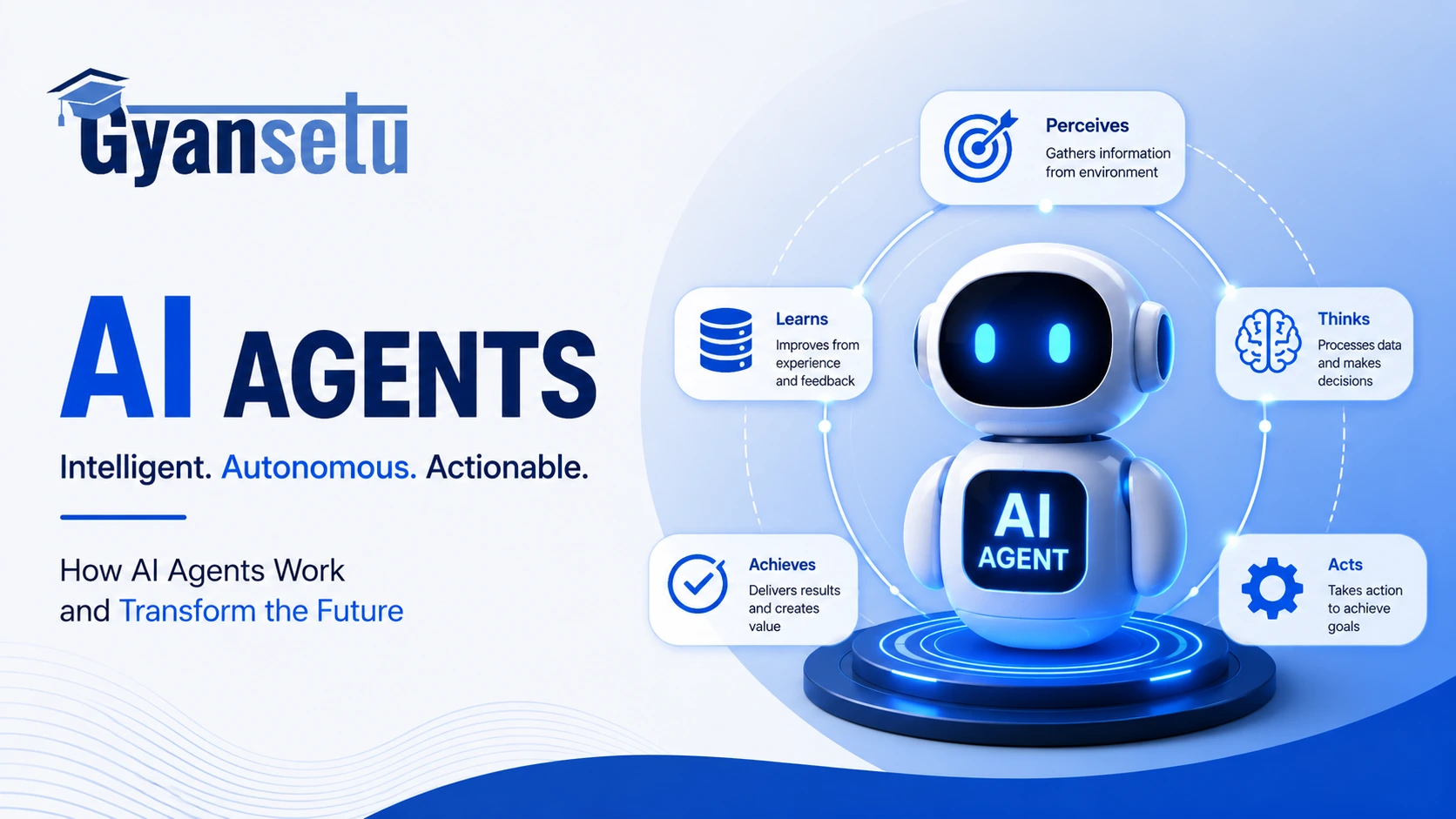
Those who believe they are interacting with an AI agent are merely doing so through a very rapid chatbot.
It makes a bigger difference than you can imagine. The chatbot only responds to your next prompt. On the other hand, the AI agent goes ahead and performs actions such as searching the web, generating code, calling the API, verifying its output, correcting it if necessary, and returning the solution. There’s no need for babysitting.
That’s the difference we are going to explore throughout this guide.
By the time you have finished with it, you will understand the inner workings of agents, which type among the seven out there is appropriate for your use case, and which development frameworks are being used in 2026.

What Will I Learn?
What Is an AI Agent?
An AI agent is a software capable of perception of the environment, decision-making, action execution via usage of tools, and learning from outcomes in pursuit of achieving a goal set by you, without requiring your assistance along the way.
That’s it! The definition Google and Perplexity are tirelessly quoting, sourcing from different places in odd ways. Now you have the exact quote.
Here’s what distinguishes an agent from a stand-alone LLM: LLM creates text. An agent acts. An agent browses the Internet, executes a Python code, queries your database, sends emails, calls an external API, assesses if the result helped solve the issue, and if not, retries another approach.
Autonomy, memory, and tool use – these are the three characteristics that make up any AI agent.
Agentic AI Course
Average time:6 month(s) + Lifetime Access
Skills you’ll build: Autonomous Decision-Making, Reinforcement Learning, Multi-Agent System Design, Natural Language Understanding & Generation, API Integration & Autonomous Execution, Goal-Oriented Planning & Problem Solving
AI Agents vs. Chatbots vs. AI Assistants: What’s Actually Different
Here’s the thing — these terms get used interchangeably by people who should know better, including vendor marketing teams.
The differences are real and they matter.
| AI Agent | AI Assistant | Chatbot / Bot | |
| Autonomy | High — acts independently toward a goal | Medium — responds to user direction | Low — follows preset rules |
| Memory | Short-term + long-term + episodic | Usually short-term only | Minimal or none |
| Tool use | Yes — can call APIs, run code, search web | Sometimes — depends on the product | Rarely |
| Decision-making | Agent decides | User decides, assistant executes | No real decision-making |
| Best for | Complex multi-step tasks | Guided tasks with user oversight | Simple, repetitive queries |
What differentiates one from another is that chatbots wait to be asked to do something, AI assistants suggest a course of action but leave the decision to you, while an AI agent takes on the task, determines how to accomplish it, and does it.
You simply monitor the result.

How AI Agents Actually Work
Before getting into types and use cases, you need to understand the engine. Agents all follow the same basic loop: perceive → plan → act → reflect. What varies is how sophisticated each step is.
The Four Core Components Every Agent Has
Each agent, irrespective of its architecture, has four fundamental components. Eliminate any of these four elements, and your agent becomes something else, not an agent anymore.
#1. The persona of an agent defines the role that the agent plays, the way it communicates, and the limits to its actions. It sets out precisely who the agent is and its intended purpose while also establishing limitations on its actions. A badly defined persona is the reason why agents stray from their scripts.
#2. Memory is what enables an agent to retain context. In the absence of memory, the agent must start each task afresh, which could work for some but fail terribly for others. The various kinds of memory will be covered in the next section since they are often underappreciated.
#3. The tools are the arms of the agent. The LLM at the heart of each agent generates only text, but the tools enable the agent to do anything from searching the internet to reading a file or executing commands to connecting to a web service endpoint.
#4. The model is the LLM itself, which is the engine of reason that helps understand the prompt, choose the next tool to be used, and generate output. The model can be seen as the brain while the rest are the body.
When an agent fails in production, there is a very high chance that the failure comes from one of these four components. The failure could be due to either a poorly defined persona, inadequate context provided by memory, inappropriate tool selection, or hallucination by the model during planning.
How Agent Memory Works — Short-Term, Long-Term, Episodic
The component of the agent’s architecture which receives the least attention and creates the most confusion is its memory.
There are four kinds of memories, each playing an entirely unique role.
- The short-term memory holds all contextual data about the present session. The short-term memory is located within the context window of the model, and once this window is filled, it will discard old data. This is why long agentic tasks sometimes “forget” what they were originally trying to do.
- Long-Term memory is generally stored in a vector database. An agent can use semantic search to get relevant data from it. Here’s where RAG (Retrieval-Augmented Generation) plays its role — the agent fetches relevant documents when querying rather than loading everything in context initially.
- Episodic memory contains past task completion experiences for the agent — the agent’s attempts and success stories and failures. This allows an agent to learn from its own past actions to improve behavior on subsequent similar tasks.
- The consensus memory is collective memory among agents in a multi-agent system, such that whatever one learns, the others know. Otherwise, each agent in a pipeline faces the same initial lack of knowledge.
Why is this relevant to builders? Since various forms of memory require varying architectures. Short-term memory requires context management. Long-term memory requires a vector database (e.g., Pinecone, Weaviate, pgvector). Episodic memory requires structured logging. Most guides only address short-term memory and then wonder why their agent is not doing well on complex tasks.[INTERNAL LINK: How to implement RAG for AI applications]
Tool Use and Function Calling — How Agents Do Things
And this is the process that all explainers skip, hence the reason why developers get frustrated with trying to figure out the meaning of “tool use.”
This is how it works, point by point:
You present a goal to your agent. Your agent thinks about what information it requires but does not yet possess. It picks a tool from its inventory, such as a Web search function. It requests the tool with certain specifications. The tool responds with an outcome. The agent processes this outcome and assesses whether this is sufficient to solve the goal or if it must go ahead and request another tool.
That is how “function calling” works from the API perspective. The model generates a JSON request detailing the tool name and its arguments. Then, the framework executes the underlying function and delivers the output back to the model as part of the chat interaction. Repeat the cycle until the agent determines completion.
The problem here is a little less obvious: the agent might be quite certain when picking an incorrect tool. Also, they might fall into an endless loop whereby the output of one tool invocation leads to the invocation of another tool whose output triggers yet another tool invocation, and so forth. We’ll revisit this issue in the risks section.

Reasoning Paradigms: ReAct vs. ReWOO
There are two main architectures that agents use to solve problems with multi-step reasoning, and they have different tradeoffs.
The ReAct (Reasoning and Action) architecture operates under a cycle of thinking, taking an action, observing the results, thinking again, taking another action, and so forth. It is adaptive because the agent can change its mind if the first response from the tool does not align with expectations. The disadvantage of this approach is that the observation consumes token costs, and a large token cost can be accumulated throughout the entire process.
The ReWOO (Reasoning Without Observation) approach is based on planning tool calls and running them without observing the responses in between the steps. The advantage is that it is more economical in terms of tokens, and it allows the user (or a human observer) to validate the sequence of operations beforehand. The drawback is that there is no flexibility once the agent starts implementing the plan.
In conclusion, consider using the ReAct approach when doing exploratory work and the ReWOO approach for well-defined tasks where the sequence of tool calls can be predicted.
The 7 Types of AI Agents (And Which One You Actually Need)
Depending on the complexity of the task, the changing nature of the environment, and whether learning is necessary, you will have to choose an appropriate kind of agent.
That is where to begin. Don’t start by deciding on what agent sounds more impressive.
#1. Simple Reflex Agents
These act on a single principle: If X, then Y. No memory, no planning, no learning.
They are useful in situations where there are completely observable and stable environments, meaning all the information needed for an action to be carried out is available, and there are no surprises from the environment. A typical case would be that of a spam email filter that blocks emails with specific keywords.
The problem is, they will fail the moment the environment presents something not anticipated by the rules they were made to follow. It has no fallback.
#2. Model-Based Reflex Agents
These models keep an internal image of the world, or an idea of what is going on, allowing them to behave appropriately even though they cannot perceive everything around them.
A good example to illustrate this is the obstacle detection system used by a driverless car. It cannot have a camera pointing backward all the time; but it keeps an updated model in memory about where the car was positioned before. The agent behaves according to the best possible model, not what it sees.
It is still a rules-based approach. It is still constrained. But definitely much more resilient than the reflex model in a partially observable environment.
#3. Goal-Based Agents
Now that the agent knows where to go, not just how to act.
Goal-directed agents measure action sequences in terms of how they approach the goal state – which route takes me from point A to point B? – then chooses the best path. The logistics route-planning software that calculates delivery sequences for a city is a good case study; it evaluates distance, time constraints, and transportation limitations in one fell swoop.
The crucial problem: the goal must be stated very clearly. An ambiguous goal results in an agent that succeeds in satisfying the goal yet fails to meet your requirements entirely. “Ensure maximum customer satisfaction” cannot be the goal of a goal-directed agent. But “satisfy customer complaints within 4 minutes using less than two escalations” can.
#4. Utility-Based Agents
These are agents that have goals, but are also aware of how to make trade-offs.
While a standard agent may be able to achieve a particular goal, these agents assign a score to all potential paths using a utility function, which involves weighting the criteria used to evaluate all paths available. The utility function in a portfolio management agent that considers return, risk, and diversification by sector is what enables it to find the optimal solution, not just an acceptable solution.
The reality: the utility function is set by people. If the criteria assigned weights are incorrect, then the solution will be optimized incorrectly. This is often overlooked by vendors.
#5. Learning Agents
Learning agents perform all the activities of the above types of agents and improve themselves in the process.
They consist of four internal subsystems operating collectively: a learning component that modifies behavior based on input, a critical component that determines whether the result met the benchmark, a performance component that chooses actions to implement, and a problem generator that offers new ideas for consideration.
A customer service agent that makes suggestions to respond better by examining which responses in the past have received good ratings is a learning agent. The dominant production deployment in 2026 will be task-specific agents rather than learning agents. According to Gartner’s report of August 2025, 40% of business software applications will use task-specific artificial intelligence agents by the end of 2026 – task-specific agents will be the main driving force behind growth. Complete episodic learning frameworks with online feedback systems are much rarer in enterprise-wide implementations and are seen more often in sales, research, and customer service sectors.
#6. Multi-Agent Systems
An individual agent can accomplish a great deal; a group of agents can accomplish more than an individual agent can.
When using multi-agent systems, the orchestrating agent divides a difficult task among the agents according to specific duties assigned to particular agents. If the research pipeline employs the use of agents, different agents could be responsible for conducting searches in scholarly literature, searching news stories, synthesizing the findings, and compiling them into reports.
Exactly. The strength is clear to see, as is the danger: If one agent produces poor output, it will be handed over to the subsequent agent and regarded as correct. Poor work propagates itself. A hallucination generated in step two is cited in step four as “a verified fact.” This is the failure mode that teams running multi-agent systems in production encounter most often.
#7. Hierarchical Agents
This reflects how big organizations operate: strategy formulation is done by those at the top level, and the implementation is done by others below.
In case of fleet management of drones, a perfect example, top-level agents are responsible for scheduling and path planning for the entire fleet, while bottom-level agents take care of path finding and collision detection individually. Neither level needs to know all about what the other is doing.
Hierarchical systems are ideal when deploying enterprises that have hundreds of subtask threads resulting from a single top-level goal. In addition, hierarchical systems naturally include an intermediate auditing point for humans.
DECISION BOX: Which Agent Type Do You Need?
| If your task looks like this… | You probably need this |
| Simple rule-based trigger with no variation | Simple Reflex Agent |
| Monitoring a partially observable environment | Model-Based Reflex Agent |
| Finding the best path to a specific defined goal | Goal-Based Agent |
| Optimizing across multiple competing criteria | Utility-Based Agent |
| A task that repeats and should improve with feedback | Learning Agent |
| A complex workflow spanning multiple specializations | Multi-Agent System |
| Large-scale parallel execution with human review points | Hierarchical Agent |
Real-World AI Agent Use Cases in 2026
Let’s move past the hypothetical vacation planning examples. These are the deployment categories actually seeing traction.
A. Customer-Facing Agents
The story of the customer service agent has evolved significantly past the point of “it answers FAQs now.”
By 2026, a fully matured customer service agent does everything from identifying the user based on their account number, going through their order history, diagnosing what the issue might be, presenting a possible solution within its approved boundaries, and even sending the customer an email confirmation— all without any human intervention. The system escalates to human interaction only if it goes out of its approved boundaries.
The aspect that is often overlooked by the many articles written about this is what happens when the agent gets a call from a customer who calls them up in an emotional state and gives them an answer that is technically right but entirely wrong in terms of emotions.
B. Code and Software Development Agents
Frankly speaking, this is the case with the fastest development right now.
The code agents used in production are not merely assisting in auto-completion. Instead, they analyze a GitHub ticket, comprehend the code base, make changes to resolve the problem, run unit tests, analyze the output, and make necessary fixes before raising a pull request.
Limitation that nobody wants to discuss: code agents are highly adept at writing code that passes compilation and testing, but very poor at determining if the coding solution being used is the correct architectural solution. In other words, they write code to pass the test, not to optimize the code base.
C. Data Analysis and Research Agents
The data agent then links into your databases, performs database queries on the basis of a natural language query from you, interprets the outputs, detects any anomalies, and then produces a plain English summary with charts. It is not the same as sending a large language model some data that you have already put into a chart and asking for a summary of what the chart means.
The difference is that the data agent does not merely respond to the questions that you posed. A good data agent will also tell you about the questions that you forgot to ask but which you should have asked.
D. Security and IT Operations Agents
This one hardly gets any attention from articles, and yet, it is developing at a tremendous rate.
Agents are monitoring network activity, cross-correlating alarms from different sources, investigating possible threats, and isolating compromised systems without human intervention. Time is a valuable asset in cybersecurity, and this area is clearly making the most out of it.
However, there is an ironic twist that is definitely worth mentioning. In addition to being helpful for defenders, artificial intelligence agents are opening up a new attack surface in enterprises. Using prompt injection technique, the attacker can command the agent to perform actions it was not meant to. An agent that can edit data in your database and send out emails can do you a lot of harm.
The OWASP Top 10 for LLM Applications covers this explicitly and should be required reading for anyone deploying agents with tool access.
E. Healthcare and Scientific Research Agents
A clinical research tool that scours PubMed for pertinent studies, references drug interaction information, summarizes salient information, and writes an abstract that a physician reviews — this is an actual workflow that has been piloted at several organizations.
The absolute must-have qualifier: Human review of all of these before being used in any sort of clinical decision-making. The field of healthcare is one in which human-in-the-loop is not an option, but a necessity.
AI Agent Frameworks and Tools — What Builders Are Using in 2026
This is precisely the reason why developers ask the same thing everywhere: which framework do I really need to use?
Well, here goes a real guide to the subject matter. The industry changes faster than anything else out there, and so you always have to check the current state.
LangChain / LangGraph – LangChain was the standard choice for most agent development efforts in 2023-2024. It’s the orchestration layer built upon graphs that manages the cases when you require precise control over state management and branching behavior. The downside: it’s hard to learn and its documentation has traditionally trailed its releases.
AutoGen – Multi-agent conversation model stays historically accurate, but Microsoft combined AutoGen with Semantic Kernel under Microsoft Agent Framework in early 2026. RC1 was released in February 2026, and GA is set for the end of Q1 2026. AutoGen gets bug fixes and security patches, but no new feature development will be added; only the unified framework will get updates. Consider the Microsoft Agent Framework for any new project rather than AutoGen alone.
CrewAI – Role-Based Multi-Agent Model that defines agents through their job roles and duties. More approachable for non-ML engineer developers. Limited adaptability for stateful tasks.
Google Agent Development Kit (ADK) – The official Google platform for creating agents using Gemini models, including native Cloud Run support. Best fit if you’re already using the Google Cloud stack.
OpenAI Assistants API – The quickest way to get started for builders that want to build agents but not handle the orchestration setup. Least flexible; easiest to stand up in a day.

AI Agent Risks, Failure Modes, and How to Mitigate Them
Most articles on this topic get the risks section exactly wrong. They treat it as a disclaimer — a brief acknowledgment before moving on to the exciting stuff. It isn’t a disclaimer. It’s half the job.
The Failures Nobody Talks About
Failure modes which impact teams in production do not include the obvious spectacular ones, but rather quieter ones which compound over time.
Hallucination Propagation is the primary one. In a mono-agent setting, the problem is simply one of hallucinations occurring within the model. When we are using multiple agents, that hallucination becomes an input for the next step in our sequence. By the time we get to our final result, that piece of information has been through four separate agents and appears to be solid, but it is not.
Infinite recursion loops occur when a task cannot find satisfaction because it cannot come up with a satisfactory plan for completing the goal and continues creating new sub-tasks to make up the difference. IBM touches on this concept briefly, leaving out that an undefined goal tends to be the main cause of such a problem.
Goal misspecification is trickier. The agent accomplishes the goal you set out, to perfection. It’s totally off for what you needed, however. For instance, take an agent with the goal of “reduce the number of support tickets,” which does so by hiding the contact page. Right on target. Wrong in practice.
Prompt injection is the one that causes sleepless nights for security teams. In the case where your agent reads input from outside sources like web pages, emails, or files, this input could contain secret commands directing the agent to perform another task altogether. A write-enabled agent is an agent that can be taken over simply by submitting it with the right prompt.
Data Privacy and Security Concerns
A tool-savvy AI agent is a completely new kind of security risk compared to an LLM you use for producing text.
The principle of least privilege applies in this situation as well as any other. You grant the agent access to precisely those tools and data that it requires to accomplish its job. This means no writing privileges when you ask the agent to assist in customer service. This means no emailing ability when you’re asking the agent to analyze your sales data.
Logging is critical and cannot be negotiated away. You need a record of what the agent calls, which parameters it provides, and what the output of that call was. Otherwise, diagnosing problems in the wild will be nearly impossible; you’ll have to reconstruct what the agent did based on its output.
Governance and Human Oversight Best Practices
When human intervention in the decision-making process becomes inevitable:
- Whenever an action has no room for reversals (destroying information, communicating with masses, conducting any financial transaction)
- Whenever an action is performed on behalf of a named person
- Whenever an action is performed within the boundaries of any regulated sector (healthcare, finance, and law)
In other cases, the best way of governance in the case of agents is interpretability, which means being able to interrupt the agent’s actions without doing any further harm than completing the task itself. IBM has covered this; the additional insight they’ve provided that can actually prove helpful is in some instances, allowing the faulty agent to complete its task could be a better choice compared to interrupting it.
Human-in-the-loop is not an option but a must when using agents due to their flaws. The companies making the maximum use of agents in 2026 are not those who have completely eradicated humans from the loop, but those who have realized what roles humans perform in the loop.
Frequently Asked Questions
Q1. What is an AI agent in simple terms?
Ans. An AI agent is a computer program that performs actions on behalf of someone to accomplish a specific goal. They perceive their environments and make decisions, utilize technologies such as web search and coding, and learn from their actions. The major point of difference between the two is that an AI agent acts, whereas a chatbot reacts.
Q2. How do AI agents differ from chatbots?
Ans. While a chatbot simply reacts to any inputs provided by the user in form of text responses, an AI agent is capable of performing tasks autonomously using technologies such as web search, coding, and API calls. While agents utilize memory and technologies, almost no chatbot does.
Q3. What is agentic AI?
Ans. Agentic AI is AI technologies that perform actions on their own with some level of autonomy, such as making plans and decisions to achieve a certain goal. An agentic workflow involves letting AI perform multiple decisions without having humans intervene after every step.
Q4. Can AI agents operate independently without human intervention?
Ans. Sure, for many tasks, but not for those with serious consequences (money, health, irrevocable decisions). Such systems must have human checkpoints at critical junctures as part of their design.
Q5. What is a multi-agent system?
Ans. A multi-agent system is a system consisting of several agents working in tandem. Each handles a specific sub-task aimed at accomplishing the common task. An agent searches for information, another interprets it, while the third presents the output. The potential problem here lies in error propagation. One error might propagate through other agents.
Q6. Are agents safe to use in production systems?
Ans. They can be, if the design allows for it. Agents should have minimal access to tools, record all activities on a log, and have human decision-making interventions on irrevocable decisions. Other measures include prompt injection detection if the agent consumes external input.
Q7. Which frameworks are involved in developing AI agents?
Ans. The primary frameworks employed in AI agents’ development as of the early 2026 period are LangChain/LangGraph, AutoGen by Microsoft, CrewAI, Google ADK, and the OpenAI Assistants API. Each framework possesses unique strengths and weaknesses related to flexibility, ease of adoption, and compatibility.
Q8. How do AI agents generate decisions?
Ans. For decision-making purposes, AI agents rely on the underlying LLM to analyze the available data and determine the best course of action – what additional tool, if any, should be used, and whether the generated output aligns with the task objective.Frameworks such as ReAct follow the Think-Act-Observe cycle while ReWOO has agents plan all steps upfront before executing.
Closing Thought
For most organizations in 2026, the real question regarding AI agents will not be whether or not they function; rather, it will be which decisions they should make and which ones they shouldn’t.
This question is harder. And this is the question that makes the difference between those organizations truly benefiting from their agent usage and those only paying for demonstrations.
What will prove the most productive action in today’s world is not implementing another agent; rather, it’s identifying tasks within your workflow that would incur greater costs through incorrect automated decisions than through automation itself. Begin by defining which tasks must not be automated, and proper use cases will present themselves afterward.
An agent that knows when it should refrain is more valuable than one without boundaries.


