


You’ve used AI today, probably before breakfast.
The spam filter that caught the phishing email you never saw. The navigation app that steered you around traffic before you even knew there was traffic. The autocomplete that finished your text message before you finished it. It’s all AI.
Most explanations of AI start by saying that this is a question for researchers and students. This one says that it’s a question for everyone else. Everyone else is a person who needs to understand AI in some depth in order to use it effectively and correctly, and make confident decisions about it in work and in life.
It’s a different task. It’s a different kind of guide.

What Will I Learn?
What Is AI, Actually?
The real answer?
“AI” isn’t one thing. It’s a catch-all term for dozens of different technologies, techniques, and tools – each doing different things in different ways to different degrees of success. When one person says “AI is getting scary,” and another says “AI is just fancy autocomplete,” they’re both referring to real things. They’re just referring to very different aspects of the same broad field.
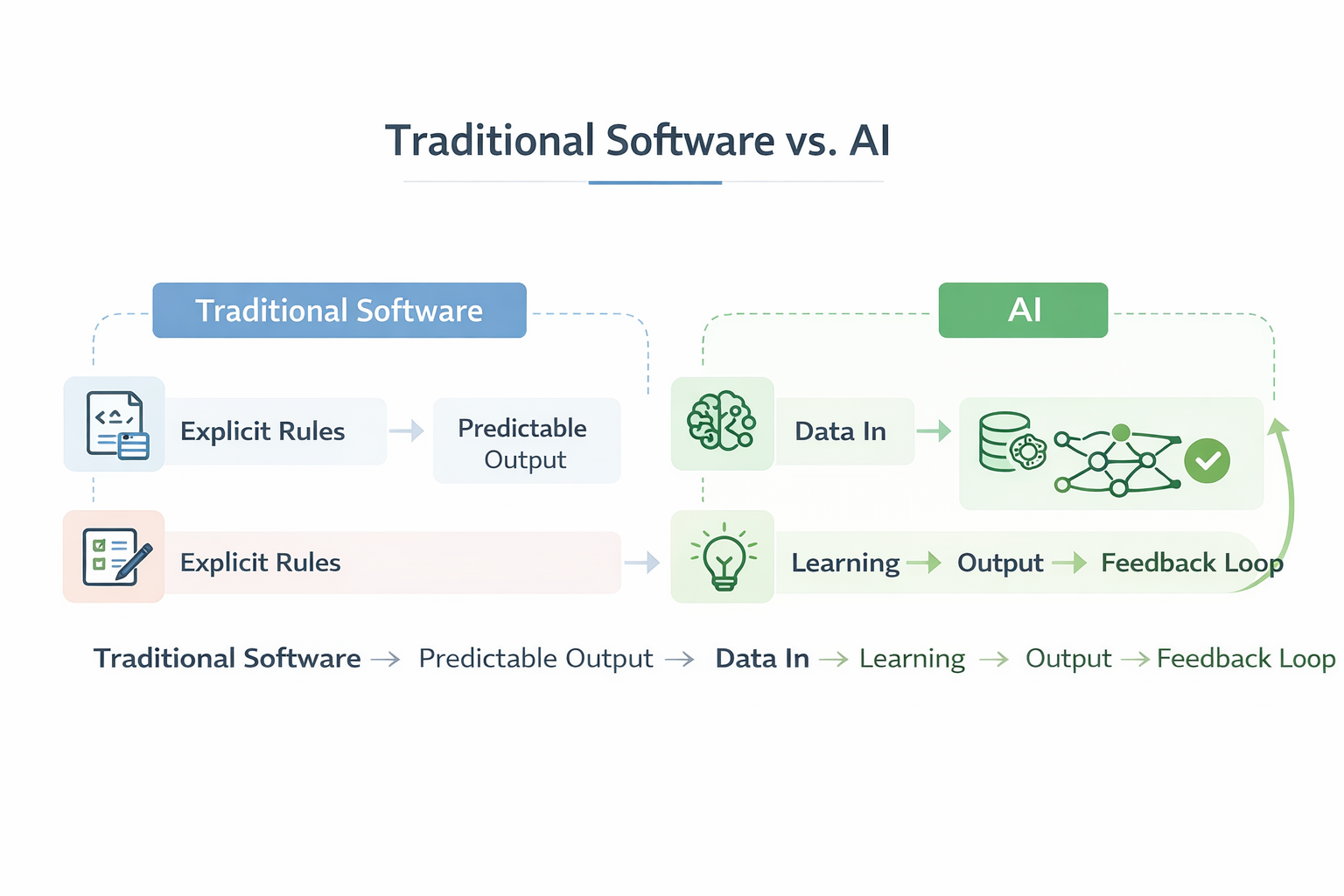
The best definition – “AI” is software that learns from data to make predictions, decisions, or create content – as opposed to executing a set of rules that a human wrote in advance.
This is important. Old software does what its code says to do. AI software does what it learns to do from its data. Show it millions of emails. Label some as spam. It learns to recognize spam. Show it millions of X-rays. Label some as having tumors. It learns to recognize tumors. Learning from data is the key characteristic that distinguishes AI from ordinary software. This. And only this.

Artificial Intelligence (AI) Course
Average time: 4 month(s)
Skills you’ll build: Python for AI, Machine Learning, Neural Networks, NLP Basics, AI Tools (ChatGPT, Copilot)
The Difference Between AI, Machine Learning, and Generative AI
It’s like three concentric circles.
The largest circle is AI. This is the whole business of creating software that can reason, learn, or create. Inside this is machine learning, the technique of using models to learn from data. Inside this is deep learning, the technique of using models with multiple layers of interconnected nodes. Inside this is generative AI, the technique of using models to generate text, pictures, and other content.
So if someone says ChatGPT “uses AI,” this is not wrong, but also not precise. More precisely, ChatGPT is a generative AI product using a deep learning model, which is a type of machine learning, which is a type of AI.
What’s the Difference Between AI and ChatGPT?
ChatGPT is to AI as the iPhone is to smartphones.
One is a product, the other is a class of products.ChatGPT is a product, a specific product, made by a specific company (OpenAI), using a specific class of models (large language models), for a specific purpose (chat/conversation/text). Using the class of products, “AI,” to refer to ChatGPT is like referring to the internet as “Google.” While understandable, it is incorrect.
There are dozens of similar products available in the world right now, each with its unique characteristics, each made by a different company, each using similar but not identical technology, each a subset of the class of products, “AI.” None of these products is “AI” as a whole, but each is a subset of the class of products, “AI.”
How Does AI Actually Work?
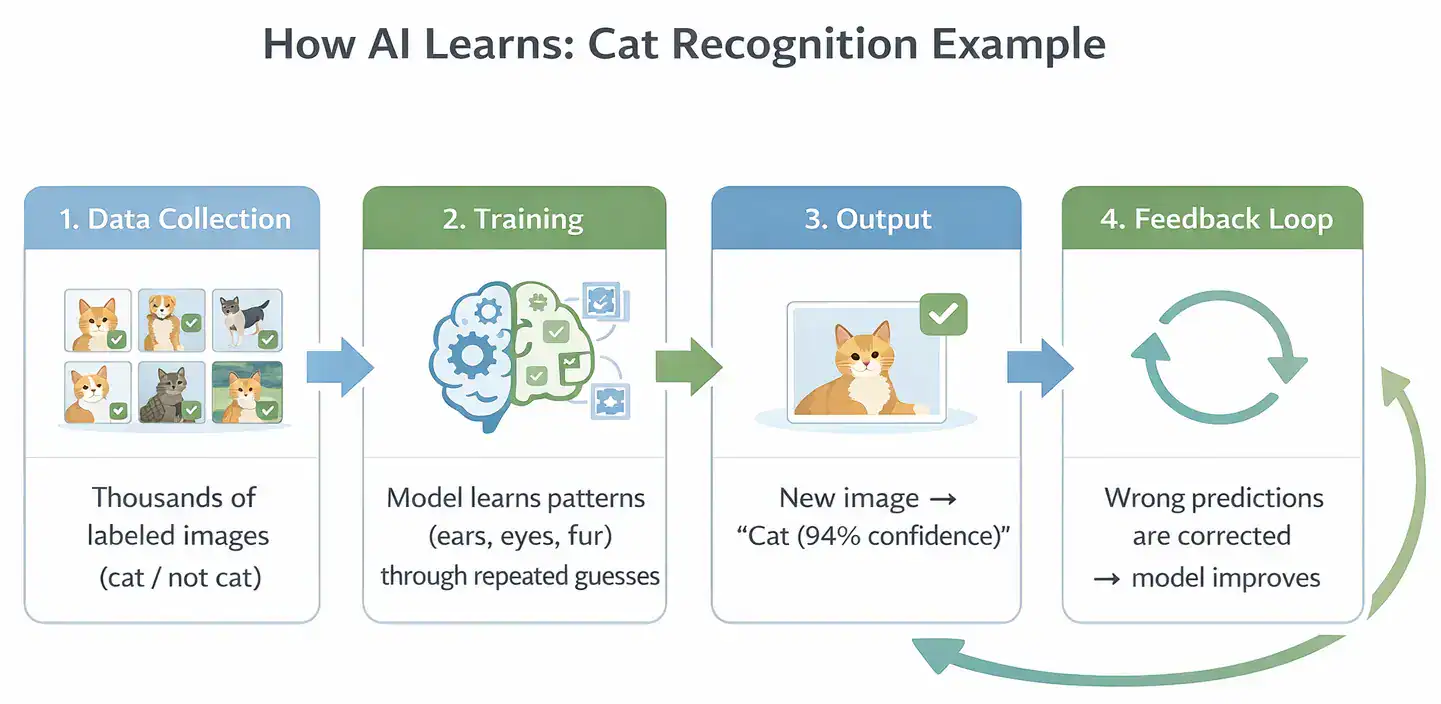
Of course, in reality, most attempts to explain how AI works end up losing the reader with the third sentence and a haze of technical terms. So here is an attempt to explain how an AI works in plain language, with one example used throughout: how to teach an AI to recognize whether an image contains a cat:
Step 1- Data collection: Collect hundreds of thousands of images, each labeled “cat” or “not a cat” by human workers. The AI needs to be shown examples to learn from. Without this step, nothing else works. This is the step that people most often forget when thinking about how to build an AI.
Step 2 — Training: The computer looks at an image, makes a prediction about what’s in it, checks whether its prediction was correct, and slightly tweaks its internal settings. This process is repeated billions of times. At the end of this process, the computer has learned to recognize patterns that reliably predict “cat.”
Step 3 — Output: Present the model with a picture it has never seen before. It will analyze the picture in relation to all the data it has learned and then give you an output: cat, 94% confidence.
Step 4 — Feedback Loop: If the model has gotten it wrong, like if it has confidently identified a dog as a cat, this goes back in. The model updates. The model improves. This is why AI models get better with time.
And that is the basic process. Neural networks, transformers, reinforcement learning… all of this is just an advanced form of these four steps.
The Role of Data in AI
The quality of the data that the AI is trained on is directly proportional to the quality of the AI.
If you were to teach a hiring tool on ten years of hiring history from a company that predominantly hires men, the model will learn to favor men.
Not because the model was designed to, but because the data the model was taught on contained bias.
The quality of the data, the diversity of the data, and the people who label the data are all critical considerations. These are not technical design considerations, but considerations with real-world implications.
What Are Neural Networks?
The brain analogy is overused, but it isn’t false.
A neural network is a series of nodes, each of which connects to other nodes, arranged in layers, with the input layer getting the data, the hidden layers doing the processing, and the output layer generating the answer. Nodes transmit signals to other nodes and modulate the strength of the signals based on feedback over time.
The depth of a neural network, as opposed to its width, is what makes a neural network powerful, as a shallow network might have only a few hidden layers, while a deep network, like those used in large language models, might have hundreds of layers, allowing the network to pick up more abstract patterns, like “this sentence implies the speaker is frustrated, not confused.”
The Main Types of AI (And What Each One Does)
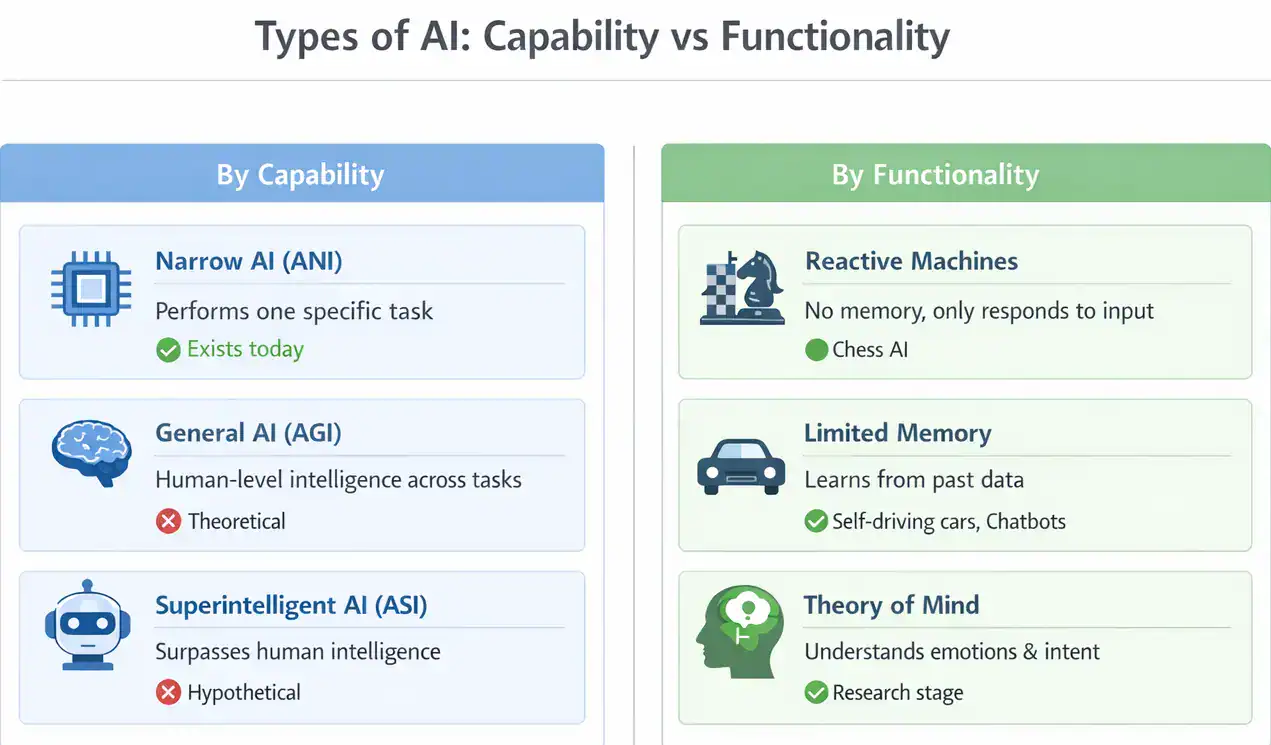
Two classification systems are worth understanding. One tells you how capable an AI is. The other tells you how it operates.
Which sounds obvious until it isn’t — plenty of people confuse them.
By Capability:
| Type | What It Means | Exists Today? |
| Narrow AI (ANI) | Does one specific task well | ✅ Yes — all current AI |
| General AI (AGI) | Matches human reasoning across all tasks | ❌ Theoretical only |
| Superintelligent AI (ASI) | Surpasses human intelligence in every domain | ❌ Hypothetical |
By How It Operates:
| Type | What It Does | Example |
| Reactive | Responds to inputs with no memory | IBM’s Deep Blue (chess, 1997) |
| Limited Memory | Learns from recent data to improve | Self-driving cars, most chatbots |
| Theory of Mind | Understands human emotion and intent | Research stage only |
Everything you use today — every AI product, every model, every tool — is Narrow AI with Limited Memory at best. AGI does not exist. Anyone telling you otherwise is either confused or trying to sell you something.
What Can AI Do Right Now?
Weirdly enough, this is the part of an AI explainer article that most of them skip entirely. They’ll spend three pages explaining history and taxonomy and then leave you without any idea of what AI can do in the real world.
So here is the honest state of play in early 2026.
What AI does well:
Writing, summarizing, translating—large language models such as Claude, Gemini, and GPT-4o do these tasks well in virtually every text format. Not always brilliant. Always speedy.
Generating images, audio, and video—tools such as Midjourney and Sora generate images and audio from text descriptions. The quality of these tools is much better than it was in 2023.
Code writing and reviewing – GitHub Copilot and other tools produce code in plain English, identify bugs, and explain codebases. This aspect has seen widespread adoption among developers. Taking actions on your behalf – This is the shift of the AI agent in action, and this is the single largest change in the use of AI technology. More on this in the next section.
What AI still gets wrong, regularly:
Facts. Dates. Math. Source attribution. Any of the above that require any kind of long-term memory. These are not bugs waiting to be fixed in the next release. They are fundamental limitations of the technology as it exists.
#1. Generative AI — Text, Images, Video, Code
In 2022, you can give the AI the task of writing a paragraph and receive something decent. In 2026, you can give the AI the task of describing a scene in three sentences and receive a photorealistic video clip. Hum a tune and receive a generated song. Type “build me a basic invoicing app” and receive code.
The way generative AI works is that it is trained on the patterns and structure of vast amounts of existing content (billions of web pages, images, audio clips) and then uses these patterns to generate new content that matches a given description.
The results are often quite impressive. They are not necessarily accurate. This is the area in which the vast majority of new users of AI are currently getting stuck.
#2. AI Agents — What They Are and Why They Matter
The chatbot can give you the answer to your query. The agent can take actions.
And that, in short, is the fundamental difference. The chatbot can give you the details of the best flight from Delhi to London. The agent can find you the flight, book it for you, add it to your calendar for you, and send you the confirmation – all this while you are in the meeting.
The AI agents can surf the web, write and execute code, interact with applications, and perform multiple actions without your intervention. They can get it wrong, get it confused, and do the wrong thing with complete confidence. This is because it also represents the next step in the way we think of AI performing. From ‘generate’ to ‘act.’
And this is the bit that all the articles miss.
#3. Multimodal AI — The Default in 2026
Until now, most AI models have only been able to understand one kind of input: text, images, or audio. One model for one task.
No more. The best models in early 2026 can understand text, images, audio, and video in a single conversation. You can share a picture of a broken appliance and ask what’s wrong. You can say something out loud and share your screen. You can get a response that refers to what it can see.
This is important because it opens up the potential audience for AI by many orders of magnitude. You don’t need to learn a new tool for each task.
Real-World AI Applications (By Industry)
The short answer is: all of them, at some stage, with some degree of success.
1. Healthcare: Images like X-rays, MRI scans, retinal scans, etc., are analyzed by the AI with the same level of accuracy as a human expert in a specific, narrow test. Drug discovery pipelines employ AI to create models of protein structures and test compounds in a fraction of the time it currently takes using conventional methods.
2. Finance: Fraud detection tools can identify unusual patterns of transactions in real-time.The time between a fraudulent transaction occurring and the detection of the same by the system has shrunk from hours to mere milliseconds.
3. Education: Learning platforms can adapt the level of difficulty of the questions according to the responses of individual students.Tutors can explain the same topic twenty different ways until the student understands, which no human teacher can do.
4. Software development: This is the space where the adoption of AI has accelerated the most.Developers who use AI coding assistants claim to experience increased productivity, especially for routine tasks like coding. The work involves more reviewing and directing the code generated by the AI than coding from scratch.
5. Customer Service: AI handles tier-1 customer service operations like password recovery, checking the status of orders, and simple troubleshooting. The best implementations automatically escalate emotionally charged or complex issues to human customer support agents.
6. Content Creation: AI tools are used by writers, designers, and marketers to accelerate content creation, not as a replacement for judgment, but as an accelerant of execution.

The Risks and Limits of AI — What You Actually Need to Know
Most articles about this subject get this completely wrong. Instead of listing risks that an enterprise-level compliance team might need to worry about—“model drift,” “operational risk,” “governance structures”—they should provide readers with information on what they need to beware of.
Here are the risks you need to worry about as an individual.
#1. Why AI Gets Things Wrong (Hallucinations Explained)
It can make things up. This phenomenon has a name: “hallucination.” And it’s not a flaw; it’s a part of the architecture of LLMs.
How LLMs work: when asked to respond to a prompt, LLMs make predictions about what word comes next, then what word comes after that, and so on. They are not checking against a verified list of facts. They are guessing what sounds like it might be true. Most of the time, this works. Occasionally, it does not. And there’s no way for the LLM to distinguish between the two.
The practical rule: if using AI to help with a task, always verify any facts. Using AI to help with a first draft? That’s okay. Using its citations verbatim in a legal document? No.
#2. What the EU AI Act Means for You
The EU’s AI Act is now in enforcement – making it the first global rule on AI worldwide.
The bit that’s most relevant to people who aren’t experts: From now on, within the European Union, any AI system used for high-risk activities (hiring people, credit scores, medical diagnosis, law enforcement tools) must be transparent and accurate. If you’re building or buying an AI system for any of these activities, compliance is now mandatory.
If you’re not building but instead use AI systems, the new law gives you the right to know whether an AI system was used to make a decision that affected you. This is more important to most people’s lives than they realize.
AI Ethics — The Questions That Actually Matter
To be honest, the whole concept of AI ethics is debated on an abstract level, which makes it sound like something for some unknown person in some conference room to deal with. It’s not.
I think the majority of people using AI tools on a daily basis are already dealing with the ethics of it; they’re just not thinking about it in those terms. Here are some examples of what I mean.
1. Bias: If the data the AI was trained on has some kind of inequality, the AI will reflect that inequality. And it will do so on an enormous scale, much quicker than any human could. There are AI hiring tools out there, for example, which have already been proven to put women and certain ethnic groups at a disadvantage.
2. Transparency: When an AI system decides something about you – for example, that you don’t qualify for a loan, that your medical emergency is not life-threatening, that your social media post is hate speech – you have every right to know why. Current AI systems are unable to explain themselves in any way that is either transparent or actionable. This is a real issue, and it is being worked through in courts and legislatures now.
3. Privacy: An AI system is only as good as its training data. Some of that data is yours. What was done with that data is currently governed inconsistently and often poorly across jurisdictions.
4. Accountability: When an AI system causes damage – for example, because of a flawed recommendation engine or because of a decision that was biased – who is liable? The company that developed the system? The company that used it? The person who asked for its use? The answers to all of these questions are unclear. Probably they won’t be for many years.
A Short History of AI
We can weave through the entire timeline in a book. These are the events that explain why AI is the way it is today.
1950 – The question that started it all. Alan Turing wrote “Computing Machinery and Intelligence” and posed the question that would start it all: “Can machines think?” The Turing Test – can a machine trick a human in a text-based chat? – was born in this paper. The question is still being argued today; the paper is still being referenced.
1956 – The field has a name. John McCarthy organized the Dartmouth Summer Research Project and gave the field its name – Artificial Intelligence. He also advocated for the name to differentiate the field from Norbert Wiener’s work in cybernetics, which he found to be conceptually restrictive.
1970s-80s – The AI Winters. The early days of AI research oversold its potential. Twice, in the mid-1970s and the late 1980s, funding for AI research was halted. The cycle of exaggerated expectations and subsequent disillusionment has a longer history than most people think. It was not caused by the arrival of ChatGPT.
1997 – Beating the Chess Champion. IBM’s Deep Blue computer program beat the world chess champion, Gary Kasparov. Chess was considered one of the highest forms of human cognitive ability. This was a real debate about machine cognition. In hindsight, it showed that AI can be good at highly specialized and rule-bound domain
2012 – Deep learning ascendant Geoffrey Hinton and his team at the University of Toronto won the ImageNet competition in computer vision by a margin so great that it effectively put the entire field to task. Neural nets, previously unfashionable, became the new dominant technique. Hinton was awarded the Nobel Prize in Physics in 2024 for this work.
2022 – ChatGPT changes the conversation. OpenAI released its product in November 2022. It gained 100 million users in two months – the fastest consumer product adoption in history to that point. Suddenly, AI was not something for researchers to ponder or IT professionals to implement. It was something anyone could try in a browser tab.
2025-2026 – The agent era. The current frontier in AI is AI that does not simply react to a prompt but plans and acts. The shift from “AI that writes” to “AI that does” is the key shift in this period.

Common AI Myths
Myth 1: AI is conscious and has feelings. Currently, there is no AI that is conscious. No AI is conscious. Large language models generate text that sounds as though it is emotionally rich because they were trained on human-generated text that is emotionally rich. The text is simply matching patterns; it does not have feelings. This is an important distinction because it is critical to how you evaluate what an AI is telling you.
Myth 2: AI is objective. AI is trained on human-generated content. Human-generated content is full of human biases, human errors, and human preferences. AI is full of human biases, human errors, and human preferences. Saying that an AI is objective because it is a machine is one of the most dangerous myths in this space—and it is used to justify some of the worst outcomes.
Myth 3: AI will take all the jobs. While it is true that some jobs will change dramatically, and others will cease to exist, new ones will also be created. This has been the history of every major technology shift in the past. The particular prediction of AI replacing all employment has been made in various forms since at least the 1960s and has consistently proven to be incorrect in its assessment of human resiliency.
Myth 4: AI is one technology. Already covered. “AI” as a homogeneous technology is like “medicine” as a homogeneous technology. Reality exists, but uniformity does not.
Artificial Intelligence (AI) Course
Average time: 4 month(s)
Skills you’ll build: Python for AI, Machine Learning, Neural Networks, NLP Basics, AI Tools (ChatGPT, Copilot)
How to Get Started With AI — Your First Three Steps
You don’t need to know any of that. You don’t need to know what a transformer is. You don’t need to know what a parameter is. What you need to know is three things:
Step 1: Choose one tool and use that one tool for one week. Not five tools. One tool. ChatGPT, Claude, Gemini, Pick any one of them. Use that one tool for one week for doing one thing that you normally do: summarizing documents? Writing emails? Answering questions that you normally Google? Just use one tool for one week.
Step 2: Verify before you trust. Assume that every statement of fact that comes out of an AI is “probably true but needs verification.” Dates? Statistics? Citations? Anything where being wrong has consequences? Get that habit early on.
Step 3 – Map what it can’t do for you. After a week of real-world use, you’ll begin to notice what it does reliably, what it does reliably but incorrectly, and what your judgment is simply incapable of replacing. Your map of what it can’t do for you is worth more than any other map you might read about in an article about AI.
FAQ — Quick Answers to Common Questions
Q1. What is the difference between AI and machine learning?
The difference between the two is that, while AI is a broad term for any technology that can perform tasks that were traditionally the domain of human intelligence, machine learning is a subset of that, referring to a specific type of artificial intelligence that can learn from the data it is presented with, as opposed to being directly programmed.
Q2. What is generative AI?
Generative AI is a subset of artificial intelligence that focuses on creating new content, as opposed to classifying or analyzing existing content, which is what other forms of artificial intelligence do. ChatGPT, Claude, Gemini, and Midjourney are all generative artificial intelligence tools that work by learning patterns from vast datasets and then using those patterns to create new content on the fly.
Q3. Is AI the same as a robot?
No. Robots are physical devices. AI is a program. Some robots have AI to assist them in navigating. Most do not. Most AI has no physical presence. A chatbot running on a website is AI. It is not a robot.
Q4. Can AI think for itself?
No. Current AI cannot think in the way that humans think when they say the word. It can process some information and produce some output based on patterns. It does not have its own goals. AI programs can make a series of decisions to attain a defined goal. The goal was defined by a human.
Q5. What is the most advanced AI?
As of 2026, GPT-5.4, Gemini 3.1 Pro, and Claude Opus 4.7 lead the field. Selection depends on specific needs like PhD-level reasoning, massive context, or agentic coding.
Q6. Is AI dangerous?
Well, that depends on what you mean. The dangers of current AI are real and pressing. They include bias in high-stakes decisions, the spread of misinformation on a massive scale, loss of privacy, and economic disruption in some industries. Those are the dangers that you should be concerned about. The science fiction threat of AI deciding to do us harm on its own is not a current technical threat. It is worth noting that the long-term safety of AI is a serious and sincere topic of technical debate.
Q1. What is Artificial General Intelligence (AGI)?
Artificial general intelligence is a hypothetical future AI system that can perform any intellectual task that a human can. It is not just one task that a machine can do better than a human. Is it possible for a machine to do all tasks that humans can do? It does not exist. Whether it will exist in the future, and if so, what it will require and what dangers it will bring, are topics that researchers seriously and sincerely debate.
Q1. How does AI learn?
Artificial intelligence learns by processing vast amounts of data, recognizing patterns within this data, and adjusting its internal settings accordingly. This process of learning can take weeks and needs powerful computing capabilities. After this process, called training, the program uses what it has learned to solve new situations that it has never seen before.


