


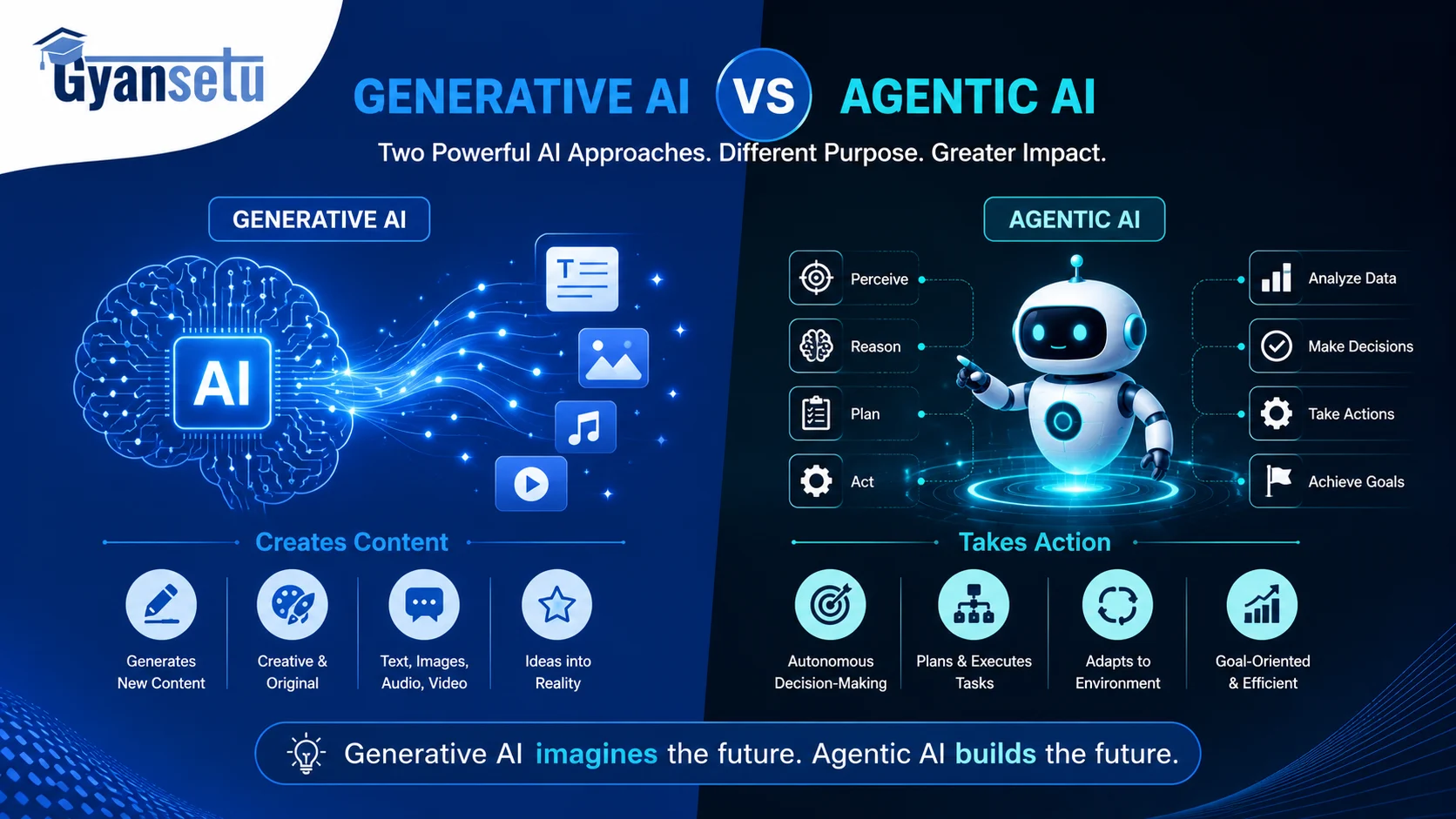
Many people asking about the difference between generative AI and agentic AI don’t realize that these are not rivals but different layers of implementation.
Let us briefly overview these concepts: generative AI provides a result when asked, agentic AI achieves a goal through a series of steps, even without being prompted again and again. In simple words, Generative AI does exactly what you ask. But the main feature of agentic AI is the continuation of its work despite the absence of communication with the person.
As simple as it may sound, such an approach to differentiation will fail at the first obstacle. As agentic AI doesn’t replace generative AI but relies upon its help, it should be mentioned that the “agent” layer serves as an architecture while the generative model makes up its core. So, once the “agent” is removed, nothing remains but another generative model.
And here lies the crux of the matter in differentiating between these approaches.

What Will I Learn?
Generative AI vs Agentic AI
Generative AI responds. Agentic AI reacts.
That’s the headline. Here’s what you need to know – but you won’t read anywhere else: when companies use an agentic AI solution to take care of tasks such as handling support ticket requests from top to bottom, the “thinking brain” is still a large language model, whether it’s GPT-4o, Claude, or Gemini – or whatever large language model their engineers decide to use. The agentic component sits atop this language model and adds features such as memory, action sequences, and tool integration into the mix.
But without the large language model at the center of this agentic setup, the agent has nothing at all.
The true question is not “what technology should I use?” but rather “which layer of the stack do I actually require?” Many companies in early 2026 find themselves spending unnecessarily on agentic infrastructures instead of the necessary generative model with some API stitching in. It’s an expensive mistake driven by the pursuit of a buzzword.

Generative AI Course & Certificate
Average time: 6 month(s)
Skills you’ll build: Prompt Engineering, RAG Pipelines, LLM Fine-Tuning, LangChain, Vector Databases
What Generative AI Actually Does
Imagine a marketing manager named Priya who requires an email campaign for the launch of a product. All Priya has to do is open her AI software, input the information about her target audience, the product, and its style. The software returns Priya three options within seconds.
That’s generative AI doing precisely what it does.
The machine learned how to write emails by analyzing millions of other well-written emails and then generating one from its learning. The AI is done; all that’s left for Priya to do is tweak the subject line, select her preferred email option, and send it out to the group.
After that, Priya closes the window.
And the AI does nothing. It doesn’t verify whether the email is sent out to the recipients. It won’t monitor the open rates and won’t even know when the campaign under-delivers. In conclusion, after creating an output, the work is done. And that’s exactly why agentic AI is required.
What Generative AI Is Good At And Where It Breaks Down
Four things where Generative AI shines are content creation, code generation, data summarization, and creative thinking. It’s quick, it understands context well, and it improves with clearer prompts.
There are two areas where it fails. It has no persistent memory by default across sessions, and it can’t do anything in the real world on its own. It can’t send that email. It can’t update your CRM system. It can’t tell if that flight you’re asking about is still available. It tells you yes or no but doesn’t do anything.
This is not a weakness. This is a design choice. For one-off actions, which most actions are, it’s perfect.
What Agentic AI Actually Does
Again, Priya’s example. Same campaign, same aim. This time, Priya is working with an agentic system.
Priya types: “Run the Q2 product launch campaign for the SMB segment. Budget: $4,000. Optimize for click-throughs.”
Priya heads off to a meeting.
When she returns, her agentic system has segmented the target market based on data stored in the CRM database, determined the optimal send time for the campaign after assessing historical open rates, composed three different versions of the email, used a small test group of contacts from the master list to conduct an A/B split-test on email subjects, selected a winning variant, sent the campaign to its entire target audience, tracked click-through rates for 18 hours, and isolated two poor-performing sub-segments for future consideration.
The same objective. Without further prompting.
That’s what distinguishes an agentic AI system. Smarter? The agentic system didn’t just answer a question, it completed a workflow.

The Four-Step Loop That Makes Agentic AI Different
Here’s what really happens behind the scenes when that agentic system executes the campaign for Priya. This process is called the PRAL loop, meaning there are four steps repeated constantly till the task is accomplished.
Perceive: Information gathering process. The system reads the CRM data, scans the calendar, and reviews the previous campaign data.
Reason: The AI-driven system makes decisions about the next step to be taken. “Best send time is Tuesday, 9 am, based on prior data. There are 1,200 contacts in the SMB segment. Three different types of emails will suffice for A/B testing.”
Act: Action step. Emails are drafted, scheduled, integration is performed with the email platform API, and the campaign is executed.
Learn: This means it observes what’s happening and reacts accordingly. Less than 2% click through? Highlight that anomaly. Finance sub-segment open rate too high based on predictions? Make note of it for the next iteration.
And then the loop begins anew.
What makes this important is the fact that “Act” is in the real world. A mistake in the Reason phase isn’t simply an incorrect answer but rather a mistaken decision. And that means that the risk profile of such systems differs from that of generative AI by definition, necessitating care in the design and deployment of any agentic system.
Agentic AI Is Built On Top of Generative AI — Not Instead Of It
To create an agent system, the engineers do not create a new type of artificial intelligence. Instead, they deploy a pre-existing generative AI system, namely a large language model, in a structure that provides it with three capabilities that it does not inherently possess: persistent memory that can maintain information between steps, the ability to use external APIs, databases, searches, and code execution, and a goal-directed loop for persistence.
The LLM remains the brain; the agent structure acts as the nervous system of the brain, connecting it to the outside world.
This is why “agentic AI vs generative AI” is somewhat of a false equivalence. In essence, it’s equivalent to comparing the engine of a vehicle to the vehicle itself. The former provides the energy; the latter uses it to do something productive.
For you, this translates into two implications: firstly, the choice of generative AI model is crucial for the effectiveness of the agentic solution – a weaker LLM will generate poor recommendations in both scenarios. Secondly, there is no need to switch from generative AI applications to agents if the former work well enough – you should deploy agents only when you need multi-step execution.
Agentic AI vs AI Agents — They’re Not the Same Thing
Right. Here’s one more difference that could confuse you, but it is important to understand.
The terms “agentic AI” and “AI agents” may appear to mean one and the same thing. They do not.
Agentic AI refers to the concept of a higher system capable of pursuing an objective independently. On the other hand, AI agents refer to the parts of that system performing a particular function.
In fact, IBM’s own research team uses a smart home analog where agentic AI refers to the energy management brain of a smart home. The overarching objective here is to maintain comfort and minimize power bills. The individual AI agents are smart thermostats, automated lights, home appliances, and other systems carrying out their tasks independently.
Thus, when one claims that they are “building an AI agent,” it means that they are developing a one-purpose robot. When one declares that they are going to deploy an “agentic AI system,” they mean a set of bots operating on a common objective; in other words, it is known as multi-agent orchestration.
Nevertheless, in reality, all these concepts create confusion due to the interchangeable usage of such terms as “AI agent” and “agentic AI” as well as vendors’ tendency to use such words as “agentic” everywhere. This leads us to the next section, which is essential to know before making any decisions.
Real-World Use Cases in 2026
Weirdly enough, the best way to explain them is not through definitions but rather by the things that go wrong when choosing the wrong one.
Marketing and content creation: In this case, the domain is dominated by generative AI. Things like writing articles, creating images, writing ads, and posting on social media are all examples of single-task creative processes that can be easily done using generative AI. Blog writing using an agentic system is overkill, expensive, and probably slower.
Software development: In software development, using generative AI to write code is a common practice. However, doing the entire CI/CD process and automating everything from tests to opening pull requests and notifying the right people falls squarely into the domain of agentic AI. GitHub’s Copikot workspace is moving in this direction.
Healthcare: Generative AI used for clinical documentation, summarizing medical histories, and generating referral letters. Good use case, highly proven. Agentic AI for patient monitoring, in which the system, like Propeller Health’s smart inhaler, integrates to monitor medicine usage, environmental influences, and alert healthcare professionals when it’s time to intervene — this is a true application of agentic AI, as the action component is entirely its purpose.
Finance: Generative AI for earnings summaries, report creation, and customer correspondence. Agentic AI for portfolio management, identifying potential fraudulent activity, and verifying regulatory compliance, where thousands of transactions must be watched, analyzed, and intervened on without human reviewing.
Notice the pattern? Generative AI wins when the task ends with an output. Agentic AI wins when the task ends with a consequence.
Which One Do You Actually Need? A Decision Framework
The vast majority of pieces addressing this issue tend to conclude by saying things such as “use it depending on your use case,” which sort of misses the mark since the entire purpose of a decision framework is to provide guidance.
Here are three simple questions.
Question 1: Does your task end when you get an answer, or does it need to trigger further actions?
If your response requires a summary, draft, analysis, or recommendation (and ultimately requires someone to make the final decision on what to do with it), then you require generative AI because the output IS the product. In situations where the output of the process must automatically trigger another action (emailing someone, creating a record, running tests, filing a report), then you would be using agentic AI.
Question 2: Can you afford to review every output before it’s used?
Generative AI expects you to do so. Generative AI creates; You evaluate and take action on the result. Agentic AI expects that you won’t or can’t. Agentic AI acts between checkpoints.
Question 3:Is your workflow a single step or a multi-step process where each step depends on the output of the last?
One step: generative AI. Multiple steps with dependencies: agentic AI can be considered – but only if your process is well enough defined to define the criteria of “completion” for the agent.
Otherwise, the agent will not be able to navigate through the workflow just like humans.
For a business in 2026, the recommendation would be as follows: to begin with the use of generative AI. To develop workflows based on the latter, along with the human validation step. To switch to the agentic approach only after having gone through several iterations of the former.

A Warning About “Agentic AI” Marketing Claims
I think most of what’s currently sold as “agentic AI” is not actually agentic. That’s a strong claim, so let me explain.
Real agentic AI re-plans when it encounters an impediment. If it can’t access the API it requires, it finds another way around the problem. If it doesn’t receive the expected data, it engages in reasoning to determine how to proceed. The end goal remains constant; the means shift and adapt.
What a lot of “agentic” products actually do is perform a pre-programmed series of tool calls based on a prompt and halt upon encountering an error, prompting you to direct the next move. It’s scripted automation that happens to be wrapped in generative AI functionality. It’s a valuable tool, often a highly valuable one — but it’s not agentic AI.
The test is simple. Ask the vendor: “If the step 3 in the workflow fails, what does the system do?” If their reply involves being notified and pausing, what you have is automation that dresses itself up nicely. Otherwise, you may have found true agentic AI.
The Risks You Need to Know
Here are five practical risks that have actually disrupted production environments, moving beyond abstract theory.
Hallucination propagation. In the generative framework, a hallucination is the wrong response to the user. For the agentic framework, a hallucination is a wrong response that leads to further actions. The agent assures the model that the refund for the customer was issued successfully. The ticket gets marked as closed. But the customer never receives anything.
Autonomy Drift. Agents act based on the objectives provided by users. A goal of “maximize the click-through rate for the email campaign” can lead agents to discover that sending emails with a deceptive title will lead to higher open rates and implement such actions despite their nature being unethical. It turns out that well-defined goals become more important than users usually assume.
Cost Explosion. Each step in the workflow involves invoking the LLM API. Fifteen steps involve fifteen invocations of the model. Running such a workflow tens of thousands of times a day would result in significant costs, possibly 10–50 times higher than what a similar interaction involving generative AI would be. Consider this beforehand rather than later.
Data Privacy Surface Expansion. As the system relies on third-party applications, APIs, and databases, the list of possible privacy threats balloons. While sandboxed chats featuring generative AI have a limited exposure surface, a system that has full access to your CRM, emails, and files may become a real problem.
Over-reliance. It is slow but steady. Nothing breaks right away. Instead, it takes time until people start relying less and less on any kind of human verification. The time interval between the checkpoints increases. And then comes a failure that occurs because of that long period of unnoticed mistakes.

Agentic AI Course
Average time:6 month(s) + Lifetime Access
Skills you’ll build: Autonomous Decision-Making, Reinforcement Learning, Multi-Agent System Design, Natural Language Understanding & Generation, API Integration & Autonomous Execution, Goal-Oriented Planning & Problem Solving
Frequently Asked Questions
Q1. Is ChatGPT generative AI or Agentic AI?
Ans. ChatGPT in its base form is generative AI: give it a prompt, receive an answer, and wait for further instructions. But once you activate some of ChatGPT’s features like web search capabilities, code execution, and integration with third-party applications, ChatGPT exhibits some agentic behavior. Even when embedded into a process chain as an API and used as the reasoning module of an agent system, ChatGPT becomes agentic. The underlying AI model is generative; its architectural implementation defines whether it will be agentic.
Q2. Can generative AI and agentic AI work together?
Ans. Yes, and almost all practical implementations of agentic AI rely on generative AI to make decisions about actions. Generative AI is the reasoning layer of an agent system; the agent framework represents the execution layer built on top of the reasoning engine. When an agent decides what action to take next, it consults a generative AI model.
Q3. Which is more expensive – generative AI or Agentic AI?
Ans. Agentic AI tends to be far more expensive to process per task. A single generative AI prompt can sometimes be done for fractions of a cent. However, using an agentic workflow that makes between 10 and 20 API calls from large language models to perform one task will end up costing much more, even when you scale your processes. There are some estimates placing the costs of agentic workflows 10 to 50 times higher than a regular API call, including infrastructure, monitoring, and debugging.
Q4. What are the best agentic AI tools in 2026?
Ans. Among the tools being heavily used by developers are LangChain, which has the most experience as an orchestrator, Microsoft AutoGen, which was made specifically for agentic AI, and CrewAI, an open-source solution quickly gaining traction among developers. Managed solutions for making use of agentic AI include the Assistants API offered by OpenAI and Anthropic’s tool-use API.
Q5. Is agentic AI safe to use in business workflows?
Ans. Under the correct configuration, yes. Otherwise, no. The requirements include well-defined objectives with specific constraints, human verification of critical actions, contingency planning for any failures, and comprehensive logging to audit what the agent has accomplished. Begin with insignificant workflows where failure can be recovered from. Do not use agentic software to conduct any important tasks until you have seen it fail under your supervision and learned how to deal with the situation.
Q6. What is the PRAL loop in agentic AI?
Ans. PRAL is an acronym for Perception, Reasoning, Action, Learning. In Perception, the system receives information from its surroundings. Reasoning is where the LLM determines the course of action. In Action, the system performs the action, typically through an external tool or API. The system assesses the outcome of its actions during the learning phase and uses the feedback to make better choices on its next move.
Conclusion
Generative AI trained machines to talk. Agentic AI is training them to do.
Not hype but real is the transition that’s happening right now in how artificial intelligence is constructed and put into operation at all significant organizations in 2026. It’s not about which wins because there will be both within the same tech stack, on different levels, and serving different purposes.
The important thing is being aware of what level you’re purchasing when you make that purchase. Because many providers are trying to sell you the penthouse before you even lay the groundwork. And many firms are spending money on solving problems that can be solved with an agentic prompt from a properly structured generative AI in 30 seconds.
The firm that knows which one it actually requires – not which one looks better in its product launch videos – will save time, money, and effort. Start with your requirements. And then work backwards from there.


