

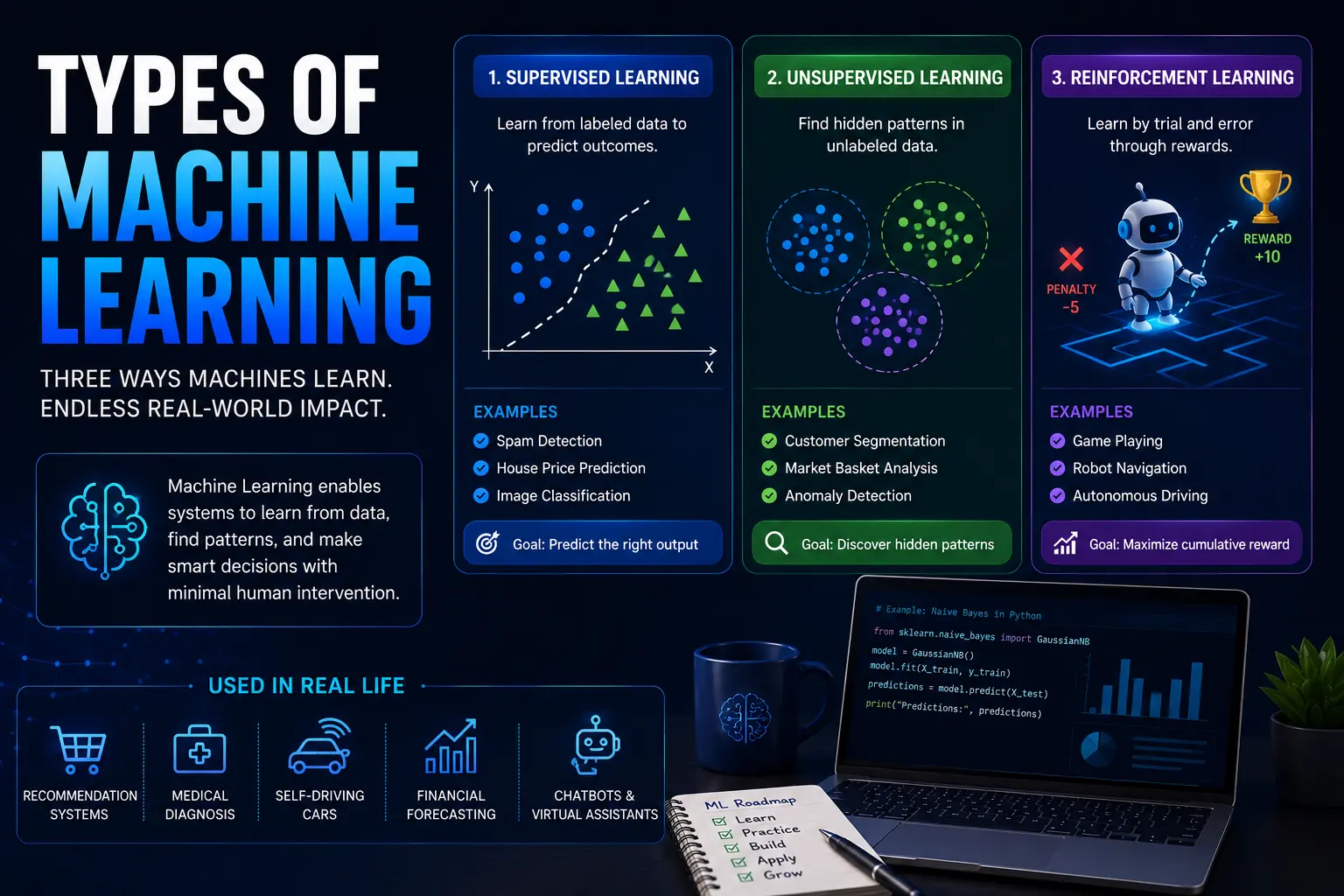
The failure of most machine learning projects does not come from having a poor model. Instead, it comes from selecting the wrong form of learning for their use case and wasting three months figuring it out.
There are five different forms of machine learning. These all have distinct processes, distinct requirements for data, and distinct uses. Knowing the difference between them is not merely helpful in passing interviews. It is the difference between completing a project or scrapping it.
The following are the aspects of this guide that make it unique among all others on the subject: after reading it, you will be able to not only identify what the five forms of machine learning are. But also know when to use them, and how contemporary artificial intelligence systems such as ChatGPT, Gemini, and Llama employ all five in series.

What Will I Learn?
What Is Machine Learning?
Machine learning is a process for creating computer programs where the pattern in the data is learned, as opposed to being defined explicitly in code by a programmer.
The development doesn’t involve “if the message includes the phrase ‘free money’ then flag it as spam” but rather exposing the program to thousands of spam and non-spam messages and letting it figure out the pattern itself. The concept of machine learning was invented way back in 1959 by Arthur Samuel, who was working at IBM on a checkers-playing machine that would improve with play.
The notion of improvement through experience is at the heart of everything in this field.

Machine Learning Course
Average time: 5 month(s)
Skills you’ll build: Python, Scikit-learn, Supervised & Unsupervised Learning, Feature Engineering, Model Deployment, and more..
The 5 Types of Machine Learning at a Glance
Before going deep on each type, here’s the full picture in one table. Use this to scan and orient yourself, then read the sections that matter most for your work.
| Type | Data Needed | How It Learns | Key Algorithms | Best For |
| Supervised | Labeled (input + correct output) | Maps inputs to known outputs | Linear regression, Random Forest, SVM | Prediction, classification with historical data |
| Unsupervised | Unlabeled (raw data, no answers) | Finds hidden patterns and groups | K-Means, PCA, Apriori | Segmentation, exploration, anomaly detection |
| Reinforcement | No dataset, learns from interaction | Gets rewards or penalties for actions | Q-learning, Deep Q-Networks | Sequential decisions, game-playing, robotics |
| Semi-Supervised | Small labeled set + large unlabeled set | Labeled data guides, unlabeled data fills gaps | GANs, Label Propagation | When labeling is expensive or slow |
| Self-Supervised | Raw, unlabeled data at massive scale | Creates its own training signal from the data | BERT, GPT, SimCLR, CLIP | Foundation models, NLP, computer vision |
1. Supervised Learning — The Most Common Type
Supervised learning is a branch of machine learning in which the algorithm learns using data sets that have inputs and correct outputs.
The key idea here is that it learns in the presence of a teacher who evaluates each answer. You present your algorithm with 10,000 previous bank transactions with labels of either “fraud” or “legitimate.” And then the model learns from the experience how to detect fraud. If a new transaction arrives, the algorithm makes use of its knowledge.
This is the prevailing paradigm of machine learning in action. The vast majority of real-world applications are built upon supervised learning algorithms: spam filters, credit scoring systems, medical diagnosis systems, pricing predictors.
Classification — Predicting Categories
Classification is a type of supervised learning for cases in which the output is categorical rather than numerical.
Examples of such problems include whether an e-mail is spam, whether a customer will churn, and whether an image has a tumor. The algorithm creates a separation line to classify the two categories in the data.
Popular methods for solving these problems include logistic regression, decision tree, Random Forest, SVM, KNN, and Naive Bayes. In Python, the implementation of most of these models consists of three lines of code using scikit-learn.
Regression — Predicting Numbers
Regression is used to solve issues when the output is a real number instead of a discrete class.
How much will this house cost? How many units will we deliver next month? What is the hospitalization rate for this patient? This is all about regression tasks. Linear regression is the simplest form; Ridge, Lasso, and Gradient Boosting can cope with complex issues.
When to Use Supervised Learning
Apply supervised learning whenever all three criteria apply.
- You have data from the past with the right answer known for sure.
- You need to predict the same result on previously unseen data.
- The correctness can be measured through comparison of predicted answers and correct ones.
The caveat: the labeling process is time-consuming and costly. A thousand examples might take a human annotator days to label. What about one million? That’s budgeting in a serious way. When labeling cost is your bottleneck, consider semi-supervised or self-supervised approaches.
2. Unsupervised Learning — Finding Patterns Without Answers
Unsupervised learning is one of the forms of machine learning in which the model has access to raw data that is label-free, answer-free, and category-free.
It means that the task of the model is to identify certain patterns in the data that are not evident at first glance. Frankly speaking, this is when things start getting exciting. You are not directing the algorithm on what to do. You are asking it to show you the way things are.
Think of any music streaming platform that has 80 million tracks in its database. Those tracks were not labeled by anyone by their mood or energy level. The unsupervised learning algorithm groups the acoustically similar tracks and creates separate clusters of fast and punchy songs and slow and atmospheric songs.
Clustering — Grouping Similar Things
Clustering algorithms arrange the data points in such a way that members of a cluster are closer to each other than to members of other clusters.
K-means is the bread and butter algorithm in which you define the number of clusters to be created and each data point is assigned to the closest cluster center. With hierarchical clustering, a tree-like structure is created and it does not require you to know the value of K in advance.
Applications: Customer segmentation, document clustering, image compression, fraud ring identification.
Dimensionality Reduction — Simplifying Complexity
Real world data has hundreds or thousands of dimensions. Out of all these dimensions, most of them are either redundant or contain noise.
PCA tries to identify the directions where there is maximum variance in the data and then projects the data on those directions. An example would be a dataset with 500 dimensions being compressed to 20 principal components without loss of information.
Association Rules — Finding What Goes Together
Association rule learning discovers what items are found together in a set of data.
One of the best examples for association rule learning is the market basket analysis – customers purchasing baby diapers will probably purchase beers. This discovery was supposedly made by Walmart in the late 1990s using data mining techniques.
When to Use Unsupervised Learning
Unsupervised learning can be used when:
- Labeled data is not available and labeling is not feasible
- You are not sure of your target (exploring mode)
- The objective is discovery and insights rather than prediction
Actual limitations: The absence of ground truth makes it difficult to evaluate how well the algorithm works. There could be two clustering scenarios that seem fine but only through domain expertise can you judge their effectiveness.

3. Reinforcement Learning — Learning by Doing
In reinforcement learning, the agent learns from interacting with the environment and is rewarded or punished based on the outcome of the actions taken.
There’s no data set. No label. The agent does something and learns from the outcome.
The best example of reinforcement learning is Google DeepMind’s AlphaGo. In 2016, it was the first ever algorithm which defeated the world champion at the game of Go. The complexity of the game is such that the number of possible board configurations is more than the number of atoms in the universe. And AlphaGo didn’t learn from “good move” examples which were labeled for it.
How the Reward Loop Works
There are four components to the main loop. The agent takes an observation of the environment’s current state, makes a decision, gets a reward for doing something, and updates its policy accordingly.
Q-learning was the basic algorithm invented first. It is capable of determining the cumulative value of the action taken in a specific state. DQN extended this approach and made it possible to process raw inputs such as frames of video games.
RLHF — How Modern AI Gets Better at Talking to Humans
Here is where reinforcement learning makes a direct impact on your everyday tools.
Reinforcement Learning from Human Feedback, abbreviated as RLHF, is the technique that transformed the language models into functional assistants. After pre-training a language model on texts, human raters evaluate a pair of generated replies by choosing the preferred one, which acts as a reward. As a result, the model is trained to generate useful and desirable replies: concise and not misleading.
All popular conversational AIs, like ChatGPT, Gemini, Claude, went through RLHF. Without RLHF, these models would be outstanding from a technical perspective but significantly less user-friendly: evasive, verbose, or just weird.
When to Use Reinforcement Learning
Reinforcement learning should be used in the following cases:
- The data is non-existent, and it comes from interaction with the environment
- This is a decision process rather than a prediction task
- You can clearly define the reward function (which is more difficult than it may seem)
The computational cost is real. Training RL agents is quite costly. Only game-playing agents, self-driving cars, and alignment research require RL training.
4. Semi-Supervised Learning — The Practical Middle Ground
The Semi-Supervised Learning technique involves training the model on a small amount of labeled data and a large number of unlabeled data.
Most often, this approach represents the nature of real-world ML project development. For some reason, people do not say a single word about this, which is rather unusual.
Let’s take an example of the hospital that wants to identify symptoms of lung diseases on the basis of chest x-ray images. It has 200,000 of the images available. However, just 3,000 of these images have already been reviewed and labeled by the radiologist. Getting a radiologist to label 50,000 more scans is an extremely expensive and time-consuming process.
The Semi-Supervised Learning technique allows training on 3,000 images and at the same time extracting valuable information from 197,000 images that do not have labels yet. Such an approach works significantly better compared to only labeled data and requires much less labeling efforts.
An example of such an algorithm is Generative Adversarial Network (GAN). In the GAN there is a network that generates synthetic samples and another one that distinguishes real and fake samples.
When to Use Semi-Supervised Learning
Semi-supervised learning should be used when:
- Some labelled data exists, but it is too costly or time-consuming to label additional data
- An abundance of unlabelled data exists that has the same underlying structure as the labelled data
Semi-supervised learning was key to building early speech recognition systems. The system would learn using a small set of transcribed audio data, along with large quantities of unlabelled speech.
5. Self-Supervised Learning — The Engine Behind Modern AI
In self-supervised learning, there is an approach of creating a training signal directly from the raw and unlabeled data.
The below paragraph is going to be the most important for anyone who wants to get to know about AI in 2026. All major foundation models that you have used till date—GPT, Gemini, Llama, Claude—all of them were created using the process of self-supervised learning.
What is self-supervised learning? Here is how self-supervised learning works. There is no labeling done by humans in this case. Rather, there is a task for the model with the answer hidden in the data. For example, in language modeling, there will be a prediction of the next word as the task. Trillions of predictions and adjustments follow.
This seems easy enough. The repercussions were far from it.
Prior to the rise of SSL, getting a useful model trained required millions of examples with human-generated labels. It was expensive and limited. SSL gave the possibility of training on all of the internet: hundreds of billions of parameters from unlabelled text and image data.
BERT, created by Google in 2018, presented one approach to doing this. Take a sentence, mask out some random words, ask the model to guess which words were covered up, rinse and repeat a billion times. The model teaches itself grammar, knowledge, reasoning and contextual understanding through the very structure of the language. CLIP, built by OpenAI, did something similar for both images and text, allowing a model to learn how images and textual description related to each other without ever explicitly telling it “this is a cat.”
Why Self-Supervised Learning Changed Everything
Prior to SSL, ML was mainly narrow. The use of a spam classifier would not enable you to perform image classification.
SSL generated a completely different thing: general representation. BERT does not only understand language. It captures the semantic relationship which can be applied in various tasks. You will fine-tune the model for the task such as sentiment analysis, named entity recognition, or medical note summarization using less data than would be required without SSL.
This idea of re-usability is referred to as transfer learning and this is the reason why Hugging Face has become an important center for the current ML community. There is no more need to start training from scratch; you simply take a pre-trained model, fine-tune it to your dataset and then deploy.
When to Use Self-Supervised Learning
Apply self-supervised learning in the following cases:
- When you have huge quantities of raw, unlabeled data
- When you are training a foundation model to use in future fine-tuning for various tasks
When labeling the amount of data you need is impossible

How Modern AI Systems Combine All 5 Types
But what other articles about this subject do not tell you is that you do not select a single approach and use it forever. The most advanced AI models in the world make use of all five approaches in succession.
Take any recent large language model such as ChatGPT, Gemini, Llama, and others.
Phase 1 (Self-supervised): The model learns language, reasoning, and world knowledge through the prediction of billions of subsequent tokens using hundreds of billions of words of raw text data from the web, books, and code. There are no labels involved.
Phase 2 (Supervised): The engineers then train the model with a curated dataset of instruction-response pairs. This teaches the model to respond to instructions and not just generate text.
Phase 3 (Reinforcement via RLHF): Humans rate pairs of responses generated by the model. The model then tries to learn how to maximize human preference scores.
The back story is that the image encoders behind all these systems were pre-trained using contrastive self-supervised learning, which falls somewhere in between unsupervised and self-supervised in the hierarchy.
And that chatbot you’ve been using? It’s supervised, self-supervised, and reinforcement learning combined purposefully. Knowing this will change your thinking about each one separately. They aren’t competing classifications. They are tools that get mixed together.
Which Type of Machine Learning Should You Use?
It is precisely the question which all three leading papers on this subject fail to address. Let us address it right now.
Follow this order of questions:
Have you got labeled data and an outcome to predict? Go for Supervised Learning then. It is the most developed paradigm, has the best documentation and is easy to implement using scikit-learn in just an afternoon.
No labeled data but you want to detect patterns or grouping? Go for Unsupervised Learning then. Clustering uses k-means algorithm; reducing the number of features uses PCA, while association uses Apriori algorithm.
Have some labeled data but cannot afford to label everything? Go for Semi-Supervised Learning then. You start from what you have labeled and allow the rest unlabeled data to do the work.
It is decision-making in sequence without any dataset available but just an environment providing feedback? Go for Reinforcement Learning then. Expect high computational requirements and a long development process.
Have huge unlabeled data and want to develop a general model able to adapt to various tasks? Go for Self-Supervised Learning then. Foundation model pre-training and fine-tuning will do the job.
One honest caveat: In practice, one will usually apply combinations of these approaches. For example, one can employ an unsupervised approach for identifying customer segments and a supervised method for predicting the segments to which a particular customer belongs. This classification is just a starting point.

Deep Learning — A Method, Not a Type
It confuses people all the time, so let’s clarify it.
Deep Learning is not the sixth kind of Machine Learning. Deep Learning is a method which involves applying multi-layer neural networks to any of the first five kinds of machine learning.
Classifying chest X-rays using CNN is Supervised Deep Learning. Compression of images using an autoencoder is Unsupervised Deep Learning. AlphaGo’s policy network is Reinforcement Deep Learning. BERT is Self-Supervised Deep Learning.
“Deep” only means many layers. It does not influence what kind of machine learning we have here.
Frequently Asked Questions
Q1. What are the main types of machine learning?
Ans. There are mainly five different types of machine learning which include supervised learning, unsupervised learning, reinforcement learning, semi-supervised learning, and self-supervised learning. These different machine learning types differ based on what data they require to create the learning signal out of the data.
Q2. What is the most commonly used type of machine learning?
Ans. Supervised learning is the most prevalent form of machine learning used in real-world applications. The majority of all the classification and prediction algorithms used in finance, healthcare, and e-commerce are based on supervised learning. Nevertheless, self-supervised learning has turned out to be the prevalent model for training foundation models.
Q3. Is deep learning a type of machine learning?
Ans. Deep learning is not another kind of machine learning but an approach – multi-layer neural networks – which can be employed for any of the five types of ML depending on the way the model learns (with labeled data, with unlabeled data, with rewards, etc.).
Q4. What type of machine learning does ChatGPT use?
Ans. All three major approaches are used in ChatGPT in succession. The self-supervised learning approach is employed to pre-train the base model using internet text. The supervised fine-tuning method trains the model to understand instructions. Finally, RLHF uses reinforcement learning to ensure that the output generated by the model matches what people want.
Q5. Which type of machine learning should I learn first?
Ans. Begin with supervised learning. It has the most straightforward definition of the problem: you have inputs, you have the correct answers, and accuracy is your guide. There are mature tools in Python (scikit-learn, XGBoost) and the feedback cycle is fast enough to learn from your mistakes.
The Real Decision Isn’t Technical
Most folks here are grappling with what to learn, what to build for their team, or why a project failed.
This is my take on things: the difficulty in selecting machine learning paradigms lies not in understanding the definitions but in accepting the actuality of the data available to one and not the data one hopes for or will gather sometime in the future. Supervised learning requires labeled data. Unsupervised learning can uncover hidden structure if there actually is any. Reinforcement learning requires the correctness of the reward function or else agents learn how to cheat the system.
The technical knowledge comes quickly. The discipline needed to select an approach based on reality is the crucial element that makes the difference between projects that succeed and those that fail.


