


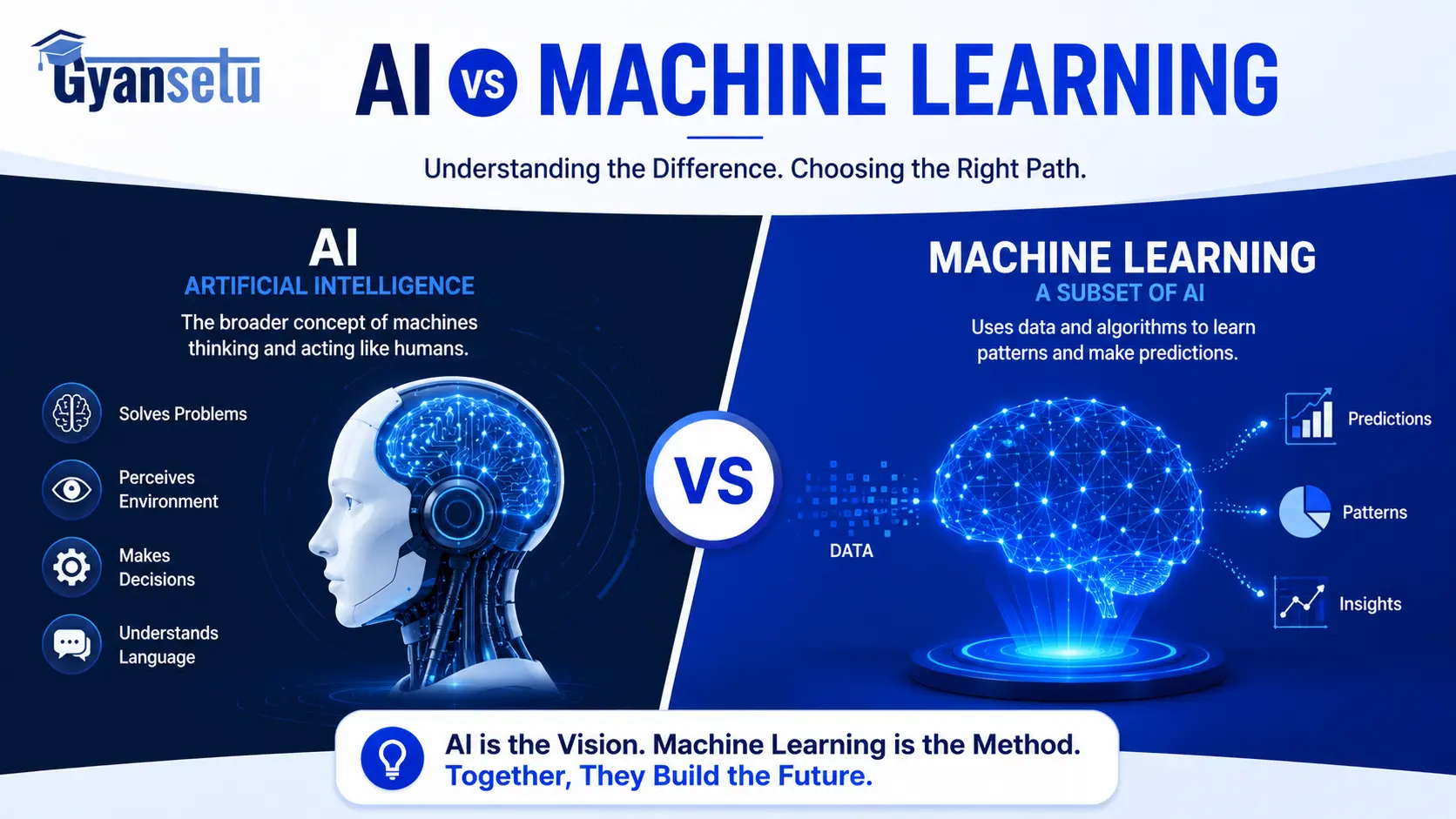
People who have tried out ChatGPT, debated self-driving cars, or attended corporate AI-strategy brainstorming sessions are unlikely to provide a clear answer to one question: is artificial intelligence synonymous with machine learning? No, they are not — but the reason why they’re different is more interesting than any definition will tell you.
The main premise of the current article goes as follows: the differences between AI and ML are increasingly becoming invisible to end users while simultaneously growing more significant to software engineers who design and implement these technologies. This context is essential for everyone: curious beginners, potential career changers, or corporate employees with an “AI roadmap” suddenly in front of them.
What Will I Learn?
AI is the goal, ML is one way to get there
Think of it in this way. Medicine is a domain. Surgery is an approach within this domain. Every illness does not require surgical intervention, and surgery cannot be performed without medicine. This is more or less how AI and ML are related to each other.
AI is the ultimate goal: create machines that can perform actions like humans, such as thinking, pattern recognition, decision-making, language processing, etc. Machine learning is one way of doing so. It’s an extremely powerful way, one of the most prevalent techniques used today, but it’s only one method among many others.
Machine learning was introduced in 1959 by Arthur Samuel, who developed a checkers game that learned from its previous games. It has been around for almost 70 years now. But the notion has existed for much longer; what has changed is the amount of data and computational power needed to carry out this process.
One of the simplest facts to remember is that all machine learning is AI, but not all AI is machine learning.

Machine Learning Course
Average time: 5 month(s)
Skills you’ll build: Python, Scikit-learn, Supervised & Unsupervised Learning, Feature Engineering, Model Deployment, and more..
What AI actually means
Artificial intelligence is anything built to emulate human mental abilities. A broad definition on purpose; AI is a broad field.
Narrow (Weak), General, and Superintelligent AI represent the usual tripartite description of the field. Narrow AI performs only one task at a time, e.g., facial recognition, translation, gaming, etc. This is all there is now, all your current apps. General AI is the same as humans in their capacity for reason and problem-solving. Superintelligent AI exceeds human intelligence in any way. All three but the first fall into the sphere of speculation only at present.
It is nearly impossible to find something other than Narrow AI under the name “AI” in 2026. Remember this when someone refers to some product as “smart”.
What machine learning actually means
Machine learning is when a system learns to recognize patterns in data rather than following hand-coded rules. Learn is the important word: the system improves with experience, not necessarily coding.
Here’s a real-world example. Take two spam filters. In the first one, the program uses a hard-coded list: if an e-mail contains “Nigerian prince” or “click here to claim,” then it is spam. The list was coded by a human. This doesn’t change until a human changes it. This is rule-based AI. Now take another spam filter, this time analyzing millions of e-mails, learning to recognize patterns in spam e-mails, constantly improving as spammers come up with new tricks. It was not programmed with rules; it learned them. That’s machine learning.
Both systems are artificial intelligence. Only one is machine learning.
The three-level hierarchy most people miss
Here’s something no one tells you clearly enough. There isn’t just a two-level structure (AI contains ML). There’s a third level sitting inside ML that explains most of what’s happening in modern AI.
AI → Machine Learning → Deep Learning
Deep learning is a form of machine learning, which relies on neural networks that contain many layers, where “deep” is an indication of the number of layers rather than any kind of philosophical profundity. The concept of neural networks is one that draws inspiration from the brain, which involves nodes being interconnected through signal passing. Deep learning explains why image recognition suddenly became incredibly advanced starting in 2012. It explains why speech-to-text has become functional.
As the godfather of deep learning, Geoffrey Hinton worked on neural networks for decades before the technology became popular.
So what happens when someone says that “the AI recognized my face”? The entire stack is:
- AI (the purpose: determine the identity of the person)
- Machine Learning (the process: trained on millions of faces)
- Deep Learning (the algorithm: convolutional neural network)
- CNN layer (the implementation: spatial pattern recognition)
In other words, this is how Apple’s Face ID works. Four layers. One buzzword: “AI”.
Why is this important? Because next time someone tells you “we use AI,” you can immediately start asking questions. What type of AI do you have? Rule-based? Machine learning? Deep learning? They are not interchangeable choices.

How they’re different — side by side
Let me be direct here: the comparison tables in most articles on this topic aren’t wrong, they’re just incomplete. Here’s the full picture.
| Dimension | Artificial Intelligence | Machine Learning |
| Scope | Entire field | Subset of AI |
| Goal | Intelligent behavior across tasks | Pattern recognition from data |
| Data dependency | Varies — some AI needs no training data | Highly dependent on quality and quantity |
| Methods | Rule-based, ML, search, logic, robotics | Statistical models, neural nets, algorithms |
| Flexibility | Can use multiple approaches | Data-driven only |
| Output | Decisions, actions, language, plans | Predictions, classifications, probabilities |
| Real example | Google Assistant, IBM Watson | Netflix recommendations, Gmail spam filter |
That “data dependency” row is the one that trips people up most. Machine learning requires data — lots of it, reasonably clean. If you’re building an ML fraud detection model, you need historical transaction records. If you have none, ML isn’t your first move. A rule-based AI system, by contrast, can run from day one on a set of hand-crafted conditions.
This isn’t a minor technical footnote. It changes how you scope a project.
The key distinction that gets glossed over
One important aspect that is usually ignored is that AI existed prior to machine learning becoming prevalent.
In the 1970s, scientists designed “expert systems,” AI-based software systems that were based on tens of thousands of human-coded rules. One such system, named MYCIN, created at Stanford University, could diagnose bacterial infections and prescribe antibiotics through roughly 600 human-coded rules. Without any learning involved – no training data, no neural network algorithms – only human knowledge encoded into logic.
By the mid-1970s, MYCIN was purportedly better at prescribing antibiotics accurately than junior physicians. However, it must be emphasized that it was definitely AI, but not ML.
The problem with expert systems was scaling the number of rules that had to be maintained manually, which was solved by ML through the creation of self-writing rules for systems.
Real examples of how AI and ML work together in 2026
Abstract comparisons only go so far. Let’s look at two real systems.
How a recommendation engine actually works
In deciding what should appear on your Netflix screen, there’s an overall objective of the AI involved: to make sure you keep watching. This happens with the help of machine learning, particularly through collaborative filtering (users whose viewing histories are similar are used as a basis for preferences) and content-based filtering (metadata comparisons between content items).
It is you who interacts with the AI. It is not the machine learning that you see.
Is ChatGPT AI or machine learning?
Both, and understanding how clarifies a lot. ChatGPT is an AI product, which means that it’s a tool that is capable of answering queries, coding programs, and writing letters. However, the technology that makes up ChatGPT is machine learning, specifically deep learning based on transformers. OpenAI trained huge neural networks on huge amounts of text data and employed RLHF to make its output helpful for people.
One is a product, the other is a technique used to create the former. They aren’t interchangeable; they just happen to be two different aspects of the same concept.
It may sound counterintuitive, but most people who employ these technologies don’t really need to understand this difference. But any person who creates such products definitely does.
When AI doesn’t use ML — and why that matters
Right. But if machine learning is so prevalent, what’s the point in learning something that has no relevance?
This is because sometimes machine learning is the wrong tool, and using it amounts to a waste of time and effort.
For example, the scenario where a bank needs to detect any transaction amounting to over $10,000 made in a previously unseen nation within 24 hours of opening a new account. It is clear that in such scenarios, there’s no room for machine learning since the algorithmic rule itself is clearly defined. Using a rule-based system makes more sense than machine learning as it will make the process transparent, avoid confusion, and eliminate the need for labeling.
There are plenty of rule-based systems in the corporate sector, too, especially in compliance and regulatory sectors like the banking sector and so on. Decision trees, search algorithms, and so forth belong to this set of applications that use AI without ML.
That’s the question worth asking before embarking on an AI journey. Does the problem at hand require learning from data or executing rules? If it’s the latter, ML is probably overkill.
What this means if you’re learning or hiring
I think this is the section most articles get wrong by omission — they write entirely for organizations and ignore the individual entirely. So let’s fix that.
If you’re learning
It influences the type of skills required. Would you like to create AI products from scratch—train models, optimize hyperparameters, manipulate data sets? Then you need machine learning: probability, statistics, linear algebra, Python, and knowledge of frameworks like PyTorch or TensorFlow.
Would you rather be in charge of integrating AI into business processes or creating products based on pre-trained models through APIs, or would you want to work in AI product management, or even use tools like ChatGPT and GitHub Copilot for professional tasks? Then you might need zero knowledge of machine learning.
Neither choice is inherently better than the other. It is simply a matter of personal preference. However, confusing “learning AI” with “learning machine learning” causes many people to focus their studies on the wrong subject.
If you’re hiring
The terms “AI engineer” and “ML engineer” denote different job roles that entail entirely different skill sets. The ML engineer who excels at building models does not have any expertise in designing AI-based products for end-users. In the case of an AI product manager, they should have sufficient knowledge to ask appropriate questions to ML engineers.
Consider these as separate categories of jobs while crafting the job description.

Artificial Intelligence (AI) Course
Average time: 4 month(s)
Skills you’ll build: Python for AI, Machine Learning, Neural Networks, NLP Basics, AI Tools (ChatGPT, Copilot)
Frequently asked questions
Q1. Is ChatGPT an artificial intelligence or machine learning?
Ans. Both. ChatGPT is an AI product because it acts as a conversational AI assistant. But it was developed through the machine learning approach. In fact, ChatGPT employs the transformer-based approach in deep learning that involves the analysis of vast volumes of text. While ChatGPT is an AI product, the machine learning process was used to develop it. These aren’t mutually exclusive — they describe different levels of the same system.
Q2. How does AI differ from ML and DL?
Ans. There are three nested processes here. AI is the umbrella term for any technology that mimics human intelligence. However, ML is one type of AI technique that helps train machines. DL is a specific type of machine learning that uses multi-layered neural networks. Thus, all types of deep learning belong to ML, while ML belongs to AI. Not all types of AI can be called ML.
Q3. Can you have artificial intelligence without machine learning?
Ans. Absolutely. Expert rule-based systems, decision trees, search algorithms, and symbolic artificial intelligence are some examples of artificial intelligence systems that do not require any form of training datasets or machine learning. The medical diagnosis system, MYCIN, developed at Stanford in the 1970s, is one example of such a system. Many of the current applications of artificial intelligence for compliance and legal purposes operate under this concept.
Q4. Which is harder to learn – AI or Machine Learning?
Ans. It all depends on where you are coming from. Machine learning as an academic discipline involves mathematics and statistics and is thus more challenging. Artificial intelligence as a professional discipline is much broader, with job profiles like an AI product manager or an AI ethicist requiring no knowledge of machine learning at all.
Q5. Is deep learning the same as machine learning?
Ans. Not at all. Deep learning is just a form of machine learning. In particular, it involves algorithms based on artificial neural networks. Everything that falls under the term “deep learning” is machine learning. But there are many machine learning algorithms, such as linear regression, decision tree, k-means, etc., that have nothing to do with deep learning.
Q6. Are AI and machine learning the same thing?
Ans. No, but this confusion is inevitable since the two are often used together, even in the same sentence. Machine learning is one of the algorithms that enable the development of many AI applications. However, the two should not be used interchangeably. Calling something “AI” instead of machine learning is comparable to calling medicine surgery.
Conclusion
The distinction between AI and ML is bifurcating into two sides. For end-users, it’s almost invisible. ChatGPT doesn’t specify whether it uses a transformer architecture for its deep learning neural network. Your email spam filter doesn’t say which method it uses to train the algorithm. The abstracting effect is deliberate and, in fact, very practical. You can operate your car without knowing its mechanics.
However, for developers, this distinction becomes more critical. As AI systems become more accessible through API integration, the selection issue becomes more pressing. Rules-based approach or machine learning? Machine learning model or large language model? Fine-tuning or prompt? These differences entail real expenses and implications for efficiency and explainability, and making the right decision demands understanding these concepts beyond textbook knowledge.
The individuals who comprehend the distinction will not only be more knowledgeable during meetings but will also make better decisions when it counts.
Are you ready to explore further? Discover the actual workings of machine learning and how you can construct an ML system from scratch.


