


No one sets out to build a project and then selects a technique. Instead, you start out with a problem, a budget, a time constraint, and a dataset, and then try to determine how to get there.
The debate between deep learning and machine learning is typically framed as a discussion of raw capabilities. That’s not how it works. It’s a tool-selection problem.
Almost all articles on this subject are completely, totally, and utterly wrong, as they assume that deep learning is necessarily better than machine learning, and that’s simply not true. The correct answer, however, is that it depends entirely on what you’re working with.
This article will provide you with both, so that you can understand the definitions and then use a four-step approach to go from a vague question to a very specific answer.
What Will I Learn?
Deep Learning vs Machine Learning
Machine learning (ML) is the process of training computers to learn patterns in data and make predictions based on those patterns. Deep learning (DL) is a type of machine learning that uses artificial neural networks stacked together to learn patterns directly from the data. All deep learning is machine learning, but the reverse is not true.

Machine Learning Course
Average time: 5 month(s)
Skills you’ll build: Python, Scikit-learn, Supervised & Unsupervised Learning, Feature Engineering, Model Deployment, and more..
The key difference between the two is described in the following six dimensions:

| Dimension | Machine Learning | Deep Learning |
| Data size | Small to medium (hundreds–thousands of examples) | Large (tens of thousands to millions) |
| Feature engineering | Manual — you define the inputs | Automatic — the model finds them |
| Hardware | Standard CPU | Typically needs a GPU or TPU |
| Interpretability | Relatively transparent | Often a “black box” |
| Training time | Fast | Slow and compute-heavy |
| Best for | Structured, tabular data | Images, audio, raw text, video |
The difference is real, but which one you need depends on your data — not on which sounds more impressive.
What Is Machine Learning, Really?
At its core, Machine Learning (ML) is the art of teaching computers to recognize patterns without being explicitly programmed for every possible scenario. Instead of a developer writing millions of “if-then” statements, they provide an algorithm with a vast dataset and a goal.
How a Machine Actually “Learns”
You could think of it like this: a loan officer discovers after working for many years that people whose income is not stable and who have a high debt level are risks. An ML model discovers this after working on 200,000 previous loans. It analyzes them, refines its guesses, and gets better at making predictions.
The same conclusion, a different route.
So, this is what supervised machine learning is in a nutshell: you give examples to a machine and it learns to generalize on its own. No programming of any kind is required. The other two types of machine learning are unsupervised learning, which is finding patterns in data without a right answer, and reinforcement learning, which is interacting with an environment.
Well, kind of. You give the machine data and answers to those data points. The machine learns a model and uses it on data it has never seen before.
Where ML Genuinely Excels
Credit scoring. Churn prediction. Product recommendations. Fraud detection. Search ranking.
These are all problems involving structured data: tables, rows, columns, numbers. In these problems, scikit – learn and XGBoost have been shown to perform on a level comparable to deep learning techniques, or sometimes superior, at a small fraction of the cost of deep learning solutions.
One texture detail of interest: XGBoost was first publicly presented in 2016. It was created by Tianqi Chen as a side project during his PhD at the University of Washington. Now, it is used in production by dozens of large financial institutions and retailers – not because it is the newest solution, but because it works very well on structured data, which these industries have in spades.
ML is not a simplified version of DL. ML is simply the right tool for a large class of real-world problems where DL would simply be a waste of resources.
What Is Deep Learning, Really?
If Machine Learning is about teaching a computer to follow a map, Deep Learning (DL) is about teaching it to see the world. It is a specialized subset of machine learning inspired by the structure of the human brain—specifically, layers of artificial neurons that process information in increasingly complex stages.
Why Neural Networks Changed Everything
In 2012, a convolutional neural network named AlexNet was entered into the ImageNet Large Scale Visual Recognition Challenge. The best non-deep-learning system that year had an error rate of 26%. AlexNet’s error rate was 15.3%.
The field basically stopped what it was doing.
This was the result of decades of work by Geoffrey Hinton, Yann LeCun, and Yoshua Bengio, researchers who continued to improve neural networks through the 1980s and 1990s when the rest of the field had moved on to other things. They were awarded a Turing Award in 2018. Hinton, had apparently continued to believe that deep neural nets would work, even when the rest of the field had written them off as a dead end.
A neural network is a series of mathematical transformations. Data goes in at one end, and each node in a series of layers adapts based on how wrong the final output was. Repeat that, and patterns emerge that no human programmer would have thought to look for. That’s how they work; honestly, they’re not that complicated.
The Main Architectures and What They Do
Not all deep learning is the same. The honest truth about the four that do most of the work is:
1. Convolutional Neural Networks (CNNs) work on images. ResNet is an algorithm from Microsoft Research that has been used in some medical imaging situations where it meets some level of specialist accuracy.
2. Recurrent Neural Networks and LSTMs work on sequential data. Before the advent of the transformers, these were the workhorses behind most of the work in speech recognition and machine translation.
3. Transformers are the new normal for natural language processing. BERT is the Google algorithm, the GPT series from OpenAI are both transformer-based. All those chatbots, code auto-completers, and document summarizers use some variant of these.
4. Generative Adversarial Networks (GANs) use two networks competing against each other. One generates the fake data, the other detects it. They are used for image creation and data augmentation.
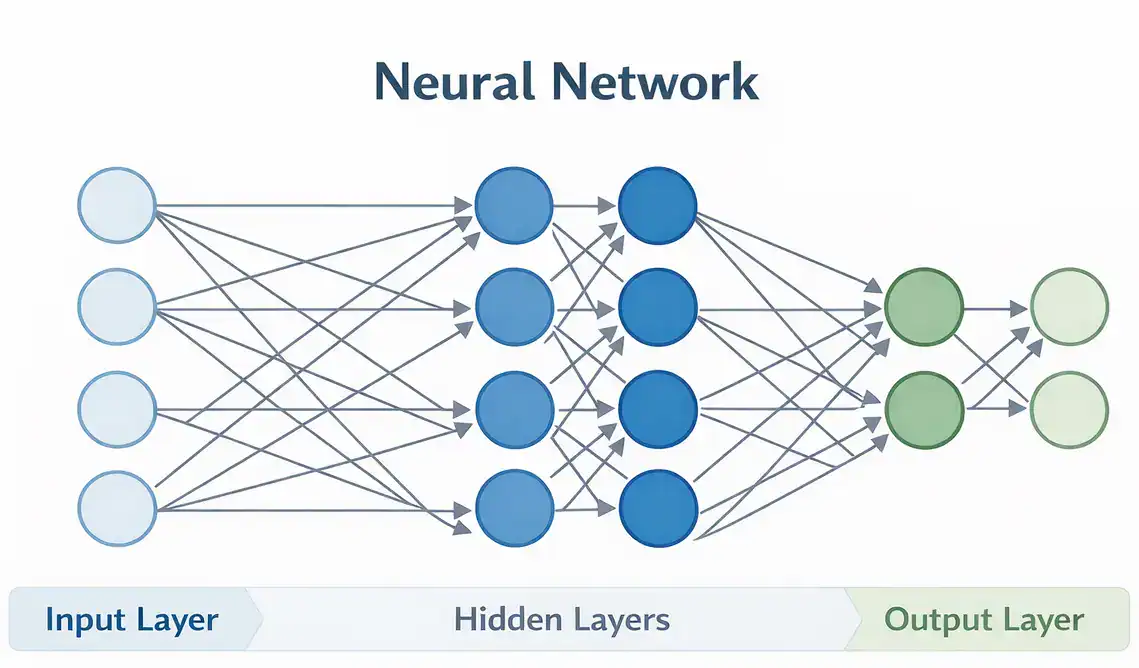
The power of deep learning comes from letting the network discover the key features. That is also the hardest part to understand.
8 Key Differences Between Machine Learning and Deep Learning

A few of these merit more than one row in the table.
Interpretability is the one that bites people in a regulated world. A decision tree can be given to a compliance officer to read line by line. A neural network with hundreds of millions of parameters can’t be explained in this way. It can’t be explained at all. The math is not human readable. It’s not interpretable.
Failure modes differ in important ways. An ML model with bad features fails in a way that you can understand. An DL model fails in a way that is genuinely opaque, picking up on a spurious pattern in the training data with no easy audit trail to follow.
The cost is very real. It’s something that is frequently underestimated. The cost to train a mid-size deep learning model on cloud GPU infrastructure can cost hundreds to thousands of dollars.
An ML model running on a standard CPU server costs a fraction of this cost. It costs less than one dollar for the entire training process.
All the differences in this table come back to one fundamental reason. DL models find their own features. ML models require you to provide them.
When Machine Learning Is the Right Choice
The Case For ML That Nobody Makes
The truth is, most projects think they need deep learning, but they really don’t. The argument for using deep learning is attractive, and the benchmark articles are always written about neural networks.
Now, let’s talk about when ML shines:
- You have a spreadsheet full of data, rows, columns, features
- You have less than 50,000 labeled examples
- You have to explain individual predictions to a manager, a regulator, or a lawyer
- You have a deadline measured in weeks, not months
- You’re dealing with machines without GPU support
For example, a mid-sized European bank wants to build a transaction monitoring system, and they have 80,000 labeled examples, a team of compliance officers who must approve every decision, and a two-month deadline. Deep learning is a terrible choice for this project in every dimension: they’re not dealing with a huge number of examples, they have to explain their predictions, they’re on a short deadline, and they’re not using GPU support. A well-tuned gradient boosting tree model with XGBoost will get this project done, a deep network will not.
Signs That Deep Learning Is Overkill for Your Project
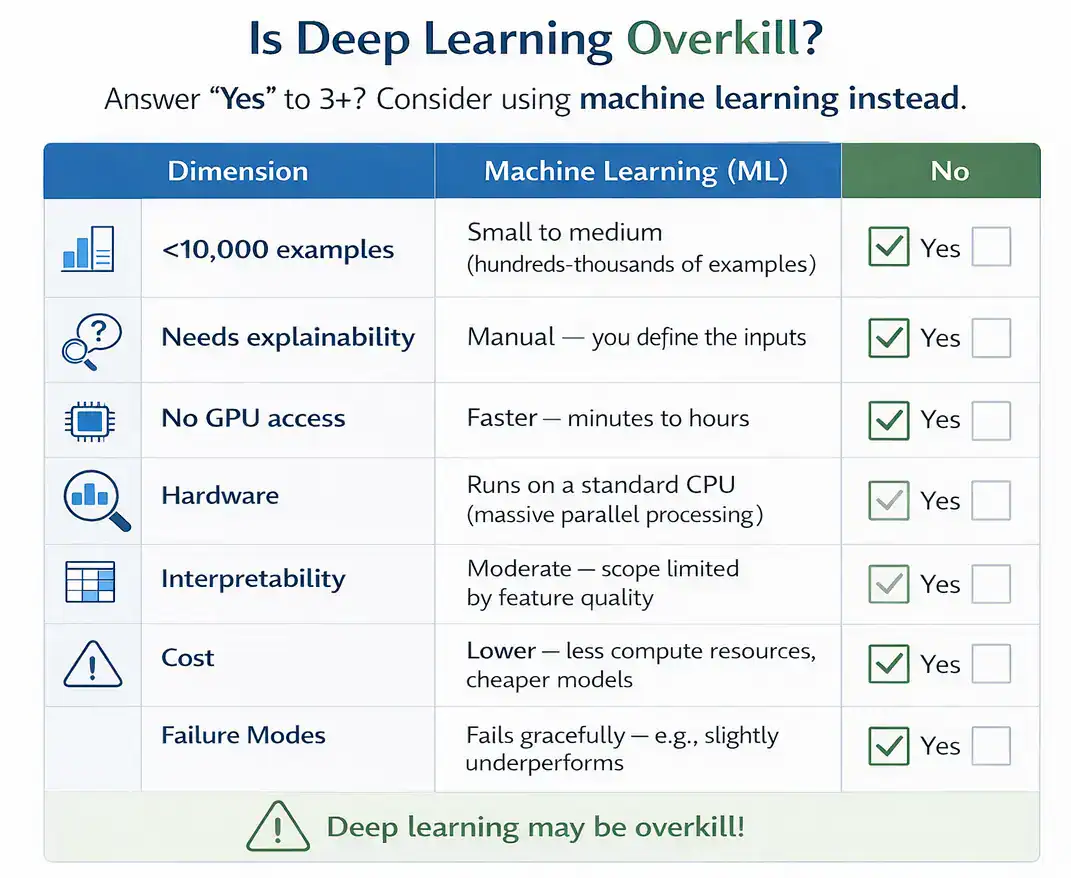
- Less than 10,000 examples in your dataset, labeled
- Someone non-technical must understand individual predictions
- You have no access to GPUs, either locally or in the cloud
- Delivery time is less than six weeks
- Data is structured and tabular
Three or more of these checked? Use ML.
Using DL when ML will do is not ambition. It is a waste.
When Deep Learning Is the Right Choice
Raw images. Raw audio. Unstructured text at scale. Video.
These are the areas where ML techniques plateau, and DL techniques take over. Again, this is because of the feature richness. It is extremely difficult to train an ML model to locate a tumor in an X-ray image using features such as “edge density in region X” and “pixel contrast ratio Y.” There are many relevant features, and the interactions between them are complex and not easily definable. A deep CNN will learn the relevant features automatically.
In reality, of course, the key words are “unstructured data at scale.” Google DeepMind’s work on medical imagery has demonstrated that a DL system performs at or even better than a specialist for a particular problem. OpenAI’s Whisper system is able to handle speech-to-text for dozens of languages with an accuracy rate that previous sequence model technology could only dream of. Hugging Face has made it as simple as a few lines of Python code to access a set of pre-trained transformer-based models.
If you have millions of images to classify, a labeled dataset of genuine scale, or a stream of
real-time audio to process – and the compute budget to do so – DL is not a luxury. It is a requirement.
The Decision Framework: Which One Should You Actually Use?
Most comparisons of ML and DL are meaningless because they simply state what the difference is without offering a way forward towards a solution for your particular problem. Four questions cure what ails most of these comparisons.
Step 1 — What Does Your Data Actually Look Like?
If your data is structured and tabular in nature — customers, financial transactions, sensor data, survey results — then you should start with ML. It was made for this data and works great on it.
If your data is images, audio recordings, raw text documents, or video — then you should start with DL. This data is all about discovering structure in data in a way that humans can’t really define in advance – exactly what a neural network is designed to do automatically.
Step 2 – How Much Labeled Data Do You Have?
Less than 10,000 examples – ML is the better bet. While DL is possible if you use transfer learning (start from a pre-trained model (there are thousands of them on Hugging Face) and fine-tune on your dataset), the results are unpredictable and generally less good than ML.
10,000 to 100,000 examples – it depends on the task. Again, ML is probably a better bet. Use DL if you hit an accuracy plateau that cannot be broken by any other method.
More than 100,000 examples of complex unstructured data – DL is the obvious choice.
Step 3 – What Are Your Hardware and Budgetary Constraints?
You can train an ML model on a laptop. Seriously. A good scikit-learn model will train in seconds to minutes on a standard CPU. This is the kind of thing you can do during your lunch break.
You need a GPU to train a DL model. A cloud A100 GPU costs about $2-4 per hour. A 20-hour training session is not cheap. And if cloud GPU access is not in your budget and you don’t have any special hardware lying around, ML is your only hope… and that is not a good thing.
Step 4 — Do You Need to Explain the Decision?
It is the question that none of these approaches answer well. It is also the most important of the four questions.
If you’re ever going to be asked by a regulator, customer, or even the courts, “Why did your system arrive at that decision?” then you want to make sure you’re building a system that can answer that question well. Decision trees and linear methods can. Deep learning cannot. And not in a way that an intelligent layperson can verify.
In the EU, the AI Act places direct requirements on high-risk systems that make decisions for people. If your application is in one of the regulated categories, then interpretability is not optional.
Wrong.
It is a legal requirement.
Four questions, one answer: Most projects that think they need deep learning really don’t.

[INTERNAL LINK: ML model interpretability and explainability explained]
Tools and Frameworks in 2026: What You’ll Actually Use
<A> For Machine Learning: scikit-learn, XGBoost, AutoML
1. Scikit The standard ML library for Python is scikit-learn, which has everything from logistic regression to support vector machines to clustering, with a standard interface and good documentation. If you want to do ML, this is where you want to start – nowhere else.
2. XGBoost (and its cousin LightGBM) is how you will win any competition on a tabular dataset. There are many simple decision trees stacked on top of one another, with each tree trying to correct the errors of the previous tree in a stack. The result is a model consisting of the output of all trees in the stack. It is fast and, on well-structured data, actually accurate.
3. AutoML is the future. Google’s Vertex AI AutoML and its open-source cousin, Auto-sklearn, are promising to revolutionize ML by eliminating the need for model selection and tuning. The line between “doing ML” and “doing AutoML” is no longer clear.
<B> For Deep Learning: PyTorch, TensorFlow, Hugging Face
1. PyTorch is now the dominant framework for deep learning research, and increasingly, for deep learning in production environments as well. Most new papers in deep learning release their code in PyTorch first. If you are starting from scratch in machine learning or deep learning, this is the framework with which you should start.
2. TensorFlow, and its higher-level cousin Keras, is still widely used in organizations where deep learning systems have been in production environments for a number of years.
3. Hugging Face has completely changed what it means to “do deep learning.” Rather than training a model from scratch, which takes enormous compute power and huge datasets, you simply download a pre-trained model, tune it on your dataset, and go.
The tool you choose determines what machine learning or deep learning looks like in practice more than any theory underlying it.
How This Comparison Has Shifted in 2026
But the ML vs DL distinction is getting increasingly messy. Which is actually useful to understand.
These foundation models, which include massive pre-trained models like the GPT family and multimodal models, don’t really fit into the old model. They were trained using deep learning techniques, but when you access them via an API, it looks increasingly like prompt engineering and less like model building. The distinction between using a model and building a model is no longer the same as it was even three years ago.
AutoML is similarly challenging the ML/DL distinction. AutoML tools for automating neural
Architecture search is making deep learning accessible to people who might previously have defaulted to ML approaches.
Of course. The small model movement is a genuine backlash against the idea that “bigger is better.” It is producing models that can run on devices, in browsers, and on phones. DL techniques that previously required access to a server can now run on hardware you carry in your pocket. Which is to say, the hardware requirement in Step 3 of the above decision framework is no longer the same.
In 2026, the gap between ML and DL is narrowing fast — but that makes the decision framework more important, not less.

Data Science Course
Program Highlights
✓ 6 Months Industry-Focused Program
✓ Live Classes by Industry Experts
✓ 15+ Real-World Projects
✓ Resume & Interview Preparation
✓ Placement Assistance
Skills You’ll Build
Python • SQL • Power BI • Statistics • Machine Learning • Generative AI
Frequently Asked Questions
Q1. Is deep learning always more accurate than machine learning?
Ans. No, although on complex unstructured data like images, audio, and raw text, with a large enough dataset, DL will generally come out on top. On structured data with a small dataset, gradient boosting will generally beat neural nets.
Q2. Is machine learning worth learning without deep learning first?
Ans. Yes, and I would argue most people in the field would say you absolutely should. Machine learning gives you a conceptual foundation on which deep learning will make sense, whereas attempting to go straight to neural nets without first learning ML will, in my opinion, make everything harder than it needs to be.
Q3. How much data do I need for deep learning?
Ans. A general rule of thumb: 10,000+ examples for fine-tuning a pre-trained model, 100,000+ examples for training from scratch. The barrier has been lowered by transfer learning through Hugging Face. Fine-tuning a pre-trained model on 2,000 task-specific examples can perform better than training from scratch on many text classification tasks. The amount of data varies depending on whether you are fine-tuning or training from scratch.
Q4. What is the difference between AI, ML, and DL?
Ans. Imagine three concentric circles. Artificial intelligence is the biggest. Any machine that does something that normally requires human intelligence. Machine learning is a subset of AI. It is a type of artificial intelligence that uses data to learn. Deep learning is a subset of ML. It is a type of machine learning that uses neural networks. All deep learning is machine learning. All machine learning is artificial intelligence. Neither of these last two is true.
Q5. Which is better compensated, a machine learning engineer or a deep learning engineer?
Ans. The pay difference is smaller than the hype. Both are in high demand. Jobs that specifically require expertise in DL are a bit better compensated overall – research institutes, large AI companies, and computer vision startups. But a good machine learning engineer is generally well compensated by a very wide range of employers. Learning machine learning first opens doors; specializing in deep learning makes them even wider.
What Comes Next
The comparison was never really the point. The question lurking behind “deep learning vs. machine learning” is always the same: Which approach is best suited to the problem in front of me, right now, with the data I actually have? In early 2026, foundation models and AutoML are redefining the question for large parts of the space simultaneously. The tools are more accessible than ever. The cost of compute is coming down. The divide is closing.
But the judgment calls on the type of system to build, on the data to use, for what purpose, under what constraints—this remains the domain of the person asking the question. And this skill, of course, remains impossible to automate.
Use the approach that works for your data. Start simple. Start simpler than you think you need to. Scale up when the ceiling feels too low. The biggest time wasters are those who decided to use deep learning before they knew what they were trying to accomplish.


