

MYCIN was better at diagnosing bacterial infections than most doctors. MYCIN was never used in a single hospital.
That is not a failure of technology, but a failure of trust, and it is the most important thing anyone can tell you before explaining what expert systems are.
They have been running inside hospitals, banks, and on factory floors for more than five
decades. They do not have product launches, nor do they trend on social media. However, with the tightening of regulations on AI and black-box models facing legal challenges, the architecture behind expert systems is worth understanding again.
In this guide, you will get a clear explanation of how expert systems work, an honest comparison with tools like ChatGPT, and a framework for when you should use one, and when you should not.
What Will I Learn?
What Is an Expert System?
An expert system is a computer program that uses knowledge and logical rules to solve a problem in a way a human expert would. It is different from a search engine or an LLM in that it does not simply retrieve information or generate new information; instead, it works through a problem step by step and shows you how it did it.
The first expert system was a program called MYCIN, built at Stanford University in the early
1970s. It was given information about a patient’s symptoms and test results, and it worked through a set of medical knowledge to come to a conclusion about what was wrong with the patient, then told you exactly what it did to come to that conclusion.
One sentence to anchor this: An expert system is a computer program that knows something, thinks about it, and tells you how it came to a conclusion about it.

Artificial Intelligence (AI) Course
Average time: 4 month(s)
Skills you’ll build: Python for AI, Machine Learning, Neural Networks, NLP Basics, AI Tools (ChatGPT, Copilot)
The Four Components of an Expert System
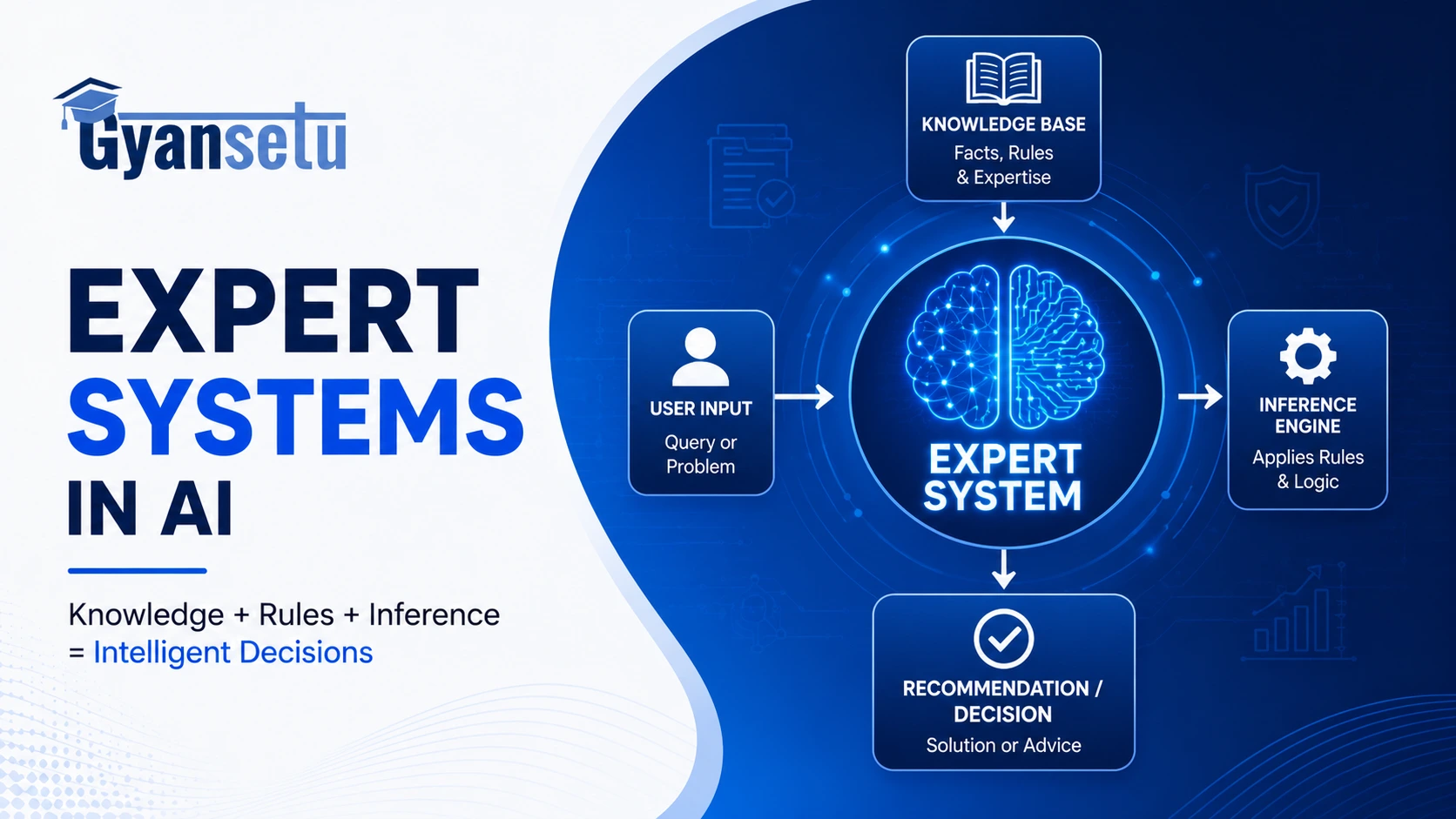
Every expert system has the same basic architecture. Four parts. Each does a specific job.

Knowledge Base
The knowledge base is where all the domain knowledge resides. It contains two types of knowledge: facts (such as “fever above 38° C means possible infection”) and rules (such as “IF fever AND cough THEN possible flu”). Together, facts and rules enable the system to reason about a problem without a human expert being physically present.
Creating a knowledge base is more difficult than it might seem. It requires a person to interview the expert, sit in on the expert at work, and attempt to distill years of experience into a form of IF-THEN statements. That person is a knowledge engineer, and knowledge engineering is hard work.
The programming languages originally used were LISP and Prolog. Both are still taught today; neither is particularly popular with modern programmers who learned to code with Python.
Inference Engine
The inference engine is the reasoning unit. It reads the facts, applies the rules, and works towards a conclusion. And it does this using one of two strategies.
1. Forward chaining starts with the facts and works towards the conclusion. You provide the facts, and it works its way through the rules to get the answer. Stock alert systems use this. If the stock goes down a certain percentage, and the volume goes up a certain percentage, then sell the stock.
2. Backward chaining works the opposite way. You start with the conclusion, and you ask, “What facts must be true for this to be correct?” Medical diagnosis works this way. You start with the hypothesis, “bacterial infection,” and then ask, “Are the facts true that the patient must have this?”

User Interface and Explanation Module
The majority of the articles discuss these as two separate parts. However, these are, in fact, two sides of the same coin. The concept of communication.
The user interface is where the user can put in their symptoms, data, or questions and get a recommendation. The explanation module is where the user is told why the system recommended something. This is the part to pay attention to.
This makes expert systems the original Explainable AI. Before the field of XAI as a science, before DARPA began to fund XAI-related projects, there were expert systems. In 2026, when the EU AI Act stipulates that high-risk AI systems must be able to explain their decisions, this is not a minor feature.
Five Types of Expert Systems
Not all expert systems are built the same way. The type you use depends almost entirely on the problem you are trying to solve.

1. Rule-Based systems employ IF-THEN logic. Simple and transparent; good for audit trails. Good for applications where a paper trail is required for every decision. Most early medical and legal systems were Rule-Based; they were designed to be this way.
2. Frame-Based systems employ knowledge structures called frames, similar to objects in programming. Each frame is a data structure for a concept and its attributes and values and relationships to other concepts. Good for applications where complex objects are involved.
3. Fuzzy Logic systems deal well with ambiguity and uncertainty. Classical Rule-Based logic is “black and white” – something is either true or false. In the real world, things aren’t always so clear-cut. “Temperature is slightly elevated” or “Risk is moderate” – these kinds of decisions are well suited to Fuzzy Logic systems; these systems are commonly used in industrial and medical applications.
4. Neural Network-Based Hybrid systems use a combination of rule-based reasoning and a neural network for pattern recognition. This is good when part of the problem is well-defined and part of the problem is not well-defined at all.
5. Neuro-Fuzzy systems are an extension of fuzzy logic and neural networks that learn their rules over time rather than having to be programmed by a person to know all of the rules to be used. These are used in an industrial setting when things change quickly and updating the rules would be difficult.
How an Expert System Actually Works — A Real Scenario
they present the parts, but not the entire system in operation.
Let’s work through an example.
A doctor enters the following information into a clinical decision support system: fever of 39.2°C, productive cough for six days, white blood cell count is elevated. This information is stored in the system as a fact in the working memory.
The inference engine is activated.
The inference engine looks through the knowledge base for rules that match the current facts. Rule R7 is triggered. This is the rule: “IF fever greater than 38.5 AND productive cough for more than five days THEN bacterial infection is suspected.” This new fact is added to the working memory. Rule R12 is triggered. This is the rule: “IF bacterial infection is suspected AND white blood cell count is elevated THEN antibiotic treatment is prioritized.”
Conclusion: bacterial infection likely. Recommend antibiotics.
The explanation module now presents a plain-language summary of the diagnosis: Diagnosis: bacterial infection — triggered by Rules R7 and R12, fever duration, cough type, and white blood cell count.
The doctor may agree with the diagnosis, overrule it, or ask the computer to explain its reasoning step by step. The entire process took only seconds.
Famous Expert Systems — What They Actually Did
MYCIN is always referred to in every article about this subject. Usually in one sentence.
That is not enough.
MYCIN (Stanford, early 1970s) was a system for diagnosing bacterial infections and suggesting antibiotic treatments. In a controlled evaluation of MYCIN’s antibiotic therapy advice in 1979, 65% of the ratings by independent judges found MYCIN’s advice acceptable, well above the ratings of all five faculty physicians who were tested, ranging from 42.5% to 62.5%. In a second evaluation of the selection of antimicrobials by MYCIN, the ratings were 90.9%. It was never actually deployed.
Not because it did not work. The major reason was technical integration. MYCIN was a standalone system that required manual data re-entry and was completely disconnected from hospital systems. There was also a liability issue and no FDA framework for software-based medical devices. Trust was one factor. Infrastructure was the major factor. Feigenbaum would later say of MYCIN, “It was a solution looking for an institutional home.”
DENDRAL, in fact, was the first. Stanford again, starting in 1964, and sponsored by Nobel laureate geneticist Joshua Lederberg, who wanted to develop a tool to interpret mass spectrometry results, and extended by Feigenbaum, Buchanan, and Carl Djerassi, a chemist. It analyzed the results of mass spectrometry to determine chemical compounds. This is a useful tool for working chemists. DENDRAL is regarded as the first successful expert system, and it is largely forgotten outside the world of academic history. Buchanan was said to be still working on the rules for DENDRAL in the form of handwritten note cards.
XCON, which is also known as R1, differed in one significant aspect: it had a business case. McDermott created it at Carnegie Mellon in the late 1970s for Digital Equipment Corporation. The system configured computer systems for customer orders. The task was time-consuming and error-prone, which was costing them money. By the mid-1980s, they were claiming a $25 million annual savings, which increased to $40 million when combined with another system, XSEL, which handled the customer-facing order configuration. Whether the figure was right or wrong, it made the business case for expert systems.
Expert Systems vs Modern AI
Most articles on this topic get this exactly wrong. They frame expert systems as a historical curiosity — a stepping stone to “real” AI. That framing misses what is actually happening right now.
A. Expert System vs Machine Learning
These are different problems, and it’s the wrong comparison altogether.
An expert system has its knowledge represented explicitly, so you can read all the rules. The machine learning model learns the patterns from the data, and the patterns are represented only in the weights, which you cannot read. One approach is transparent. The other approach works. In a heavily regulated world where every decision must have an audit trail, the expert system wins. In a world where the rules are unknown, but you have lots of data, the machine learning model wins, because the expert system will never get off the ground.

B. Expert System vs ChatGPT and LLMs
Is ChatGPT an expert system? No, it’s not, and it’s an important difference.
An expert system uses deterministic rules on facts to derive a conclusion, where the conclusion can be traced back. An LLM uses statistical likelihoods on its training data to derive its output. One method uses rule-based reasoning, the other pattern-based generation. The modes of failure are also opposite: an expert system fails in a predictable way, on some edge case it was not designed for. An LLM fails by making up something entirely, but with complete confidence.
Why Expert Systems Are Coming Back in 2026
Weirdly enough, both of these technologies are now used together.
The new architecture for regulated industries combines LLMs for natural language understanding and expert systems as guardrails. The LLM understands the meaning of what the user said; the expert system checks whether the proposed action violates any rules before the action is executed. Health tech startups and legal tech startups are currently building this stack in 2026.
I think the common thread in all of these is incorrect. The question is not whether expert systems can compete with LLMs. The question is whether your AI system is audit-able—and expert systems are the only tool I know of that guarantee this.
EU’s AI Act, which identifies certain AI applications in health, finance, and law enforcement as high-risk, mandates the need for documentation, traceability, and human oversight, with full compliance for high-risk AI systems mandated by August 2026. The European Commission, however, has failed to adhere to its own recommendations, and the Digital Omnibus, which is a proposed legislation, may delay the timeline even further. Expert systems offer exactly this architecture. Expert systems are not returning because they are superior to LLMs in every aspect. Expert systems are returning because they are auditable, and auditability is now the law.
When Should You Actually Use an Expert System?

Use one when the problem is well-defined and the rules are knowable. When every decision must be explainable and auditable. When training data is scarce or too specialized for a machine learning model to generalize from. When mistakes are costly—medical, legal, financial. When domain expertise exists and must be captured before the person who has it retires.
Don’t use one when the domain changes faster than you can maintain the rules. When you need to learn from large amounts of unstructured data. When you don’t have a knowledge engineer or domain expert who is committed to building the knowledge base correctly. When the problem domain is inherently probabilistic and rules-based systems can’t handle it well.
The hardest part to understand is the maintenance burden. The knowledge base is something you need to constantly update. The rules you know to be true in 2022 might not be true in 2026. Unless you can commit to updating the knowledge base, you will end up with a system that is giving bad recommendations or no recommendations at all.
Building an Expert System in 2026 — Tools and Frameworks
The way of development has changed much since the LISP-and-index-cards era.
The most popular ones have changed to one of the following three.
CLIPS – This is a rule-based system developed by NASA in the late 1980s and is still maintained. This is widely used in embedded systems and industries where stability is more important than newness.
Drools – This is an open-source rules engine from Red Hat. This is tightly integrated with the Java world. This is widely used in enterprise finance and insurance industries.
Python-based systems – Experta and PyKE are libraries for developing forward-chaining expert systems for Python developers. This is more easily integrated with existing ML pipelines compared to the other two options.
One method that is currently gaining popularity: using an LLM as a knowledge acquisition assistant. You give it some transcripts of expert interviews or technical documents, and it tries to come up with a list of candidate rules. Then, a knowledge engineer validates each one. This is faster than purely manual knowledge acquisition, but human judgment is still needed at every step. That cannot be replaced by automation.
The development cycle is more important than the tool you use. Make a little prototype, test it against some test data with known outcomes, refine the rules, and repeat. Expert systems that do not work usually do not work because people try to do everything before testing anything.
The most important tool you use is not as significant as how you use it. Make a little prototype, test it against some test data with known outcomes, refine the rules, and repeat. That cycle is more important than the tool you use.
The most important tool you use is not as significant as how you use it. Make a little prototype, test it against some test data
Real-World Applications of Expert Systems in 2026
“Branding has changed; you’ll hear ‘rule engine,’ ‘decision management system,’ or ‘clinical decision support’ ten times more than ‘expert system.’ However, the technology remains the same.”
- Healthcare: EMR systems have a rule engine that runs dozens of rules per patient encounter. These rules might include drug interactions, unstable vital signs, or sepsis criteria. Many of these rules fire before a doctor ever looks at the chart.
- Finance: Rule engines are used by financial institutions for real-time fraud detection. Speed of transactions, geographical location of transactions, and category mismatches are all rules that fire within milliseconds of a transaction occurring—before a human ever looks at the case.
- Legal tech: Contract analysis tools use a rule-based system to analyze contracts and look for unusual clauses, compliance issues, and missing clauses. These rules are defined by lawyers; the system then applies these rules to thousands of documents per day.
- Manufacturing: Predictive maintenance systems use sensor data and a rule-based system to represent known failure signatures of the equipment. For instance, a set of rules might be defined as: “If the vibration frequency is above a certain threshold, and the temperature is above a certain baseline, and machine hours are above a certain point, then perform maintenance.”
- Cybersecurity: Intrusion detection systems have always had a “rule-based heart.” Signature matching, behavioral rules, and anomaly detection thresholds have all been “expert systems” of one sort or another.

Machine Learning Course
Average time: 5 month(s)
Skills you’ll build: Python, Scikit-learn, Supervised & Unsupervised Learning, Feature Engineering, Model Deployment, and more..
Advantages and Honest Limitations
The advantages are real.
The consistency of the rules applied every time is a big advantage. The absence of fatigue or the influence of the previous case the expert system solved is another. The availability of the system is also an advantage. Knowledge preservation is also an advantage. When the expert in the field retires, the knowledge is not thrown out. This is not trivial in fields where expertise is in short supply. Explainability is also an advantage.
The disadvantages:
The knowledge acquisition bottleneck is brutal. Getting the domain knowledge out of the human expert’s head and into the rules is slow, expensive, and always incomplete. Sometimes the human expert cannot formalize the knowledge in his or her head. Sometimes the human simply knows things. This bottleneck is what ultimately slowed the development of the first wave of expert systems in the late 1980s. This is the main engineering challenge in the field today.
Brittleness is the second problem. Expert systems work within their knowledge domain. Outside of that domain, they work poorly or not at all. But they don’t warn you that they are failing outside of their domain! An LLM at least says “I’m not sure” when it doesn’t know the answer. An expert system just gives you an answer based on the most similar rule it has.
And maintaining an expert system is expensive. The rules need to be kept current. The domain knowledge needs to be kept current. That means a knowledge engineer needs to update and validate the knowledge base whenever anything in the domain changes.
Frequently Asked Questions About Expert Systems
Q1. Who created expert systems?
Ans. The father of expert systems is regarded as Edward Feigenbaum. He was the leader of the DENDRAL project at Stanford in the late 1960s. DENDRAL was the first successful expert system. He was also the leader of the MYCIN project. He was awarded the Turing Award in 1994.
Q2. Is ChatGPT an expert system?
Ans. No. ChatGPT uses statistical patterns in the data it was trained on to generate text. An expert system uses rules to derive a conclusion. The rules are explicitly defined by humans. The conclusion that an expert system derives is also explicitly defined by the rules. They have different architectures. They have different failure modes. They have different uses. They have different definitions of what it means to be “correct.”
Q3. Are expert systems still used in 2026?
Ans. Yes. They are used extensively. They are just called by different names. Rule engines are used to detect fraud in banks. They are used to provide clinical decision support systems. They are used to provide compliance systems.
Q4. Why wasn’t MYCIN ever used in hospitals?
Ans. Liability, not technology. MYCIN worked well in clinical trials, but no hospital or physician in the 1970s wanted to be liable for taking a recommendation from a computer and acting on it.
Q5. What is the difference between an expert system and a rule engine?
Ans. A rule engine is the “inference piece” of an expert system; i.e., the piece of the system that applies the rules to the facts. An expert system is the whole system, i.e., knowledge base, inference engine, user interface, and explanation component. A rule engine is part of an expert system but not the whole thing.
Q6. What tools are used to build expert systems these days?
Ans. CLIPS, Drools, and Python’s Experta library are the most popular tools as of 2026. The choice of tool depends on your existing tech stack more than anything else.
The Long Game
Expert systems never went anywhere. They were simply renamed and implemented while everyone else discussed whether neural nets would replace everything.
In 2026, the organizations getting AI regulation right aren’t deciding between expert systems and LLMs. They’re using both—on different parts of the same problem. The LLM is used for the words. The expert system is used for accountability.
The researchers who designed MYCIN in the 1970s knew something that regulators are only now beginning to understand: a system that can explain its decisions will always be more trusted than a system that can’t. We spent fifty years making the former faster. We are only now making the infrastructure to make sure we get the latter.
That’s everything… and expert systems were prepared for this fifty years ago.


