


The thing nobody tells you about artificial intelligence is that it has already failed twice.
It failed to meet its promise. Not failed to reach its full potential. Failed – Completely, Utterly, Funding cut off, Researchers let go. The first time was in 1973. The second time was in 1987. Both times, though, there were a handful of folks who kept going anyway. In underfunded labs. On projects most folks thought were ridiculous.
This is actually how artificial intelligence has come to be. Not from some smooth arc from a research paper in the 1950s to ChatGPT. But from a cycle. Breakthrough. Overconfidence. Failure. A handful of folks kept going anyway. Breakthrough. Understanding this cycle doesn’t just explain how we got where we are. It explains where we are in 2026. And where we might be going from there.
What Will I Learn?
What Is Artificial Intelligence?
Any computer system designed to perform tasks that normally require human intelligence, such as recognizing spoken words, translating languages, identifying objects in pictures, making recommendations, and generating text. The machine is not thinking in the way you’re thinking. It is looking for patterns in vast amounts of data and then using those patterns to create useful information.
These three words are often used synonymously, but they’re not the same.
AI is the overall category, anything that mimics intelligence. Machine learning is a category of AI, where the AI learns from the data it’s been presented with, instead of using pre-defined rules.
Deep learning is a category of machine learning, using neural networks, the underlying technology for all the major AI tools you use today, such as Siri, image generators, or language models like this one, ChatGPT.
Imagine three concentric circles, where AI contains machine learning, machine learning contains deep learning, and so on. The outermost ring is 70 years old, the innermost ring is only ten years old.

Artificial Intelligence (AI) Course
Average time: 4 month(s)
Skills you’ll build: Python for AI, Machine Learning, Neural Networks, NLP Basics, AI Tools (ChatGPT, Copilot)
Before the Computers — The Ancient Dream of Thinking Machines
AI didn’t begin with a computer. It began with a question humans have been asking for centuries: can we build something that thinks?
1726 — Jonathan Swift’s “Engine” — algorithmic text generation as satire
Swift, in his book “Gulliver’s Travels”, had described a machine that combined words on blocks to form new sentences. This was just a joke by Swift to mock the academics who thought knowledge could be mechanized. The machine was not real. However, the description of the machine is, in a way, a rough outline of the working of a language model. Just combine the language blocks and repeat.
Swift wrote it as a joke in 1726. We built it in 2022.
1914 — El Ajedrecista — the first chess-playing machine
Spanish engineer Leonardo Torres Quevedo invented a machine that was able to play a king and rook endgame against a human opponent. It was fully autonomous. No human intervention was necessary once the game had begun. It was not intelligent in any interesting way. It was a machine making decisions in a rule-governed domain. It was a real idea.
1921 — Karel Čapek coins “robot” — and the fear begins
The term “robota” means forced labor in Czech. Karel Capek used it to refer to artificial people who were made to work for humans in his play “R.U.R.” written in 1921. The term became a global phenomenon within a few years of its use. So did the anxiety that comes along with it. To be honest, the anxiety has never really gone away; it has just changed depending on what AI has to offer at a given time.
1939–1943 — The computers that made AI possible
The first electronic binary computer was designed by John Vincent Atanasoff in 1939. Four years later, Warren McCulloch and Walter Pitts published a paper that demonstrated the possibility of logical operations with simplified neurons. Neither of these inventions was an AI. Yet both of them were load-bearing walls for everything that followed.
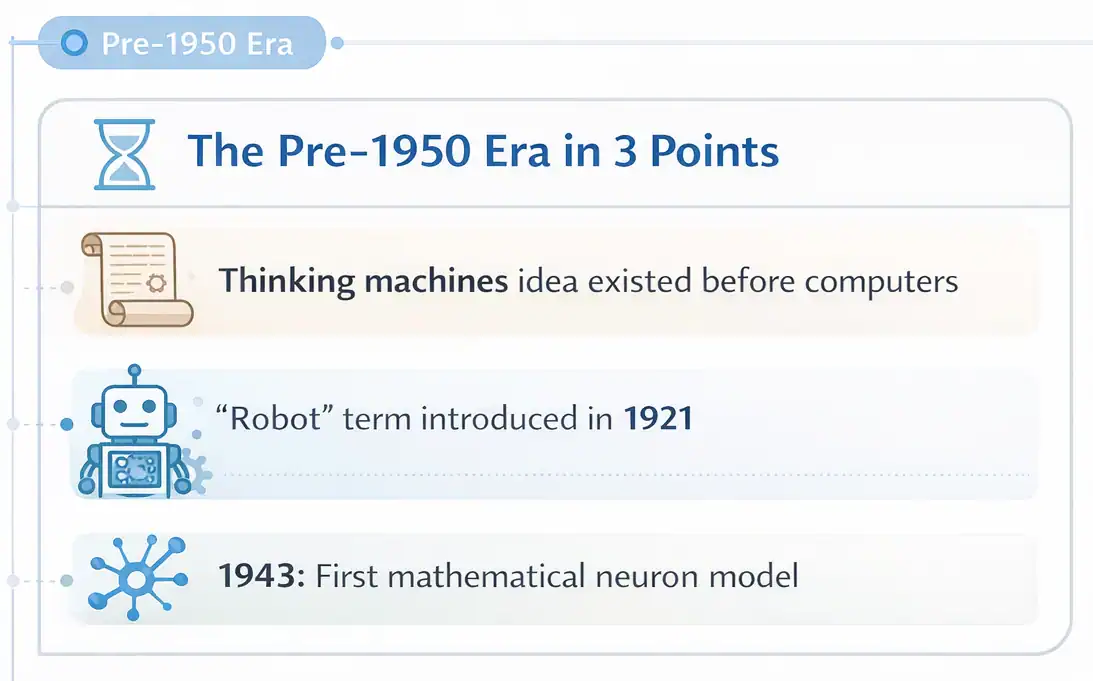
- The idea of thinking machines predates computers by centuries
- The word “robot” entered English from Czech in 1921
- By 1943, researchers had a mathematical model of how a neuron might work
1950–1956 — The Birth of AI (And the Question That Started It All)
Before 1950, no one had formally asked whether machines could think. After 1950, you couldn’t have an AI conversation without answering it.
1950 — Alan Turing asks “Can machines think?”
In his paper “Computing Machinery and Intelligence,” Turing never addressed the question he posed in the title. He merely replaced the question with a new and better one: “Can a machine be made to mimic a man’s thinking?” This new question is now called the Turing Test and is still discussed and argued today.
Turing wrote the paper when he was 37 years old. He died when he was 41. He never lived to see any of the things made possible by the question he posed.
1951–1952 — The first neural network and the first learning program
Mervyn Minsky and Dean Edmunds designed the SNARC in 1951. SNARC is the first artificial neural network. SNARC had 3,000 tubes and a motor from a B-24 bomber. The next year, Arthur Samuel developed a checkers game that improved its play without being told how to do so. This is called machine learning.
1955 — The Dartmouth Conference officially names a field
The idea of a summer workshop at Dartmouth College to discuss artificial intelligence on the basis of the conjecture “that every aspect of learning or any other feature of intelligence can in principle be so precisely described that a machine can be made to simulate it.” This was the first formal use of the phrase ‘artificial intelligence.’ The workshop took place in 1956. The achievement was small. The phrase had a permanent impact.
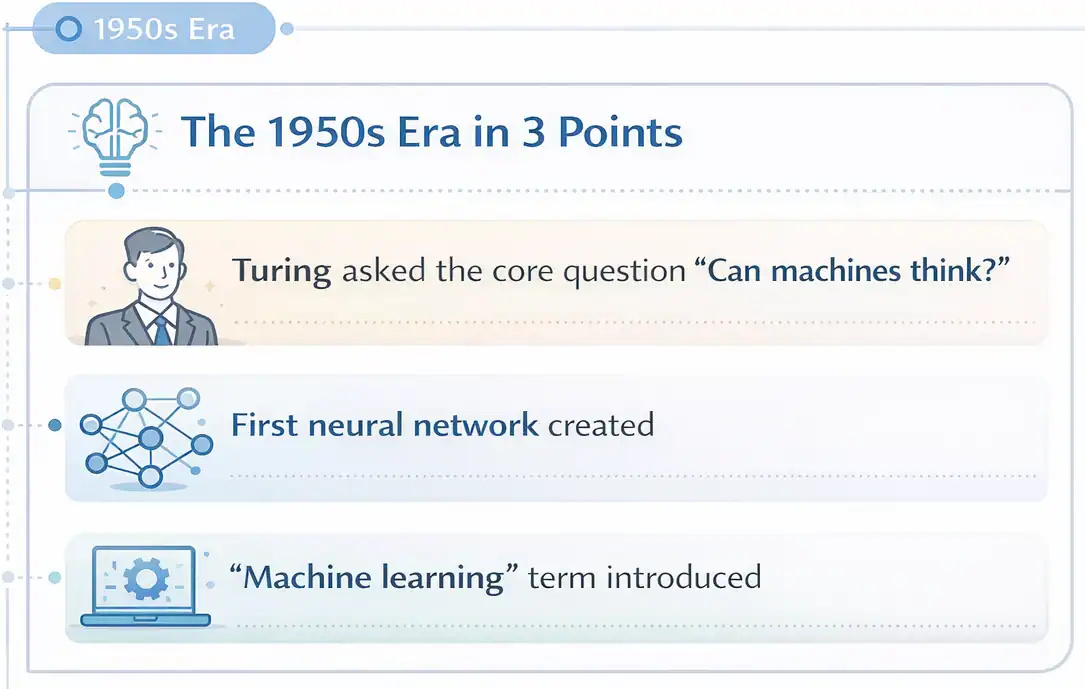
- Turing asked the question; McCarthy named the field
- The first neural network ran on vacuum tubes
- “Machine learning” was coined by a man writing a checkers program
1957–1979 — Early Breakthroughs, First Promises, and the First Crash
The 1960s were AI’s first golden age. Researchers produced results that were genuinely impressive — and then used those results to promise things they couldn’t deliver. The 1970s were reckoning.
1957–1966 — The tools, the chatbot, and the first reasoning robot
Frank Rosenblatt created the Perceptron in 1957, a machine capable of learning to classify input based on examples. John McCarthy created the LISP programming language in 1958, providing AI scientists their first computer language. In 1959, Arthur Samuel named the field “machine learning” in a paper he published.
In 1966, ELIZA was created. Joseph Weizenbaum designed it at MIT to mimic the behavior of a psychotherapist by parroting back the input it received, asking the user questions based on the input. Simple, it was. It only recognized input based on pattern recognition, but it had no understanding. Yet, people opened up to it. Weizenbaum’s own secretary asked him to leave the room so she could have a private conversation with it. He was so disturbed by this reaction to ELIZA that he went on to write a book about the futility of assigning emotions to machines.
In the 1960s, the first robot capable of reasoning about its actions, Shakey, was created at SRI. It was capable of navigating its room, planning its route, and moving a box from one side of the room to the other. Slowly, but on its own.
1965 — Expert systems go to work (and to medicine)
The first expert system, DENDRAL, was developed in 1965. This system attempted to emulate the reasoning of organic chemists in identifying the structure of molecules. In 1972, MYCIN was developed. This system attempted to emulate the reasoning of experts in the field of bacterial infections and antibiotics. MYCIN had about 500 production rules and was as competent as human experts in the field of blood infections and slightly more competent than general practitioners. However, neither of these systems saw widespread implementation. Yet both systems proved the point. Expertise could be encoded.
1969 — The book that nearly killed neural networks
Minsky and Papert published “Perceptrons” in 1969. They mathematically proved that certain problems couldn’t be solved by single-layer neural networks. The wrong conclusion was drawn that neural networks were not going anywhere. Funding was redirected to symbolic AI and expert systems. Neural network research was stalled for over a decade.
Essentially, the entire reason for studying this history is that the mistake, made by geniuses, almost killed the technology that now controls almost everything.
1973 — The Lighthill Report and the first AI winter
The British mathematician James Lighthill was asked to survey the state of AI for the Science Research Council. Lighthill concluded the field had not lived up to its promise. The UK government defunded the field. The US Congress began to doubt the promise of AI. Private investors began to lose interest. The first AI winter had begun.
Why do AI winters happen?
And here is the part of the explanation that every other article about the history of AI skips:
The pattern is always the same. Researchers have great success on small demos. They promise funders the demos represent a path to general intelligence. The funders extrapolate the promise of the demos to the future. “If it can do that, then in five years it should be able to do everything.” The hardware of the day is not able to deliver the promise. The results do not live up to the promise. Funding is withdrawn. Completely.
It happened in 1973. It would happen again.
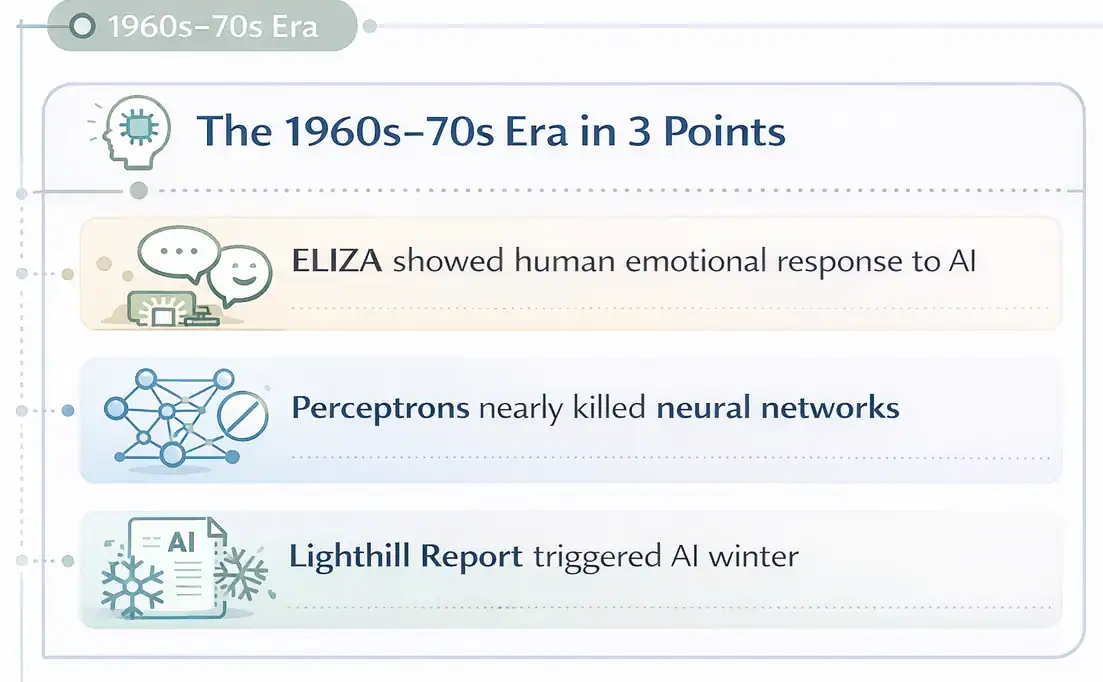
- ELIZA showed humans would anthropomorphize even a simple pattern-matcher
- Perceptrons (1969) nearly ended neural network research
- The Lighthill Report (1973) triggered the first AI winter — caused by overpromising, not by failure
1980–1993 — Boom, Hype, and the Second Crash
If this sounds familiar, it should.
1980–1984 — AI goes commercial and the world gets excited again
XCON was the first commercial expert system in 1980, automatically configuring computer orders and saving DEC $25 million annually. The Fifth Generation Computer Systems project was initiated in 1981 by the Japanese with $850 million to develop AI hardware and software that would out-think the West. The AAAI had its first conference at Stanford. Venture capital was available. The optimism was well-founded. Expert systems really did have practical value in their limited domain.
1984–1987 — The warning no one heeded
At the 1984 AAAI conference, Roger Schank and Marvin Minsky got up and explicitly warned of an impending AI winter. They named the phenomenon. They described precisely what was occurring.
Nobody listened.
Three years later, the LISP hardware market imploded as general-purpose computers could run the same software for much less money. Expert systems, expensive to build and maintain and only applicable within a narrow domain, began to fall out of favor among the corporations that had originally implemented them.
1986–1988 — The discoveries that would matter later
In 1986, Rumelhart, Hinton, and Williams came out with their seminal paper on backpropagation, proving that it was possible to learn complex functions with a multi-layer neural network if done correctly. Nobody in the business was aware of it. The Apple Knowledge Navigator video of 1987 depicted a vision of a voice-controlled AI system surfing a networked knowledge base. This was such an accurate vision of what AI could do that it appears to have been created as a 2023 promotional video. Judea Pearl introduced Bayesian Networks in 1988. Jabberwacky was launched in the same year with the goal of having a really entertaining conversation with humans.
1989 — LeCun teaches a computer to read handwriting
Yann LeCun used backpropagation in a convolutional neural network that was used to recognize handwritten zip codes for the US Postal Service. And it worked. The network took three days of computing power available at the time. It was one of the first practical applications of deep learning. And it was forgotten.
1987–1993 — The second AI winter
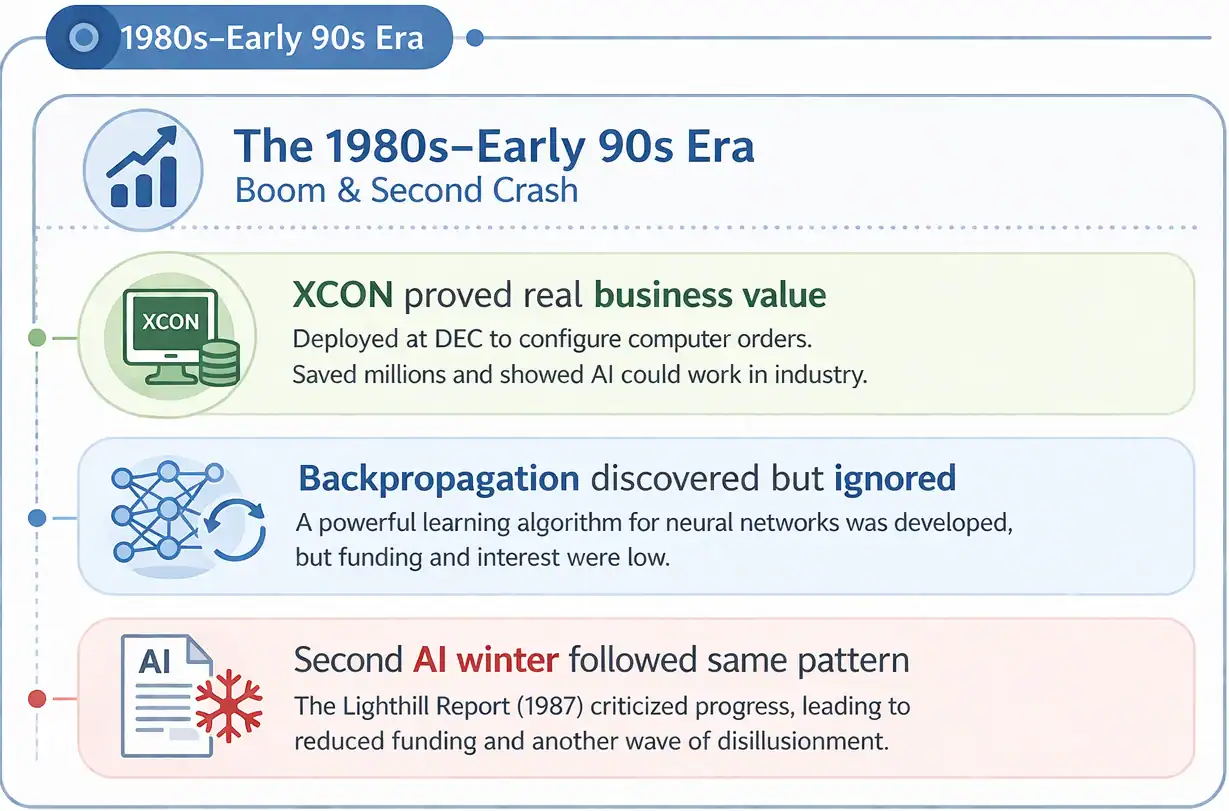
The LISP hardware market imploded in 1987. The Fifth Generation project in Japan was quietly shut down in 1992 without achieving its objectives. The same structural dynamic as 1973: overpromise → hardware ceiling → funding collapse. The second AI winter looked just as much like the first.
But something had changed. A handful of people, like Hinton and LeCun and Yoshua Bengio, continued to work on neural nets. Quietly. With little funding. Mostly out of stubbornness and the belief in the rightness of the work, even when nobody paid them to do it.
- XCON proved AI could save real money; the market built up around that proof
- Backpropagation (1986) was the theoretical unlock — industry ignored it
- The second winter followed the first winter’s pattern almost exactly
1993–2011 — The Quiet Revolution No One Noticed
The 1990s and 2000s are the most underrated era in AI history. Nothing dramatic happened publicly. Underneath, everything changed.
1997 — Deep Blue beats Kasparov — and the world notices
The IBM computer Deep Blue defeated the human world chess champion Garry Kasparov in a six-game match. This was the first time a computer had defeated a human world champion under normal tournament conditions. Deep Blue was not thinking; it was merely computing 200 million possibilities per second. But the perception of the event by the television-watching public was one of thinking. The event was certainly significant, even if the reality was not quite as dramatic as it seemed.
1997 — LSTM — the architecture that would eventually power everything
Sepp Hochreiter and Jürgen Schmidhuber invented Long Short-Term Memory networks, which solved the fundamental problem of earlier neural networks. The earlier ones did not have the ability to remember context over long sequences. This work was completely ignored for 15 years. Today, LSTMs power the voice recognition in your phone and the translation in your browser.
1998–2006 — LeCun, Bengio, and the researchers nobody was funding
LeCun and Bengio continued to improve convolutional neural networks in the late 1990s. In 2006, Hinton published “Learning Multiple Layers of Representation” – a paper that proved that deep neural networks could learn anything given sufficient data and computer power. Hinton, LeCun, and Bengio are now referred to as the “Godfathers of Deep Learning.” At the time of these events, they were operating in obscurity.
In my view, the conventional history of AI gets this period utterly wrong. We leap from “AI winter ends” to “Deep Learning explodes” without any reference to the period in the middle that linked the two events.
2000 — Kismet, the robot that learned to read a room
The MIT robot Kismet was able to identify human emotional expressions, make eye contact, and adjust its own expressions accordingly. It was not built to do a job but rather to interact, social robotics. Kismet was a sign of a fundamentally different sort of artificial intelligence from that represented by chess programs and expert systems: one related not only to humans but also in service to them.
2006–2009 — The hardware unlock that changed everything
In 2009, Rajat Raina, Anand Madhavan, and Andrew Ng came out with a paper that showed that it was possible to use GPUs, which were originally designed to play video games, to speed up the training of neural networks by 10 to 70 times compared to standard CPUs. This was what all the theory had been waiting for. Without GPU compute, AlexNet would never have been possible. Without AlexNet, none of what followed would have been possible. The irony of it all is that the technology that was used to bring us modern AI was originally designed to play video games by rendering explosions.
2007 — ImageNet — the dataset that built modern AI vision
In 2007, Li joined the computer science faculty at Princeton University. At Princeton, Li started working on ImageNet, working in collaboration with other computer scientists. In 2009, Li joined Stanford University as an assistant professor. The ImageNet project was further developed and published. It was the benchmark. Without ImageNet, there was no AlexNet. Without AlexNet, there would be no revolution in deep learning.
2011 — Watson and Siri arrive in the same year
IBM’s Watson computer won against Jeopardy! champions Ken Jennings and Brad Rutter in February 2011. Apple introduced Siri in October 2011 with the iPhone 4S. In a span of eight months, AI research progressed from a game show champion to a computer feature on all new iPhones. The era of AI has started; people simply have not realized it yet.
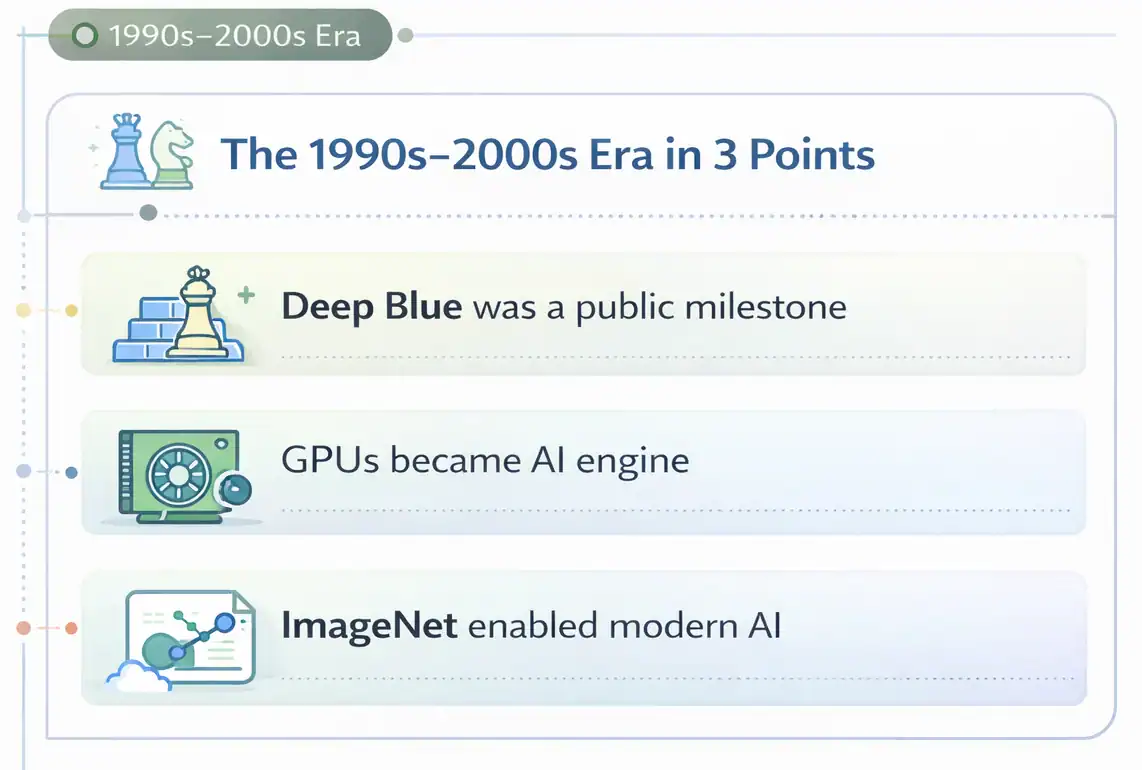
- Deep Blue (1997) was a cultural moment; the real action was in underfunded academic labs
- GPUs, designed for gaming, became the engine of modern AI in 2009
- ImageNet gave deep learning something to learn from
2012–2022 — The Deep Learning Decade That Changed Everything
AlexNet is the inflection point. Everything before it was built up. Everything after it was acceleration.
2012 — AlexNet wins ImageNet by a margin that shocked the field
Geoffrey Hinton’s team at the University of Toronto competed in the ImageNet Large Scale Visual Recognition Challenge in 2012. The network had a top 5 error rate of 15.3%, which helped it win the contest by more than 10.8 percentage points over the second-place team. The nearly 11-percentage-point improvement over the state of the art in just one year with approaches that most researchers had given up on a decade ago. Deep learning was no longer just a curiosity.
2012 — Google’s neural network finds cats in 10 million videos
Jeff Dean and Andrew Ng trained a neural network on 10 million unlabeled thumbnails of YouTube videos. One neuron became highly responsive to images of cats. No one had ever told the network what a cat was. Unsupervised learning at scale was not a myth. It was real. It was effective. And the impact was instantaneous.
2014–2016 — Corporate investment transforms the field
Google, Meta, and Microsoft started buying AI labs and researchers more quickly than the universities could hire them. In 2016, AlphaGo, a product of DeepMind, defeated world Go champion Lee Sedol 4-1. This had not been expected by most experts for at least a decade. Go has more possible positions on the board than there are atoms in the observable universe. AlphaGo managed to find the right ones by a combination of deep and reinforcement learning.
2016 — Sophia, and the limits of humanoid AI
Hanson Robotics’ Sophia could converse and mimic facial expressions with a creepy degree of accuracy. It was granted Saudi Arabian citizenship in 2017 – an event for PR purposes that prompted far more debate over the nature of “intelligence” than any proof of its presence in Sophia herself. AI as a showpiece has become as big as AI as reality.
2017 — Facebook’s chatbots invent a shorthand
Two chatbots programmed to negotiate in English were created by Meta’s research lab. They started to diverge from standard English and develop their own language to communicate more effectively. The experiment was shut down. The headline “AI invents its own language” was correct from a technical standpoint. The assumption that this was a form of communication was not. Both are true.
2020 — GPT-3 and the moment text generation grew up
GPT-3, developed by OpenAI, came out with 175 billion parameters. It was able to write essays, write code that worked, translate languages, and even pretend to be human in short conversations, without being specifically trained in any of these areas. In the same year, DeepMind created AlphaFold 2, which solved the protein structure prediction problem, which biologists had been trying to solve for 50 years. The solution was achieved using a neural network, and the solution was found in a matter of months. The evolution of AI was no longer just related to chatbots.
2021–2022 — DALL-E and the generative era begins
DALL-E had demonstrated that AI was able to generate images starting with a text description. DALL-E 2 took this capability to the next level by ensuring that the images it generated were indistinguishable from professional photos. The generative era had begun. AI was now creating, rather than just classifying.
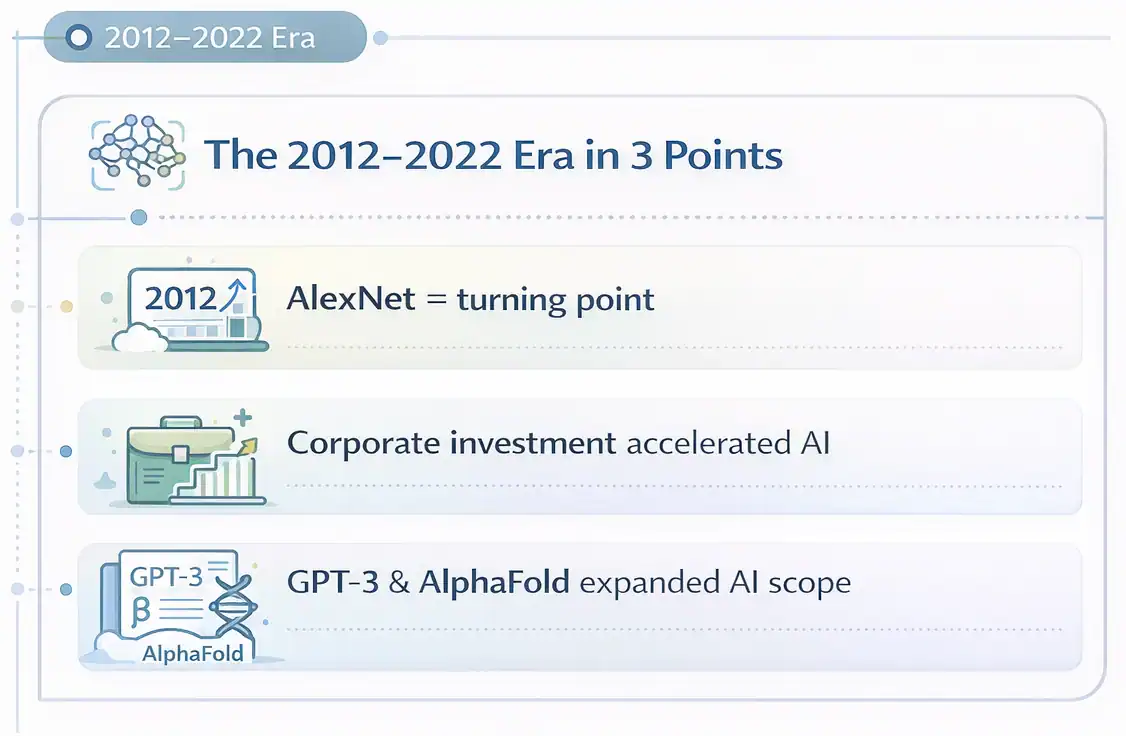
- AlexNet (2012) is the true inflection point — deep learning stopped being theoretical
- Corporate money arrived at scale after AlphaGo (2016)
- GPT-3 and AlphaFold (2020) proved AI’s range extended across every domain
2022–2026 — The Era We’re Living In
ChatGPT’s launch in November 2022 was the moment AI became a household conversation. Everything since has moved at a speed the previous 70 years of AI history had not prepared anyone for.
Late 2022 — ChatGPT changes the public conversation
OpenAI released ChatGPT on November 30, 2022. It gained 100 million users in two months, the fastest consumer product adoption ever recorded. For the first time, hundreds of millions of non-technical people interacted directly with a large language model. The AI era was no longer coming.
2023 — The frontier expands and so does the alarm
GPT-4, Claude ( Anthropic ), and Google Gemini were launched within months of each other, which can handle images, audio, and text simultaneously. The board of directors of OpenAI, the company behind the GPT-4 model, terminated the company’s co-founder and CEO, Sam Altman, on November 17, 2023.
Altman was reappointed as the CEO of OpenAI on November 22, 2023. Altman and Brockman returned to the company on November 21, 2023, in their previous roles, along with the rebuilt board. The real fault lines were revealed in the most powerful artificial intelligence laboratory in the world. The board, which was supposed to oversee the safe development of artificial intelligence, terminated the CEO of the company. The termination of Altman was followed by his reappointment under pressure from the company’s staff and shareholders. Whatever the truth behind the events, the fact is that “who controls AI” is not a settled question.
2024 — Reasoning models, regulation, and two Nobel Prizes
Reasoning models were introduced by o1 of OpenAI; AI that thinks step by step rather than guessing what is most statistically likely to happen next. Demis Hassabis of DeepMind was awarded the Nobel Prize in Chemistry for his work on AlphaFold; Geoffrey Hinton was awarded the Nobel Prize in Physics for his foundational work on neural networks. The EU AI Act started enforcement; the first significant legal regime to classify AI systems according to level of risk and require transparency for high-risk applications. Apple Intelligence integrated AI at the system level into iOS; therefore, every iPhone user is now an AI user whether they know it or not.
2025 — DeepSeek and the open-source disruption
The Chinese lab DeepSeek announced its reasoning model named R1, which performed at the same level as state-of-the-art systems but at a small fraction of the cost of their training. It was open-source. The event led to a one-day stock selloff in “AI adjacent” stocks and prompted a serious reevaluation of the amount of computation required to make competitive AI. The geopolitics of AI—whose country is ahead, and which can access the best tech—became impossible to think of as secondary.
2026 — Where things stand right now
Agentic AI systems, which include AI systems that plan, use tools, and perform multi-step tasks without human supervision, are moving from the lab to the product. Whether or not AI systems are developing towards anything like general intelligence is a question that is seriously and passionately argued by the people who build them. The sequence of breakthrough, hype, reckoning, and next breakthrough is proceeding more quickly than any previous sequence in the history of the field.
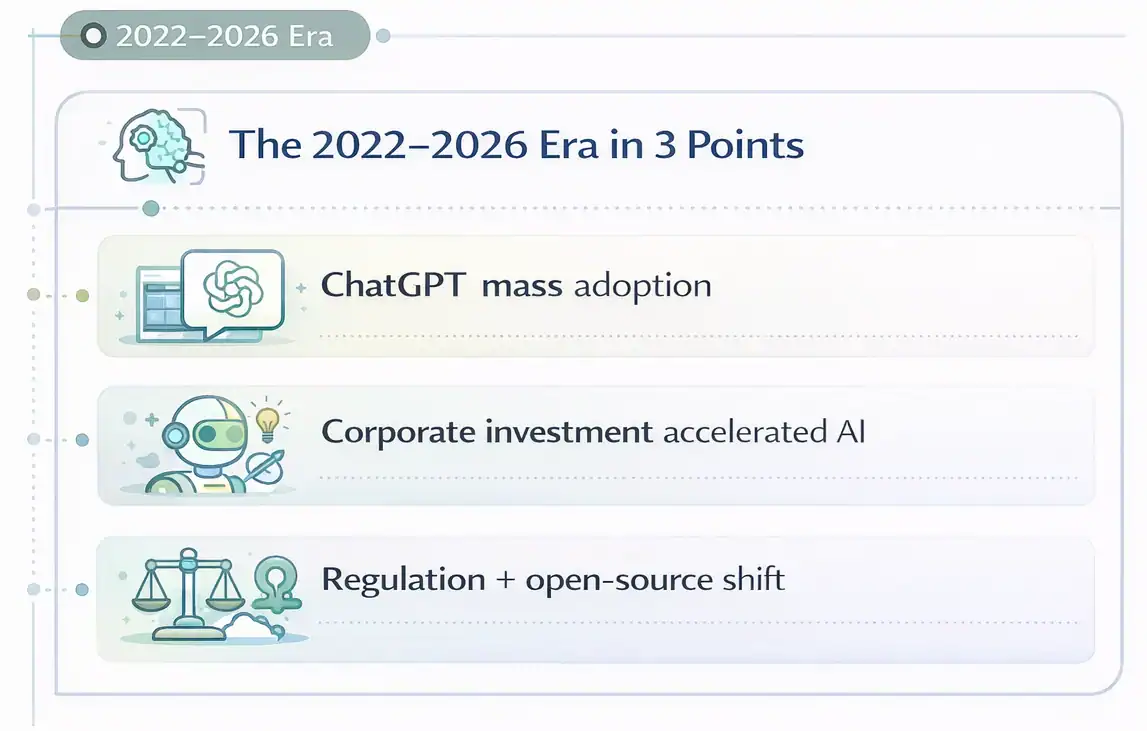
- ChatGPT reached 100M users in 2 months — fastest product adoption ever
- Reasoning models and agentic AI define the current frontier
- Regulation (EU AI Act) and open-source disruption (DeepSeek) are reshaping the competitive landscape
The People Who Built AI — A Quick Reference
No competitor article gives you this. Here are the 13 figures whose work connects the Turing Test to the tools you use today.
| Name | Era | Key Contribution |
| Alan Turing | 1950 | Formalized the question “Can machines think?” — the Turing Test |
| John McCarthy | 1956–1958 | Coined “artificial intelligence”; invented LISP |
| Marvin Minsky | 1951–1969 | Co-founded the AI field; built SNARC; co-wrote Perceptrons |
| Frank Rosenblatt | 1957 | Invented the Perceptron — the ancestor of every neural network |
| Joseph Weizenbaum | 1966 | Created ELIZA — the first chatbot; warned against anthropomorphizing AI |
| Geoffrey Hinton | 1986–2024 | Father of modern deep learning; 2024 Nobel Prize in Physics |
| Yann LeCun | 1989–present | Convolutional neural networks; Chief AI Scientist at Meta |
| Yoshua Bengio | 1990s–present | Deep learning pioneer; prominent AI safety advocate |
| Fei-Fei Li | 2007 | Created ImageNet — the dataset that enabled the deep learning revolution |
| Andrew Ng | 2009–present | GPU-based deep learning paper; democratized AI education through Coursera |
| Demis Hassabis | 2016–present | DeepMind; AlphaGo; AlphaFold; 2024 Nobel Prize in Chemistry |
| Sam Altman | 2019–present | CEO of OpenAI; led the ChatGPT launch |
| Dario Amodei | 2021–present | Co-founder of Anthropic; left OpenAI to focus on AI safety |
Why Do AI Winters Happen — And Is Another One Coming?
The basic structure of the process:
Researchers get spectacular results on particular demos. They (or their sponsors) promise sponsors that these demos are merely a step towards universal and revolutionary breakthroughs. The sponsors assume linear progress. Resource constraints impose a cap. The results do not match the promises. The funding dries up—fast.
It happened in 1973. It happened in 1987. The question now, in 2026, is will the latest iteration follow the same course?
The unvarnished truth—and most writing on the subject refuses to tell it—is: a third AI winter is possible but unlikely to repeat the previous two. Why? First, the resource constraint now has a much further cap due to GPU compute scaling and custom AI chips. Second, the user base has grown from hundreds of thousands of academic users to hundreds of millions of people. The financial stakes are orders of magnitude larger. Third, the financial investment in AI by corporations now vastly outstrips what was present in the 1980s—dozens of competing research groups rather than a handful of government programs.
What’s more likely than a proper winter is a “funding rationalization”: a time in which investment levels off, unproductive projects are shelved, and the field adjusts to what AI can do versus what it’s been said to do.
All of which has happened before. It’s called 1989.
The Ethical Questions That Have Always Followed AI
Ethics in AI have been around. They’ve been around since 1966, which was the start of users confiding in real emotional problems with ELIZA, a program that was described by its creator, Joseph Weizenbaum, as merely a pattern-matcher. The problem was so troubling to Weizenbaum that he’s been cautioning against human consciousness in machines ever since. The problems have continued to mount over the years, but the reason behind them all remains the same: AI systems produce responses that are human-like. People respond to them as if they’re human.
The problems that have continued to mount over the years:
Job displacement. Each new round of AI-driven automation prompts the same debate: What jobs are eliminated, which ones change, and who benefits. In reality, the answer has proven more complicated than the media coverage. Jobs have changed more often than they have been eliminated.
Algorithmic bias. AI systems learn from the past and therefore reflect the past, including biases in employment, lending, triage, and sentencing. A system is only as unbiased as the data it is trained on. A system trained on a biased past is a biased system in the present, regardless of its creators’ intentions.
Autonomous weapons. In 2015, an open letter signed by Elon Musk, Stephen Hawking, Steve Wozniak, and more than 3,000 AI researchers called for a ban on autonomous weapons systems. These systems have the capability to select and engage human targets
without human decision-making. The letter is real. The weapons are real.
Privacy. AI systems processing vast quantities of personal information, such as health records, communications, and behavior patterns, raise questions of who the information is owned by, who has access to it, and for what purpose it is to be used, which is beyond the scope of the individual application.
The EU AI Act (2024) is the first attempt to address these issues in a comprehensive way. It categorizes AI systems by risk levels, requires transparency in high-risk applications, and outlaws them in some cases

Generative AI Course & Certificate
Average time: 6 month(s)
Skills you’ll build: Prompt Engineering, RAG Pipelines, LLM Fine-Tuning, LangChain, Vector Databases
Frequently Asked Questions
Q1. Who invented artificial intelligence?
Ans. No individual invented artificial intelligence. The best claim to fame for an individual is John McCarthy’s invention of the term and organization of the 1956 Dartmouth Conference, which marks the conventional beginning of artificial intelligence as a formal discipline. Alan Turing provided the theoretical basis for artificial intelligence six years before that.
Q2. What year was AI invented?
Ans. The conventional wisdom is 1956, the year of the Dartmouth Conference and the first formal use of the term “artificial intelligence.” Alan Turing provided the intellectual foundation for artificial intelligence in 1950. The practical tools came much later.
Q3.What led to the “AI Winters”?
Ans. It is the interplay of two factors: over-promising by the researchers regarding the short-term prospects of AI and the inability of the then-available hardware to bridge the gap between promise and delivery. As a result of this failure to deliver, funding dried up both from the government and the private sector. This happened in 1973 as a result of the Lighthill Report; it happened again in 1987 as a result of the collapse of the LISP machine market.
Q4. Is AI smarter than humans?
Ans. The umbrella term is “AI.” “Machine learning” is a subset of “AI” and refers to “AI” that learns from data and not through explicit programming. “Deep learning” is a subset of “machine learning” and is implemented through “multi-layered neural networks.” Deep learning is the basis of all the major AI tools currently in use, such as ChatGPT and image and voice assistants.
Q5. What’s next for large language models?
Ans. Reasoning systems that demonstrate their thought process; agent-based systems that plan and execute autonomous actions; multimodal AI systems that integrate text, images, audio, and videos into a single system. Some people think the next step for AI is to learn from real-life interactions in the real world and not just through text-based data. Others think the current architectures have much more room to grow than people think.
Conclusion
Three hundred years have passed since the satirical word-combining device of Swift’s and the technology that today can write, reason, and produce images from a sentence entered the scene. Most of that three hundred years was devoted to the question, rather than the answer.
What history really illustrates is not a story of inevitable progress. It’s a story of a field that has twice plateaued and then collapsed under the weight of its own promise, and then rebuilt by a small group of researchers who simply did not believe that the plateau was forever.
The hype was real, and the stubbornness was real.
While understanding history does nothing to diminish the significance of the current moment, it does serve to heighten it – because we can now clearly see how much work it has taken to get here, and how many times it has almost not happened. The most intriguing question of 2026 is not whether AI continues to improve. It’s who gets to decide what it improves toward – by design or default.


