


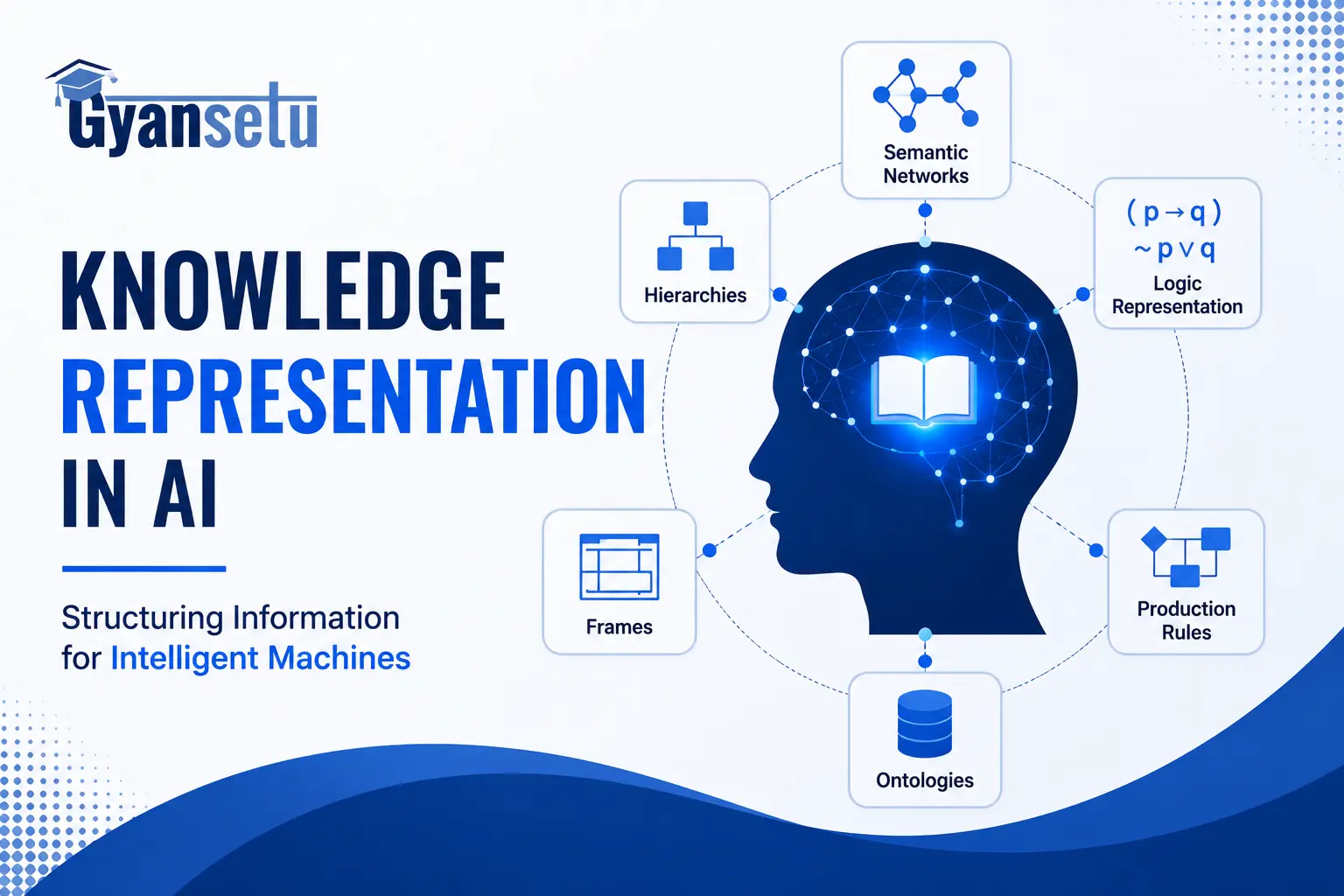
Most people studying AI invest months in learning about neural networks and completely neglect knowledge representation. This is a grave oversight since it’s the knowledge representation layer that enables reasoning in a system rather than pattern matching.
In 2026, when knowledge graphs will be at the foundation of technologies like Google Search and drug discovery software, it will become important to pay close attention to this topic, much more than your intro course did.
We’ll discuss types of knowledge, knowledge representation techniques, contemporary knowledge graphs, and even touch upon knowledge representation by large language models.
By the end of this article, you will know which technique suits which situation.
However, there’s an even deeper message we want to impart – classical knowledge representation never went away, it just turned into invisible infrastructure.

What Will I Learn?
What Is Knowledge Representation in AI?
Knowledge Representation (KR) refers to the encoding of the information known to a system that enables it to make decisions, not just recall it.
This is the difference between the two. The database is for storing information, while the KR is for storing facts and information, along with the rules and logic used by the AI to conclude. For instance, when MYCIN, the expert system developed at Stanford University in the early 1970s, identified cases of bacteria-based infections, it did not refer to a set of stored information. It applied more than six hundred if-then rules to reach its conclusion based on a knowledge base it had.
However, KR is not Machine Learning (ML). ML involves finding patterns in data through training, while KR is the encoding of explicit knowledge for review and explanation.
There are two components of KR systems. These include Knowledge (the information, rules, and logic encoded), and Representation (how that information is stored).
Right. That’s the whole foundation. Everything below builds from it.

Artificial Intelligence (AI) Course
Average time: 4 month(s)
Skills you’ll build: Python for AI, Machine Learning, Neural Networks, NLP Basics, AI Tools (ChatGPT, Copilot)
Types of Knowledge in AI
Before you can represent knowledge, you need to know what kind you’re dealing with. Five types matter here.
Declarative Knowledge
Factual/static. “Ibuprofen reduces inflammation.” “Mars has two moons.” Declarative knowledge expresses things that are true in the world in statements that the system can reference and assess. For example, a medical AI might have thousands of drug/symptom relationships recorded in declarative knowledge.
It answers the question “what,” not “how.”
Procedural Knowledge
Knowledge of tasks in a sequence. A robotic arm on a production line uses procedural knowledge, which includes steps such as tightening a certain nut before inserting a particular bracket, with a specific torque of 12 Nm. This kind of knowledge relates to performing actions, making it more complex than declarative knowledge.
This is embedded in the algorithm used for production, not in natural language.
Meta-Knowledge
Knowledge about knowledge. If an AI has knowledge about when its training ends, such that all future dates will be categorized as uncertain for it, then it’s meta-knowledge we’re looking at. This is what enables an AI to judge the veracity of its own output without being fully convinced.
Heuristic Knowledge
Guidelines based on experience. The chess engine doesn’t analyze all possible future moves since the search space is too large. It follows guidelines such as controlling the middle of the board, placing your king in safety early in the game, and placing your rooks on open ranks. They don’t work in all cases, but they work well enough most of the time.
Inexplicably simple by design. That’s the idea.
Structural Knowledge
Conceptual relationships. “Aspirin treats headaches.” “Headaches are a symptom of migraines.” “Migraines are neurological disorders.” With such relationships, we enable AI to reason through several concepts together instead of dealing with isolated facts. Knowledge graphs can be considered structural knowledge on a very large scale.
The Four Core Techniques
Here’s what most textbooks don’t tell you: these techniques aren’t competing approaches. They’re tools. The real skill is matching the right one to your problem.

Logical Representation
Logical representation employs formal methods based on either propositional logic (true or false) or predicate logic (sentences with variables) to encode knowledge and derive conclusions. The idea was used by John McCarthy, who coined the term “artificial intelligence” in 1956, and built his early AI work on this foundation.
The advantage here is clearness. Everything follows from premises; there is no hidden step in the process. However, reality does not conform to logical clarity. Logic-based AI cannot deal well with uncertainty, contradiction, or incompleteness of knowledge – an algorithm valid for 95% of situations will be inconsistent for the other 5%, which contradicts logic.
Still operates on: theorem provers, formal verifiers, constraint solvers.
Semantic Networks
A semantic network uses graph theory to model the knowledge space, whereby nodes represent the knowledge itself (concepts/objects) while arcs stand for their relations. IS-A and KIND_OF relationships are the most common.
A good illustration of a semantic network is the WordNet lexical database created at Princeton University that contains more than 155,000 English words grouped into clusters known as synonym sets, connected by relations such as hypernymy(broader category) and meronymy(part-whole).
Easy visualization and expansion. The drawback is that semantic networks lack formal semantics, whereby the meaning of a relation may depend entirely on how it was defined while creating the network.
Frame Representation
Frame representations were introduced by Marvin Minsky in 1974 as a means to represent stereotypical situations. A frame is a structure that contains slots (or attributes) and their values, much like a class does in object-oriented programming.
The frame representing a “Patient” in a hospital’s AI application could contain such slots as name, age, symptoms, medicines, and allergies. Each slot would either contain a value, a valid range, or the default one in case no value was specified. Frame representations are inheritable, which means that the frame of a “Pediatric Patient” will include all slots from the frame of “Patient”, as well as some additional ones.
This representation method is the direct ancestor of the way software programs work today. JSON objects, Python classes, database schemas: all descended from the same idea.
Production Rules (IF-THEN Systems)
Production rules represent knowledge as conditional statements, such as MYCIN used hundreds: “If the bacteria are gram-negative, and the patient has a fever, and if the location of the infection is blood, then there is strong evidence that the bacteria are E. coli.”
Three parts: the rule base, working memory (facts that are known), and an inference engine that evaluates the rules, matches the conditions and fires actions.
Modular and human-readable systems allow each rule to be added, modified, or deleted independently of the other rules, but do not adapt from experience and require all rules to be manually programmed. Large rule bases can become slow and hard to debug.
Which Technique Should You Use?
No other article on this keyword answers this question directly. Here it is.
| Situation | Best Technique |
| Rule-based knowledge with clear conditions | Production Rules |
| Relational or hierarchical knowledge | Semantic Networks / Knowledge Graphs |
| Structured objects with attributes | Frame Representation |
| Need for provably correct logical inference | Logical Representation |
| Large-scale interconnected knowledge | Knowledge Graph |
The short answer: production rules for expert systems, semantic networks or frames for structured domains, knowledge graphs for anything at scale.
Knowledge Graphs: The Modern Form of KR
The semantic networks did not disappear. Instead, they were expanded into knowledge graphs, which are now ubiquitous.
A knowledge graph comprises entities (people, places, things, concepts) and the typed relationships between them. These relationships are captured using standards such as RDF (Resource Description Framework) and are queryable using SPARQL. Google’s Knowledge Graph currently has several hundred billion facts. As of early 2026, Wikidata contains more than 100 million items. Neo4j is the most popular graph database used to construct knowledge graphs.
What changed between a 1970s semantic network and a modern knowledge graph? There has been increased scale, standardized representations, and better tools. OWL (Web Ontology Language) allows you to specify formal semantics for relationships between entities. RDF standardizes a universally accepted data format. SPARQL provides query capabilities for accessing the stored information. The underlying representation has remained the same as frames by Minsky and the IS-A relationships in early semantic networks.
This paradigm shift has found its quickest adoption in healthcare, financial, and e-commerce sectors. In a knowledge graph of a pharmaceutical firm, various nodes can include chemicals, drug targets, diseases, clinical trials, and adverse effects, among other components.
How LLMs Handle Knowledge (And How It’s Different)
KR in classical approaches is explicit. It involves creating the rules, defining the ontology, and coding the relationship explicitly. Everything is inspectable. One can ask how a conclusion was derived and trace back the reasons through the reasoning chain.
LLMs store knowledge implicitly. Models like GPT, Claude, and Gemini do not have a database containing the facts and relations. Knowledge is embedded in billions of numbers learned from data in training. There is no way to open the model and check where it learned that aspirin relieves pain; the knowledge is encoded in parameter values.
Limitations of approaches may be more revealing than their strengths. For example, classical KR approaches are explicit, updatable, but fragile on a large scale. In contrast, LLMs are flexible, implicit, and un-updatable after training. Neither approach wins in the abstract; they fail in different directions.
RAG is clearly the leading model in 2026 trying to combine the best of both… and, in reality, a classic form of KR wrapped in new clothes. In a RAG system, a knowledge base, in the form of either a vector database or a knowledge graph, is plugged into an LLM during inference. The retrieval process is doing precisely what a semantic network is designed to do: locate relevant structured information to be provided to the reasoning component.
It’s no accident that those well-versed in classical KR can construct functional RAG pipelines; it’s because that’s the architecture’s foundation.

Real-World Applications
Medical diagnosis. Modern clinical decision-making aids have evolved from early expert systems such as MYCIN and DENDRAL, which used production rules and ontologies, including SNOMED CT, to represent clinical knowledge based on mass spectrometry data.
Search engines. The Google Knowledge Graph operates beneath search engines, allowing for connections between entities such that searching for “Marie Curie” would yield structured information about her scientific contributions and other scientists.
Natural language processing pipelines. WordNet facilitates word sense disambiguation within multiple natural language processing pipelines. Schema.org is a standardized vocabulary that enables websites to mark up structured data understood by AI systems.
Robotics. ROS 2 (Robot Operating System) employs a knowledge representation approach for understanding scenes and planning actions.
E-commerce. Product knowledge graphs, which map products, categories, attributes, and user behaviors. One of the world’s largest knowledge graphs, according to claims, belongs to Amazon.
Key Challenges
Every article lists the techniques. Almost none explain where they break.
Knowledge Acquisition Bottleneck. Getting the expertise into the Knowledge Representation System entails getting the experts to communicate their knowledge, which they are unable to do most of the time. Experts store a lot of their knowledge in pattern form. The knowledge may be too implicit to make explicit rules out of it. This is one of the reasons why numerous expert systems failed when they went into the second AI winter, which ran from the late 1980s through the early 1990s.
Ambiguity. In “bank,” there is ambiguity between whether it refers to a financial institution and whether it refers to a riverbank. The classical Knowledge Representation Systems need to have rules to differentiate between every possible ambiguity.
Frame Problem. This is one of the hardest problems to solve. What changes when an artificial intelligence moves a block from one table to another? Obviously, what changed was the location of the block and not anything else. How would the system indicate all of those things that do not change without enumerating them one by one? This problem was introduced by John McCarthy and Patrick Hayes in 1969. The narrow definition of this problem has since been solved but the broader challenge remains open.
Wrong.
No beating around the bush here.

Generative AI Course & Certificate
Average time: 6 month(s)
Skills you’ll build: Prompt Engineering, RAG Pipelines, LLM Fine-Tuning, LangChain, Vector Databases
Frequently Asked Questions
Q1. What is the difference between knowledge representation and machine learning?
Ans. In machine learning, patterns are discovered in the data through examples of training. Knowledge representation means encoding explicit knowledge that the system can examine and reason with. Machine learning works with data while knowledge representation needs humans to encode information explicitly. Modern AI systems make use of both machine learning and knowledge representation.
Q2. How do large language models represent knowledge?
Ans. Knowledge representation in LLMs involves implicit encoding through billions of numbers as parameters when training. You cannot examine or modify them directly. RAG solves this by associating an external database with an LLM during inference, thereby combining neural generation and structured search approaches.
Q3. What is a knowledge graph in AI?
Ans. A knowledge graph stores entities and their relationships through the use of a graph data structure. This is given formal semantics using standards such as RDF and OWL. Actual knowledge graphs in use today include Google Knowledge Graph, Wikidata, and custom-made knowledge graphs with Neo4j. In 2026, these are the most commonly used knowledge representations.
Q4. Which KR technique is best?
Ans. It depends on the problem. Production rules can be used effectively by expert systems, semantic networks, or knowledge graphs for relational or hierarchical data, and frame representation for object attributes. Logic-based representation is suitable when provability is required. Most knowledge representations combine different methods.
Q5. What are the limitations of KR systems?
Ans. The three primary limitations are the bottleneck of knowledge acquisition (it takes too long to develop the knowledge bases), managing uncertainty (traditional KR cannot handle uncertain data – just Boolean true/false information), and the frame problem (capturing state information that does not change because of an action).
Conclusion
Classical knowledge representation did not supplant deep learning. They simply became a part of something bigger. Every knowledge graph, RAG workflows, and ontology-based medical applications operating in 2026 are based on technologies originally conceived by McCarthy, Minsky, and MYCIN researchers decades before – albeit with far more advanced infrastructure.
The usual narrative – that symbolic AI “failed” neural AI – misses the point completely. The truth of the matter is that they converged into one unified whole. And the engineers who mastered both have the upper hand when it comes to creating dependable, accountable, and maintainable systems.
This is how the gap grows ever wider.


